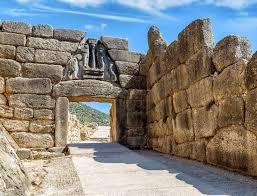
Introduction: The Threshold of Heroes
Guarding the monumental entrance to the citadel of Mycenae in the Peloponnese stands the Lion Gate. Erected around 1250 BCE during the height of the Late Bronze Age, it is the oldest piece of monumental monumental sculpture in Europe. It served as the literal and symbolic threshold to the home of Agamemnon, the legendary high king who led the Greek coalition against Troy in Homer’s Iliad.
While the Minoans of Crete built open, sprawling palaces that celebrated nature, the Mycenaeans were a starkly militaristic, warrior elite. Their fortresses were engineered to terrify enemies and withstand protracted sieges. The Lion Gate is the ultimate expression of this architectural philosophy. Positioned at the apex of a narrow, defensive approach, it used colossal stonemasonry and imperial iconography to issue a clear, visual warning to any visitor: you are entering the absolute epicenter of Mycenaean military might.
1. Cyclopean Masonry: Built by Giants
The walls surrounding the Lion Gate are constructed using a style known as Cyclopean masonry. The scale of the stones used in these defensive ramparts is so staggering that later Classical Greeks honestly believed human hands could not have moved them.
The Myth of the Cyclopes: By the 5th century BCE, the engineering secrets of the Bronze Age had been forgotten. Looking at the multi-ton fortifications, the classical Greeks deduced that the ancient kings must have hired the Cyclopes—the mythical race of one-eyed giants—to lift the boulders into place.
The Dry-Stone Technique: The walls are built without a single drop of mortar or cement. Instead, massive limestone blocks, some weighing over 20 tons, were roughly shaped and stacked directly on top of each other. The structures remain perfectly locked in place through raw friction and the crushing downward force of their own immense gravity.
2. Engineering the Portal: The Relieving Triangle
The gate itself is a triumph of structural engineering, demonstrating how Mycenaean architects solved the problem of carrying immense physical weights over open spaces.
   / \       <- Relieving Triangle (Porous, lightweight limestone relief)
  /   \
 /_____\
|_______|    <- Massive Lintel Stone (Takes no direct downward load from above)
|   |   |
|   |   |    <- Heavy Jamb Stones
The entryway follows a classic post-and-lintel design, consisting of two vertical jamb stones supporting a massive horizontal lintel block estimated to weigh roughly 52 tons. If the solid Cyclopean wall had been built directly on top of this horizontal beam, the sheer downward pressure would have snapped the stone in half, collapsing the gate.
To prevent this, the builders left an intentional, triangular gap directly above the lintel, known as a relieving triangle. They corbelled the surrounding wall stones, stepping them inward until they met at a point. This brilliant structural design diverted the crushing weight of the upper wall outward into the heavy vertical jambs and the bedrock below, leaving the open space completely free of stress.
3. The Iconography: The Guardians of the Citadel
Inside that open relieving triangle sits the famous limestone relief panel that gives the gate its name. It depicts two rampant lions (or lionesses) facing each other in perfect heraldic symmetry.
The Central Column: The lions rest their front paws on two altars flanking a singular, tapering column. This column is uniquely Minoan in style, wider at the top than at the base. In Bronze Age religion, the column symbolized the palace, the state, or the protective presence of the goddess herself.
The Headless Enigma: Visitors today note that the lions are completely headless. This is not the result of random erosion; the heads were originally carved from separate blocks of dark steatite or bronze and attached to the bodies using metal dowels. The heads were sculpted facing forward, staring down at the people approaching the gate.
The Political Message: The lions served as a living coat of arms for the Mycenaean royal house. By placing wild apex predators on top of religious altars protecting the pillar of the state, the king was declaring that his authority was divine, his warriors were invincible, and his stronghold was permanently protected by cosmic guardians.
4. The Tactical Death Trap
The Lion Gate was not just a beautiful monument; it was a highly functional military checkpoint designed to decimate an invading force.
The gate was engineered as an architectural funnel, forcing attackers to advance through a bottleneck where they could be attacked from multiple angles simultaneously.
To reach the wooden doors, an attacking army had to march up a steep, narrow ramp hemmed in by a massive, projecting bastion wall on their right side. Because ancient soldiers carried their shields on their left arms, marching up this specific ramp forced them to turn their unshielded, vulnerable right sides directly toward the defenders lining the ramparts above. Before an enemy soldier could even touch the gate, they were subjected to a lethal rain of arrows, spears, and heavy boulders from the fortress walls, turning the beautiful entrance into a blood-soaked kill zone.