Introduction: The Lifeline of Hispania
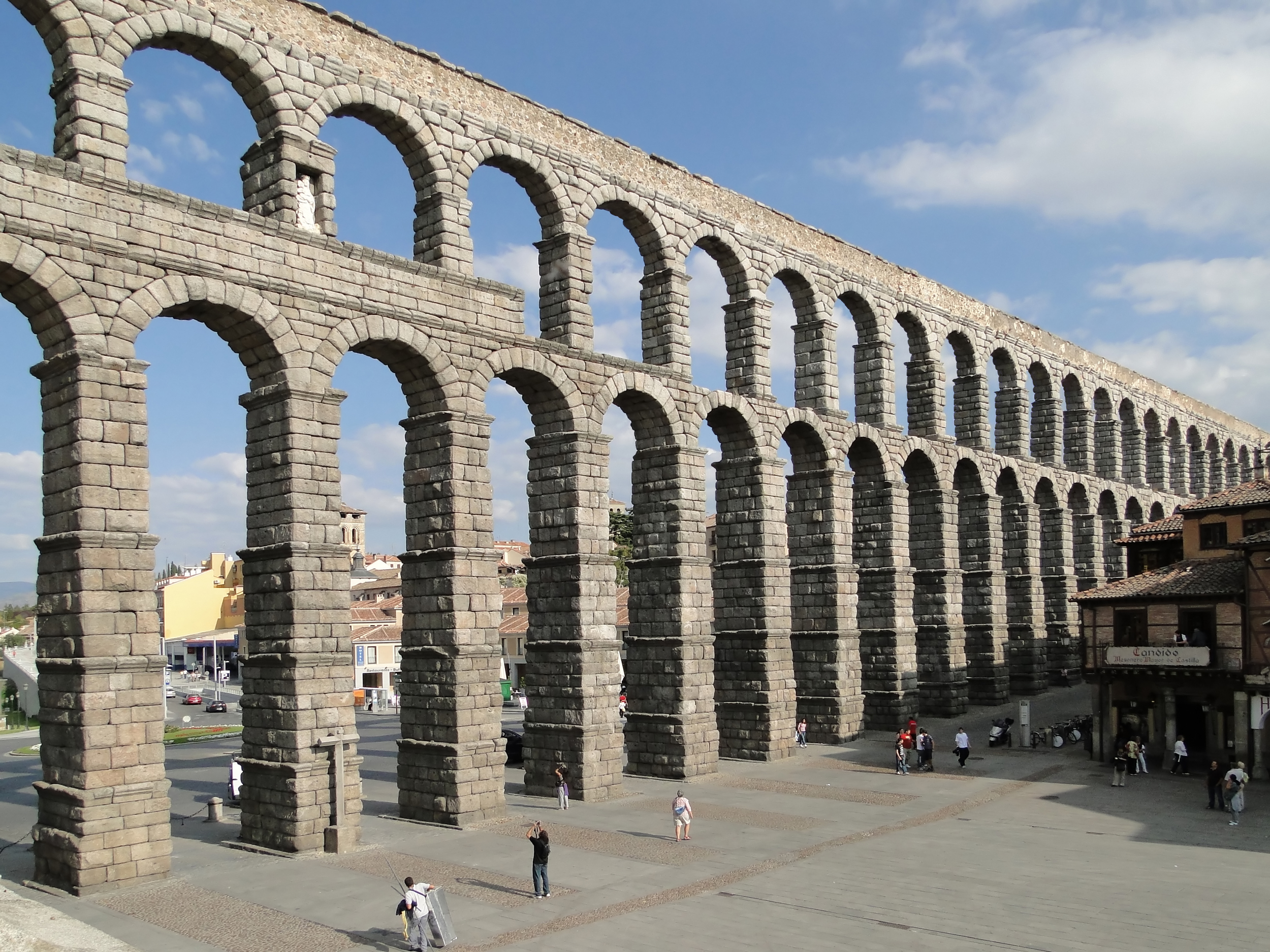
Rising dramatically over the rooftops of modern Castile and León, the Aqueduct of Segovia stands as one of the most pristine and structurally intact monuments of Roman civil engineering anywhere in the world. Built during the late 1st or early 2nd century CE—likely under the reigns of the emperors Emperor Domitian or Emperor Trajan—this monumental stone pipeline was constructed to carry fresh water from the cold springs of the Fuenfría River in the nearby Guadarrama mountains directly into the heart of the growing Roman military settlement of Segovia.
While ancient writers frequently celebrated Rome's military triumphs, the empire's true genius lay in its structural infrastructure. The Aqueduct of Segovia was a profound declaration of Romanization and technological supremacy. By seamlessly blending monumental aesthetics with hydraulic precision, Roman engineers conquered a rugged, uneven landscape, turning a remote provincial town into a thriving urban center supplied with a continuous stream of clean water for public baths, fountains, and elite residences.
1. Architectural Anatomy: The Bridge of Arches
The aqueduct is a masterclass in modular, high-altitude masonry. While much of the 9-mile (15-kilometer) watercourse runs hidden underground or in simple surface channels, the structure becomes truly legendary as it crosses the deep, natural valley that splits the city.
The Double-Tiered Grid: To bridge the deepest part of the depression, engineers constructed a towering, two-tiered arcade of arches. This double-decker design allowed the structure to reach a maximum height of nearly 93 feet (28.5 meters) without collapsing under its own immense weight.
The Pillar Tapestry: The aqueduct consists of roughly 167 individual arches. To maintain lateral stability against mountain crosswinds, the massive support pillars are designed with a subtle taper—they are wider at the base and become progressively narrower as they rise toward the upper water channel.
The Specus (The Water Channel): Running along the absolute crest of the upper tier is the specus, the stone conduit where the water flowed. The channel was completely sealed with a specialized waterproof hydraulic mortar (opus signinum) made of lime, sand, and crushed terracotta to prevent leaking and contamination.
2. Opus Quadratum: Engineering Without Mortar
The most mind-boggling aspect of the Aqueduct of Segovia is its raw structural composition. It was built entirely using the opus quadratum technique—solid, ashlar block construction relying entirely on friction and gravity.
Zero Mortar, Zero Cement: The structural framework contains roughly 20,400 individual blocks of dark gray Guadarrama granite. Not a single drop of mortar, mortar cement, or iron clamp holds these stones together. They remain perfectly locked in place through precise geometric carving and the sheer downwards pressure of their own mass.
The Siphon System: Before the water ever reached the towering stone bridge, it passed through a series of specialized stone desiltation tanks (castella aquae). These settling basins slowed the water's velocity, allowing heavy mountain sediment, sand, and pebbles to settle safely to the bottom so they wouldn't clog the elevated pipeline.
3. The Mechanics of Flow: Calculating the Gradient
The survival of an aqueduct depended completely on the calculation of a consistent, uninterrupted downward slope. Because the Romans lacked electronic leveling tools, they relied on a long, wooden water-leveling instrument called a chorobates.
To keep water moving continuously from the mountain spring to the city center without building up destructive pressure or stalling into stagnant pools, the entire 9-mile system had to maintain a steady, minute incline. Across the monumental arched bridge spanning the public square, Roman engineers achieved an incredibly precise average gradient of less than 1%:
$$Gradient \approx 1\%$$
If the slope had been too steep, the rushing water would have slowly eroded the protective stone conduit lining; if it had been too flat, the water would have stopped flowing entirely. Achieving this razor-thin degree of accuracy across an uneven valley using primitive hand tools remains a landmark achievement in the history of surveying.
4. Maintenance, Survival, and Modern Legacy
That the Aqueduct of Segovia survived two thousand years of earthquakes, political shifts, and environmental weathering is a testament to both its robust design and its continuous structural utility.
The aqueduct survived because it never stopped being useful. While other Roman monuments were torn down for scrap stone, successive rulers carefully maintained Segovia's water lifeline.
During the Moorish occupation of the region, parts of the upper arcade suffered damage during a 1072 military siege. However, rather than abandoning the system, King Ferdinand and Isabella later commissioned extensive restoration work in the 15th century, carefully replicating the original mortarless Roman masonry style to restore the broken arches. The aqueduct continued to actively deliver water to the city's hilltop alcázar castle and public fountains well into the 20th century. Today, protected as a UNESCO World Heritage site, it stands as the ultimate symbol of Segovia, demonstrating how ancient engineering could carve granite to defy time itself.