The Mycenaeans, the Bronze Age warriors of mainland Greece celebrated by Homer, viewed death as a paramount display of dynastic power, wealth, and status. As their civilization evolved from fractured chiefdoms into a highly centralized, bureaucratic empire, their funerary architecture underwent a dramatic transformation.
This evolution is physically etched into the landscape of Mycenae, shifting from deep, hidden Shaft Graves packed with golden treasures to monumental, stone-built Tholos Tombs that dominated the horizon.
1. The Shaft Graves: Vaults of the Golden Warlords
Dating to the transitional period of Mycenaean culture (c. 1600–1450 BCE), the Shaft Graves represent the sudden, explosive rise of an elite warrior class. These were not public monuments, but deep, rectangular vertical shafts cut into the bedrock, covered with wooden beams, and sealed beneath earthen mounds.
The most famous of these are contained within two distinct circular cemeteries at Mycenae: Grave Circle A (discovered by Heinrich Schliemann in 1876) and the older Grave Circle B.
The Shock of Gold
When Schliemann excavated Grave Circle A, he uncovered nineteen bodies surrounded by the most lavish funerary wealth ever found in Greece. The Mycenaeans buried their chieftains with:
Death Masks: Repoussé gold masks beaten over the faces of the deceased to immortalize their features. The most famous, dubbed the "Mask of Agamemnon" by Schliemann, features a detailed mustache and beard, though it actually dates to centuries before the legendary Trojan War.
Weaponry: Bronze swords and daggers inlaid with gold, silver, and niello, depicting dynamic scenes of lion hunts and warriors clashing with shields.
Status Objects: Massive golden goblets (such as the Nestor Cup), amber beads from the Baltic, ostrich egg vessels from Egypt, and silver rhytons (drinking horns), proving that these early warlords sat at the center of a massive bronze age international trade network.
2. The Tholos Tombs: Architectural Wonders of the Ancient World
By 1400 BCE, as Mycenaean kings consolidated their power into palace-states, they abandoned hidden shaft graves in favor of Tholos Tombs (also known as beehive tombs). These were monumental, subterranean circular chambers designed to serve as visible, multi-generational dynastic mausoleums.
Constructing a Tholos tomb was a monumental feat of engineering that relied on three distinct structural components:
The Dromos: A long, unroofed stone-lined approach avenue cutting into the side of a hill. It was used for grand funeral processions and was completely filled in with earth after each burial to protect the tomb.
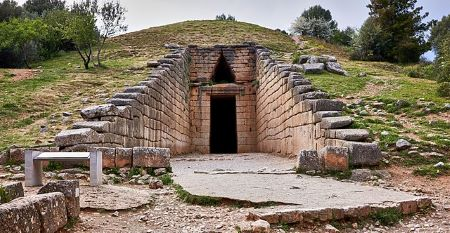
The Stomion: The grand, monumental doorway at the end of the dromos. It featured massive lintel stones—single blocks of stone weighing up to 120 tons—spanning the top of the doorway.
The Tholos: The circular, beehive-shaped burial chamber.
3. Engineering the Corbelled Dome
The interior of the tholos chamber was constructed using corbelling, a technique that predates the true Roman arch.
To create the dome, builders laid horizontal rings of stone blocks, with each successive ring projecting slightly inward over the one below it. Once the stones met at the very top, a single capstone locked the entire structure into place. The stones were then dressed and smoothed down from the inside to create a perfectly fluid, cavernous dome.
To relieve the crushing weight of the earth above the doorway, engineers left a hollow triangular space directly above the lintel stone. This relieving triangle diverted the immense downward pressure safely to the heavy stone doorjambs on either side.
4. The Treasury of Atreus
The pinnacle of this architectural style is the Treasury of Atreus at Mycenae, constructed around 1250 BCE.
For over a thousand years, until the construction of the Roman Pantheon, the Treasury of Atreus held the record for the largest unobstructed, single-span dome in the world, measuring 14.5 meters in diameter and 13.5 meters in height.
Originally, the interior of the dome was decorated with bronze rosettes attached to the walls to mimic a glittering, star-filled night sky. While ancient grave robbers looted its treasures centuries ago, the architectural skeleton remains perfectly intact, standing as a testament to Mycenaean masonry.
5. Rituals and the Afterlife
Unlike the ancient Egyptians, who meticulously preserved the physical body, the Mycenaeans focused their rituals on the transitionary period of decomposition.
Primary Burial: The deceased was laid to rest in the tholos chamber alongside grand gifts, pottery filled with oils, and sacrificed animals.
Secondary Burial: Once the flesh had fully rotted away and only bones remained, the Mycenaeans practiced secondary manipulation. The bones of ancestors were often swept unceremoniously into pits or corners of the tholos chamber to make room for the newly deceased elite. The spirit was believed to have fully moved on only after the body had turned to dust, leaving the tomb available for the next ruler in the dynasty.
The evolution from Shaft Graves to Tholos Tombs tracks the rapid political centralization of Mycenaean Greece. They began as a society of insecure, highly competitive warriors burying their wealth in hidden pits, and grew into a powerful, confident empire capable of altering hillsides and moving mountain stones to secure their eternal legacies.