Introduction: The Birth of Citizen Soldiers
During the Archaic period of ancient Greece (c. 800–480 BCE), warfare underwent a profound structural transformation that reshaped the geopolitics and social hierarchy of the Mediterranean. Prior to this era, combat was dominated by wealthy aristocratic elites who engaged in individualized, champion-style duels, as famously romanticized in Homer’s Iliad.
This heroic style of warfare was shattered by the emergence of the hoplite—a heavily armored infantryman—and the deployment of the phalanx, a tightly packed, interlocking wall of shields and spears. This shift was not merely a tactical update; it was a socio-political upheaval known to historians as the Hoplite Revolution. Because victory now required absolute collective discipline rather than individual aristocratic heroism, military power shifted to the emerging middle class, directly paving the way for early democratic reforms and the rise of the classical Greek city-state (polis).
1. Tactical Anatomy: The Phalanx Formation
The phalanx was an infantry formation designed to maximize defensive mass and frontal offensive power. It turned a group of individual men into a singular, crushing machine.
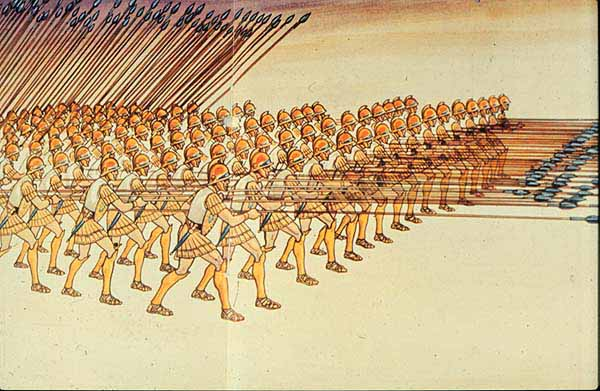
The Grid Structure: Soldiers were drawn up in a dense block, typically eight ranks deep. The men stood shoulder-to-shoulder, with the files packed so tightly that individual movement was severely restricted.
The Interlocking Shield Wall: Each hoplite carried a large, round shield. In formation, a soldier tucked his shield into his left shoulder, overlapping the exposed right side of the man standing next to him. This meant that every man depended on the shield of the comrade to his right for protection.
The Shockwave (Othismos): Battles between two phalanxes often devolved into a literal shoving match known as the othismos. The front ranks would lock shields and thrust with their spears, while the ranks behind them used their physical weight to push forward, attempting to literally trample and break the enemy line.
The Vulnerabilities: While nearly impenetrable from the front, the phalanx was rigid and cumbersome. It required flat, open terrain to maintain cohesion. If an enemy managed to flank the formation or attack it from the rear, the lack of mobility meant the entire unit could be quickly butchered.
2. The Hoplite's Panoply: Heavy Metal Warfare
A hoplite was defined by his panoply—the complete set of armor and weapons. Unlike modern armies, ancient Greek city-states did not issue standardized gear; each soldier had to purchase his own equipment, which served as a direct indicator of his middle-class economic status.
The Hoplon (Shield): The absolute core of the kit, from which the hoplite drew his name. It was a large, circular shield roughly 3 feet (1 meter) in diameter, constructed of thick wood and faced with a thin sheet of bronze. It featured a revolutionary dual-handle system (the porpax and antilabe) that allowed the soldier to carry the heavy weight on his forearm rather than just his wrist.
The Dory (Spear): The primary offensive weapon. It was a wooden spear ranging from 7 to 9 feet (2 to 2.7 meters) in length, tipped with a sharp iron leaf-shaped blade. The butt of the spear featured a bronze spike called the sauroter ("lizard-killer"), which served as a backup weapon if the main shaft broke and allowed the spear to be planted upright in the ground.
The Corinthian Helmet: The iconic bronze helmet that fully enclosed the face, providing excellent protection but severely limiting the soldier's vision and hearing—a design choice that emphasized looking straight ahead and trusting the formation.
The Linothorax or Bronze Cuirass: Torso protection consisted either of a heavy, sculpted bronze breastplate or the more flexible linothorax, a vest made of multiple layers of laminated linen, sometimes reinforced with metal scales.
3. The Mechanics of the Clash
Hoplite warfare was brief, brutal, and highly ritualized. Because the soldiers were farmers, craftsmen, and citizens who needed to return to their livelihoods, campaigns were usually confined to the summer months and settled in a single afternoon.
The Paean: As the phalanx marched toward the enemy at a steady, rhythmic pace—often timed to the playing of double-reed pipes (auloi)—the men sang the paean, a solemn hymn to Apollo designed to steel their nerves and maintain marching cadence.
The Collision: The two lines crashed together with deafening violence. The first two ranks held their spears overhand, thrusting downward at the enemy's exposed throat, face, and pelvic areas, while the rear ranks kept their spears upright to deflect incoming missiles.
The Rout and the Trophy: Once a phalanx’s shield wall cracked and a line fractured, panic set in, and the battle quickly ended. The victors rarely pursued the fleeing enemy across long distances, as chasing broken infantry risked breaking their own vital formation. Instead, they remained on the field to collect the dead and erect a tropaion (trophy) made of captured armor to mark the spot of victory.
4. The Socio-Political Ripple Effect
The transition to the phalanx completely transformed the civic identity of the Greek polis.
When military success shifted from the aristocratic knight on a horse to the independent farmer standing in the mud, political leverage shifted with it.
Because the defense of the city-state now depended on the collective bravery of ordinary citizens who could afford a panoply—men known as the zeugitai in Athens—they began demanding a formal say in the laws and foreign policy they were risking their lives to defend. In cities like Athens, this direct link between military service and civic responsibility acted as a catalyst for democratic governance.
Even in oligarchic Sparta, the system produced a radically egalitarian warrior elite; Spartan citizens referred to themselves as the Homoioi ("Equals"), bound by a brutal, lifelong martial system (agoge) designed entirely to ensure that no single individual would ever place their own glory above the survival of the phalanx.