Lime plaster was widely used in many ancient societies for coating walls, floors, architectural features, and other surfaces. Produced through the processing of limestone or other calcium-rich materials, lime could be transformed into a workable binder and applied to buildings for practical or decorative purposes. Although plaster is often studied for its architectural and artistic qualities, it can also preserve microscopic materials incorporated during production, application, use, or later burial. Pollen grains and microcharcoal particles found within plaster may provide clues about surrounding vegetation, fuel use, construction activities, and environmental conditions. Their interpretation, however, depends on understanding how these particles entered the material and whether they remained in their original context.
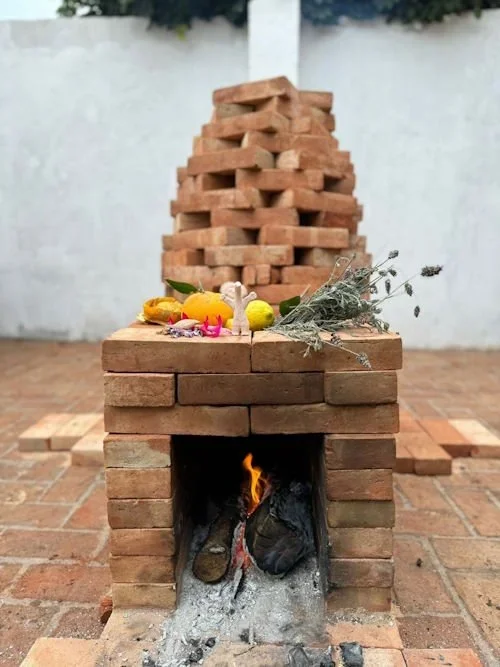
Lime production involves heating limestone or another suitable carbonate-rich rock to produce quicklime, which reacts with water to form slaked lime. The resulting material can be mixed with aggregates and applied as plaster or mortar. During manufacture, the material may encounter dust, plant debris, airborne particles, and other environmental substances. Additional particles may become trapped when plaster is mixed, transported, spread, or exposed to the surrounding environment. Consequently, a microscopic particle recovered from ancient plaster may have entered at several different stages rather than representing a direct record of the moment the wall was constructed.
Pollen is particularly useful in environmental archaeology because different plant groups produce grains with distinctive microscopic structures. Pollen preserved in sediment can help reconstruct past vegetation and changes in land use. When pollen is found within plaster, researchers may investigate whether it reflects the vegetation near a construction site, plants introduced during manufacture, or contamination that occurred after the plaster was applied. The distinction is important because pollen can be transported over considerable distances by wind or water. Some plants also produce far more pollen than others, meaning that the frequency of a pollen type does not necessarily correspond directly to the abundance of the plant in the surrounding landscape.
The presence of pollen in plaster can result from several pathways. Plant material may have been present in water or aggregates used during preparation, or airborne pollen may have settled on a surface while the plaster was still damp. Workers could also have introduced pollen through tools, clothing, or materials carried into the construction area. After the plaster hardened, cracks and exposed surfaces might have allowed later particles to enter. Archaeologists therefore examine whether pollen occurs throughout the plaster matrix or only near its outer surface. A distribution concentrated within a protected internal layer may have a different significance from particles found mainly along cracks or weathered edges.
Microcharcoal provides another form of environmental evidence. These microscopic fragments of burned plant material can be produced by natural wildfires, domestic hearths, industrial fires, vegetation clearance, and other combustion activities. Their presence in plaster may reflect charcoal-bearing aggregates, contaminated water, airborne particles, or the incorporation of residues from nearby activities. If microcharcoal is distributed throughout a plaster layer, researchers may investigate whether it was present in the ingredients or introduced during preparation. If it is concentrated on an exposed surface, it could relate to later smoke exposure, nearby burning, or post-depositional processes.
The combination of pollen and microcharcoal can help reconstruct environmental conditions, but it requires careful contextual analysis. A plaster sample containing pollen from trees and particles of burned vegetation might reflect a landscape where woodland and fire were both present. However, the particles could also have originated from transported materials or multiple events unrelated to the same period. The evidence becomes more persuasive when it agrees with independent records from nearby sediments, charcoal deposits, plant remains, or other archaeological materials. Agreement between separate lines of evidence can help establish whether the microscopic assemblage reflects the local environment or a more complex history of material movement.
Micromorphology is an important technique for investigating the structure of plaster. Thin sections of carefully prepared samples can be examined under a microscope to reveal the arrangement of mineral grains, pores, inclusions, and microscopic particles. This approach helps researchers determine whether pollen and charcoal occur within the original plaster matrix, within later cracks, or in layers added during repairs. It can also reveal differences between successive applications of plaster, potentially identifying episodes of renovation or changes in construction materials. Because the method preserves the relationships between particles and the surrounding material, it is especially valuable when the origin of microscopic evidence is uncertain.
The composition of plaster itself can provide clues about building practices and environmental resource use. Researchers may examine the type of limestone, the nature of added aggregates, and the presence of organic inclusions. Some plaster recipes included plant fibers or other materials that improved workability or altered the finished surface. However, the identification of an organic particle does not automatically demonstrate intentional addition. It may have entered accidentally during preparation or accumulated after the structure was built. Comparisons with experimental plaster production and securely identified ancient recipes can help distinguish deliberate ingredients from incidental contamination.
Environmental interpretation must also account for the long-term history of the building. Plaster surfaces may be repainted, repaired, covered, or exposed to smoke and moisture during use. Later demolition can mix construction materials with soil and organic debris. Groundwater may transport microscopic particles into cracks, while conservation treatments can introduce modern substances that complicate laboratory analysis. Researchers should document the exact location and orientation of each sample, collect suitable control samples where possible, and use clean sampling procedures to reduce contamination. Laboratory methods should be selected according to the questions being investigated and the condition of the material.
Ancient lime plaster can serve as a valuable supplementary environmental archive when its microscopic contents are carefully interpreted. Pollen may help investigate plant communities and the movement of biological material, while microcharcoal can contribute to studies of burning, fuel use, and landscape change. Neither particle type automatically records the environment at the exact time a wall was built, because materials may have been introduced during several stages of the plaster's history. By combining microscopic analysis with plaster chemistry, architectural stratigraphy, environmental sampling, and archaeological context, researchers can distinguish more reliable signals from contamination and reconstruct aspects of the environments in which ancient buildings were constructed and used.