To build an empire in the arid plateau of ancient Iran, the Persians had to solve a fundamental problem: how to move massive amounts of water across burning deserts without it evaporating. Their solution was the Qanat, a feat of hydraulic engineering so sophisticated that thousands of them are still in use today, 3,000 years later.
The Qanat system allowed the Achaemenid Empire to transform "dead" deserts into lush paradises (pairidaeza), laying the agricultural foundation for one of history’s greatest civilizations.
1. The Anatomy of a Qanat
A Qanat is essentially a long, underground tunnel that taps into a mountain water table (aquifer) and uses gravity to move the water miles away to lower-lying plains.
The Mother Well: Engineers would first dig a "Mother Well" deep into a mountain slope to reach the groundwater.
The Tunnel (Channel): A gently sloping tunnel was then excavated. The gradient had to be perfect: too steep, and the water would erode the tunnel; too shallow, and the water would stagnate.
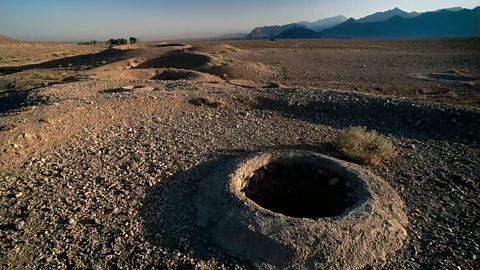
Vertical Shafts: These are the most visible signs of a Qanat from above. Looking like a line of "termite mounds" across the desert, these shafts provided ventilation for the workers and a way to haul out excavated dirt.
2. Engineering Precision without Modern Tools
The Achaemenid "water masters" (muqannis) achieved incredible precision using only simple levels, strings, and oil lamps.
The Slope: Most Qanats maintain a gradient of less than 1:1000 (a 1-meter drop every 1 kilometer). This ensured a steady, non-destructive flow over distances that sometimes exceeded 70 kilometers.
Evaporation Control: By keeping the water underground, the Persians protected it from the searing desert heat and the wind, ensuring that almost 100% of the water reached its destination—unlike open-aqueduct systems used by the Romans or Greeks in similar climates.
3. The Yakhchal: Ancient Desert Refrigeration
The Qanat system didn't just provide drinking water; it enabled the Persians to have ice in the middle of summer. They built massive conical structures called Yakhchals.
How it worked: Cold water from the Qanat was channeled into shallow pools at the base of the Yakhchal. On winter nights, the water would freeze.
Storage: The ice was then moved into a deep, insulated underground pit. The thick, heat-resistant walls (made of a special mortar called sarooj) kept the interior so cold that ice survived all through the summer, allowing the elite to enjoy chilled wine and frozen desserts (faloodeh).
4. The Social Engineering of Water
The Qanat was more than a pipe; it was a legal and social framework.
Water Shares: Since a Qanat was expensive to build, they were often communal investments. Water was distributed based on a strict time-allotment system using "water clocks" (bowls with tiny holes in the bottom).
The "Desert Bloom": The Achaemenid kings offered a special incentive: anyone who brought water to a barren land via a Qanat was granted the right to the land and its profits for five generations. This sparked an engineering "gold rush" that turned the Iranian plateau green.
5. Archaeology and the "Kariz" Legacy
Archaeologists have mapped tens of thousands of these structures across Iran, North Africa, and even into Spain (brought there later by the Moors).
Longevity: Many Qanats have been in continuous operation for over 2,500 years.
UNESCO Status: The Persian Qanat is now a UNESCO World Heritage site, recognized as a sustainable technology that works with the environment rather than depleting it, as modern deep-well pumping often does.
The Qanat proves that the Persians didn't just conquer people; they conquered the landscape. By mastering the "hidden" waters of the earth, they created a civilization that could thrive in one of the harshest environments on the planet.