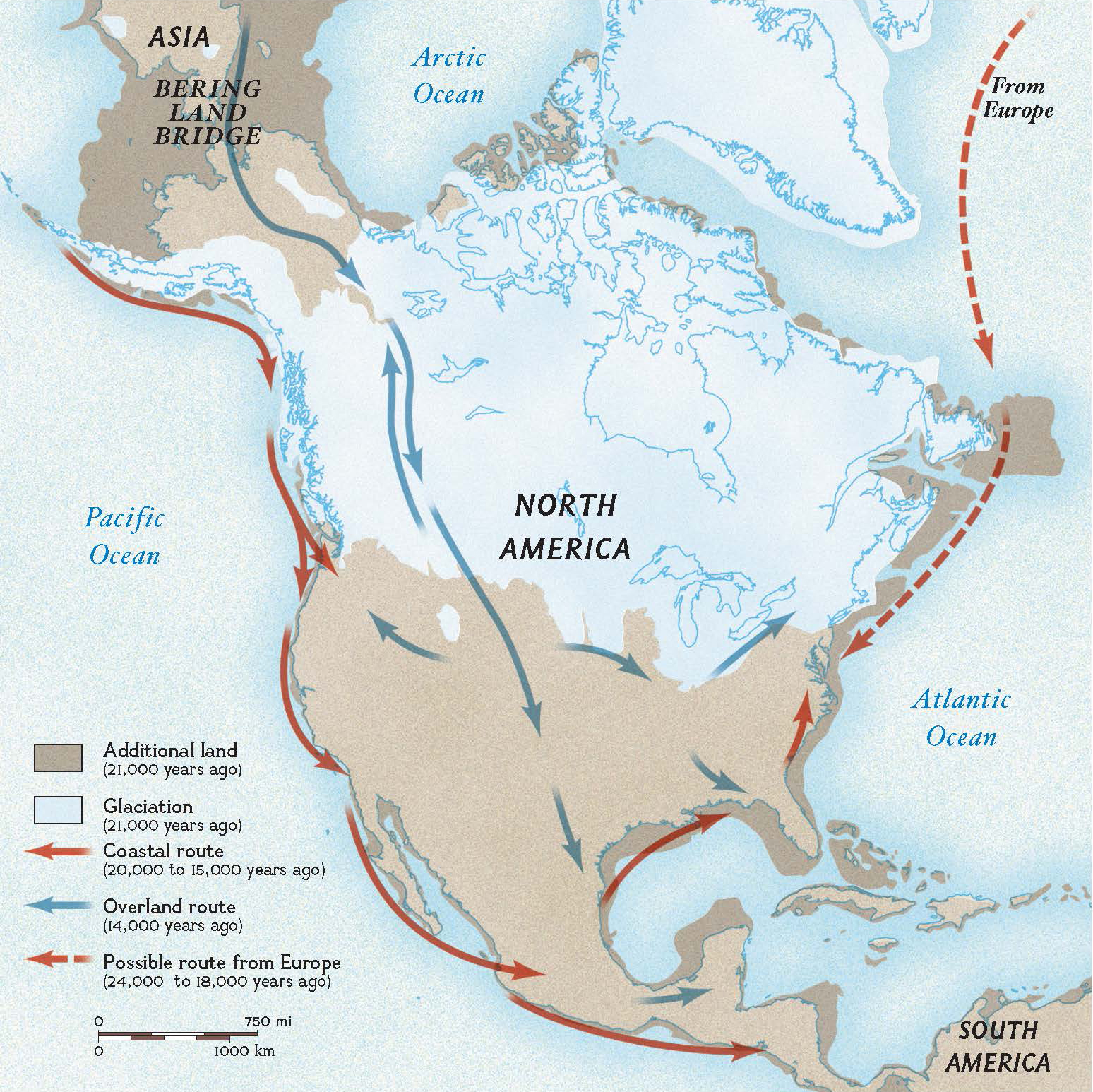
The story of how humans first reached the Americas is one of the most debated and rapidly evolving chapters in archaeology. For decades, the "Clovis First" model dominated the field, suggesting a single wave of hunters crossing a land bridge around 13,000 years ago. However, recent discoveries of older sites and genetic mapping have revealed a far more complex, multi-layered migration.
1. Beringia: The "Lost Continent"
During the Last Glacial Maximum (roughly 26,000 to 19,000 years ago), so much of the Earth's water was locked in massive ice sheets that sea levels dropped by as much as 120 meters (400 feet).
The Land Bridge: This exposed a vast landmass known as Beringia, connecting Siberia to Alaska.
Not a "Bridge," but a Homeland: Beringia wasn't just a narrow strip of land for crossing; it was a thousand-mile-wide tundra ecosystem. Genetic evidence suggests that ancestral Native Americans lived in "Beringian Standstill" for thousands of years, becoming genetically distinct from their Siberian cousins before moving further south.
2. The "Ice-Free Corridor" Theory
As the climate began to warm, two massive ice sheets—the Laurentide and the Cordilleran—began to retreat.
The Path: Archaeologists long believed that a narrow gap opened between these ice sheets through modern-day Alberta, Canada.
The Timeline: Humans were thought to have followed big game (like mammoths and bison) through this corridor, eventually emerging into the Great Plains. These people were identified by their distinct "Clovis" fluted spear points.
3. The Kelp Highway: The Coastal Route
The "Ice-Free Corridor" theory faced a major problem: humans were showing up in South America (at sites like Monte Verde, Chile) at least 14,500 years ago—before the inland corridor was actually habitable.
Maritime Migration: This led to the "Kelp Highway" hypothesis. Instead of walking through a frozen interior, humans likely used boats to move along the Pacific coast.
Resource Rich: The coastline offered a stable environment of kelp forests, shellfish, and sea mammals. Because these people moved by water, they could travel much faster than those on foot, explaining the rapid "peopling" of the entire western hemisphere.
4. Breakthrough Evidence: White Sands Footprints
In 2021, archaeology was rocked by the discovery of fossilized human footprints in White Sands National Park, New Mexico.
The Date: Using radiocarbon dating on seeds embedded in the prints, scientists dated them to between 21,000 and 23,000 years ago.
The Impact: This proves that humans were in the heart of North America during the height of the Ice Age, long before the ice-free corridor existed. It suggests that humans may have entered the Americas in an even earlier pulse of migration that we are only just beginning to detect.
5. The "Solutrean" and "Australasian" Controversies
While the Beringian route is the primary consensus, two other theories have sparked intense debate:
The Solutrean Hypothesis: The idea that stone-tool makers from Ice Age Europe crossed the North Atlantic ice rim. This is largely dismissed by genetic evidence, which shows no direct link between ancient Europeans and early Native Americans.
The Australasian Signal: Geneticists have found a mysterious "Population Y" signal in some Amazonian tribes that shares DNA with indigenous groups in Australia and Melanesia. It is currently unknown how or when this genetic signature arrived in South America.
6. Archaeology's Submerged Frontier
One reason the coastal route is hard to prove is that the original campsites are now underwater. When the ice melted and sea levels rose, the ancient coastlines were flooded.
Underwater Archaeology: Scientists are now using sonar and divers to search for submerged shell middens and stone tools off the coasts of British Columbia and California to find the "smoking gun" of the maritime migration.
The peopling of the Americas wasn't a single "event," but a process involving multiple waves of people with different technologies and strategies. Whether they were mammoth hunters or seafaring foragers, these first Americans adapted to a completely new world with incredible speed.