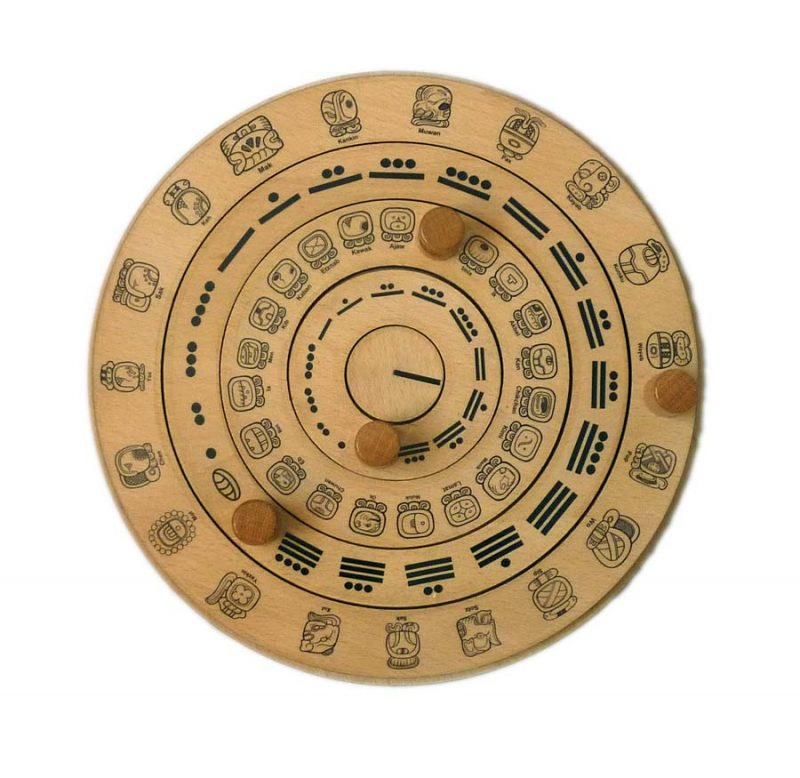
To the ancient Maya, time was not a straight line moving from the past into the future; it was a series of interlocking cycles, some short and some spanning millions of years. Their ability to track these cycles required a mathematical system far more advanced than what was being used in Europe at the same time.
By combining a vigesimal (base-20) system with the concept of zero, the Maya created a calendar so accurate that it could predict solar eclipses and the movements of Venus with a precision of only a few seconds' error over centuries.
1. The Three Interlocking Gears
The Maya didn't use just one calendar; they used three distinct systems that worked together like the gears of a mechanical clock.
The Tzolk’in (The Divine Calendar)
Duration: 260 days.
Structure: It combined a cycle of 13 numbers with a cycle of 20 named days.
Purpose: This was used for religious rituals, naming children, and divination. It roughly corresponds to the human gestation period or the agricultural cycle of maize.
The Haab’ (The Civil Calendar)
Duration: 365 days.
Structure: 18 months of 20 days each, plus a 5-day "unlucky" month at the end called the Wayeb’.
Purpose: This tracked the solar year and the seasons, essential for large-scale farming.
The Calendar Round
When the Tzolk’in and Haab’ were combined, they created a larger cycle called the Calendar Round. A specific date (e.g., "4 Ahau 8 Cumku") would only repeat once every 52 years, which the Maya considered a full "century" or a complete life cycle.
2. The Long Count: Tracking Deep Time
While the 52-year cycle was fine for a human life, it wasn't enough for recording history. For that, the Maya developed the Long Count, which allowed them to date events from a fixed starting point: August 11, 3114 BCE.
The units were based on their base-20 math:
K'in: 1 day.
Uinal: 20 days.
Tun: 360 days (18 Uinals—adjusted to stay close to the solar year).
K'atun: ~20 years.
Bak'tun: ~394 years.
The "Great Cycle" consists of 13 Bak'tuns (roughly 5,125 years). It was the completion of this cycle on December 21, 2012, that sparked the famous (and misunderstood) "end of the world" prophecies—though to the Maya, it was simply the "odometer" rolling over to a new era.
3. Base-20 Math and the Zero
The Maya were one of only a handful of civilizations globally to independently discover the concept of zero. This was a mathematical breakthrough that allowed for "place-value" notation.
Vigesimal System: While we use base-10 (0-9), the Maya used base-20 (0-19).
The Notation: They used a simple, elegant system of dots (value 1), bars (value 5), and a shell (value 0).
Vertical Positional Value: Numbers were written vertically. The bottom row represented 1s, the next row 20s, the third row 400s ($20 \times 20$), and so on.
4. Astronomy: The Sky as a Laboratory
The Maya were master astronomers without telescopes. By building temples like El Caracol at Chichén Itzá as observatories, they aligned their architecture with celestial events.
The Venus Table: In the Dresden Codex, the Maya tracked the synodic period of Venus (584 days). Their calculations were accurate to within two hours over a 500-year span.
Solar Eclipses: They developed tables to predict when the moon would cross the sun’s path, allowing priests to "predict" the darkening of the sun to maintain social control.
5. Archaeology: The Stelae of Time
We know so much about their calendar because the Maya were obsessed with recording dates on Stelae—massive stone slabs.
Archaeologists use these dates to reconstruct the rise and fall of dynasties. Every time a new king took the throne or a K'atun (20-year period) ended, they would commission a "time monument" to lock that moment into the cosmic record forever.
For the Maya, understanding time was the ultimate form of power. If you knew the cycles of the past, you could anticipate the future.