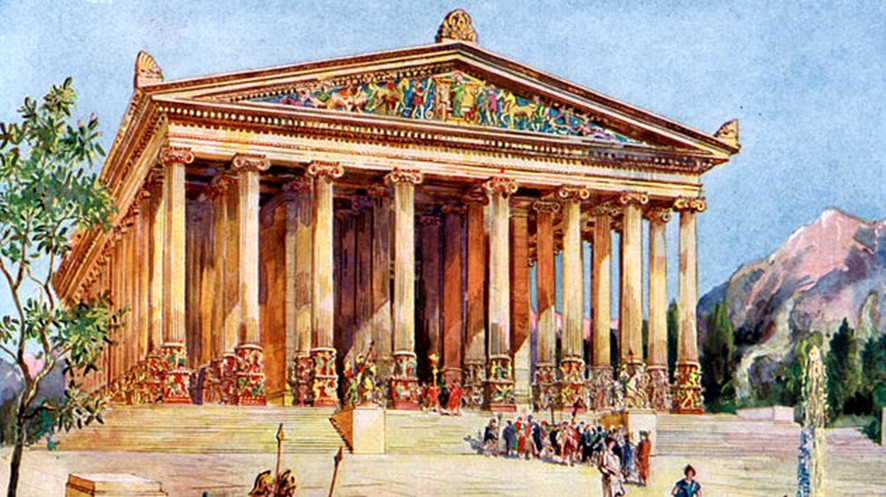
The Temple of Artemis (the Artemision) at Ephesus was not just a building; it was an architectural statement of scale and grandeur that earned its place as one of the Seven Wonders of the Ancient World. Built of solid marble, it was the largest building in the Greek world, four times the size of the Parthenon in Athens.
The story of its excavation is as dramatic as its destruction, involving a British railway engineer, a massive swamp, and the rediscovery of a lost "Hellenistic masterpiece."
1. A Tale of Three Temples
Archaeologists have discovered that the "Temple" was actually a series of structures built on the same sacred site over centuries.
The D-Phase (Archaic): Built around 550 BCE, funded largely by the legendary King Croesus of Lydia. It was the first Greek temple to be made entirely of marble.
The Herostratic Fire: In 356 BCE, a man named Herostratus burned the temple to the ground solely because he wanted his name to be remembered in history. Legend says it burned on the same night Alexander the Great was born.
The E-Phase (Hellenistic): The final, grandest version, rebuilt after the fire. This is the version described by ancient travelers as "overwhelming the sun."
2. Architectural Innovation: The Dipteral Forest
The temple was a "dipteral" design, meaning it had a double row of columns surrounding the central chamber (cella).
The Columns: It featured 127 columns, each standing 60 feet (18 meters) tall.
The Sculpted Bases (Columnae Caelatae): In a unique twist for Greek architecture, the lowest sections of 36 columns were decorated with life-sized relief carvings of gods and myths.
The Amazon Connection: According to legend, the temple was founded by the Amazons. Sculptures found at the site depict these warrior women, reinforcing the temple's identity as a sanctuary for the feminine divine.
3. The "Lost" Wonder: John Turtle Wood’s Search
By the 19th century, the temple had vanished. It had been dismantled for its marble or sunk into the silt of the Cayster River.
The Obsession: In 1863, British engineer John Turtle Wood began a obsessive six-year search. Because Ephesus had become a swamp, he had to dig through 20 feet (6 meters) of mud and water.
The Discovery: On New Year’s Eve, 1869, his team struck the pavement of the temple. Wood had found the "ghost" of the structure—the massive foundation blocks and fragments of the sculpted column bases.
4. The Ephesian Artemis: The Lady of the Animals
Excavations within the cella revealed that the statue of Artemis worshipped here was unlike the "huntress" seen in mainland Greece.
The Multi-Breasted Statue: The "Ephesian Artemis" was covered in oval-shaped protrusions. While often interpreted as breasts (symbolizing fertility), many archaeologists now believe they represent bull testicles (sacrificial offerings) or amber gourds (protective amulets).
The Wildlife: Her garment was adorned with carvings of lions, stags, and bees, representing her role as Potnia Theron (Mistress of the Animals).
5. The "Croesus" Hoard
Underneath the foundations of the earlier Archaic temple, archaeologists discovered a spectacular "foundation deposit."
The Treasure: Hundreds of items were found, including ivory statuettes, gold jewelry, and some of the world's earliest coins (made of electrum, a natural gold-silver alloy).
The Lydian Influence: These finds proved the temple was a hub of international finance and trade, acting as a "bank" for the wealthy kings of Lydia and the merchants of the Ionian coast.
6. The Temple Today: A Single Column
If you visit the site in modern-day Selçuk, Turkey, you will see a solitary, reconstructed column standing in a marshy field.
The Plunder: Much of the temple’s marble was reused to build the Hagia Sophia in Istanbul and local Byzantine structures.
The Storks: Today, the top of the single remaining column is often the nesting site for storks—a quiet, natural irony for a temple once dedicated to the protector of all living things.
The Temple of Artemis reminds us that even the most "permanent" monuments of human achievement can be reclaimed by the earth. It took a railway engineer’s grit and a decade of digging through muck to prove that the legends of its size weren't just ancient exaggerations.