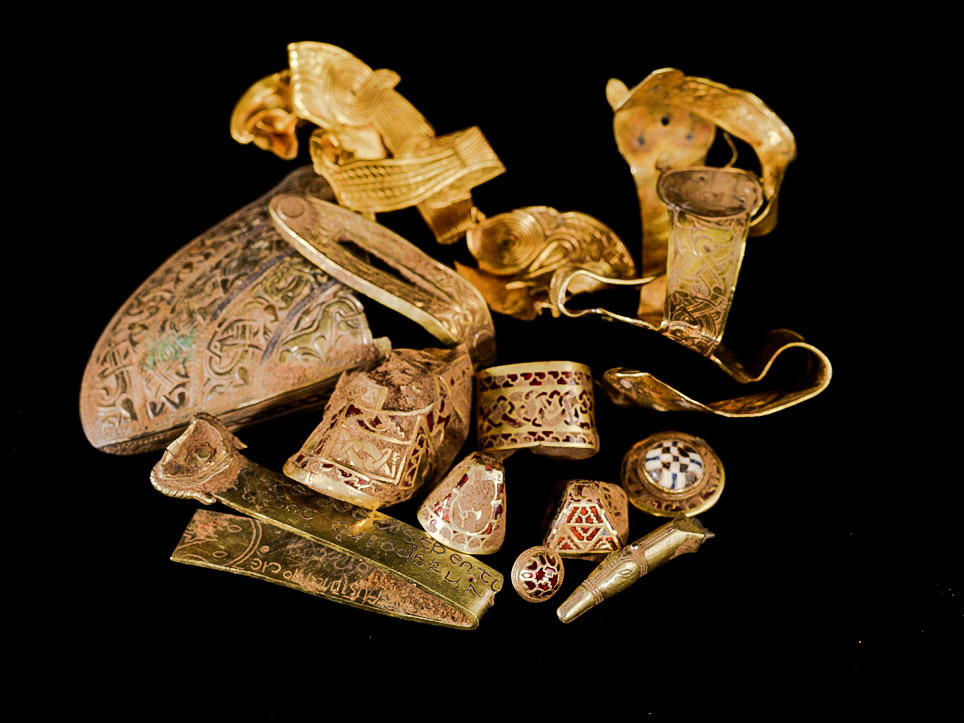
The Staffordshire Hoard is the most significant collection of Anglo-Saxon gold and silver ever discovered. Found in a field near Lichfield in 2009 by a metal detectorist, it consists of over 3,500 items, totaling roughly 5 kilograms of gold and 1.5 kilograms of silver.
What makes this hoard truly unique is not just its value, but its contents: it is almost entirely composed of martial (military) items, with almost no jewelry or domestic objects found in the mix.
1. The Nature of the Find: A Warrior’s Treasure
Unlike other hoards that include coins or tableware, the Staffordshire Hoard is a collection of "warrior bling."
Weapon Fittings: The vast majority of the items are hilt plates, pommel caps, and sword-hilt fittings.
The Absence of Blades: Curiously, the iron blades themselves were missing. It appears the gold and silver fittings were stripped from the weapons and gathered together, possibly as trophies or "spoils of war."
Gold and Garnet: Many pieces feature the cloisonné technique, where thin slices of Almandine garnets are set into gold cells, creating a shimmering, blood-red effect that was a hallmark of high-status Anglo-Saxon craftsmanship.
2. The Mystery of its Burial
The hoard dates to the 7th or 8th century, a time when the Kingdom of Mercia was frequently at war with its neighbors, Northumbria and Wessex.
A Ritual Deposit? Some archaeologists suggest the hoard was a religious offering to a pagan god or a Christian "thank you" for a victory.
Emergency Hiding: Others believe it was the treasury of a defeated army, hidden in haste during a retreat and never recovered.
Intentional Damage: Many of the items were bent or broken before being buried. This "ritual killing" of objects was a common practice in prehistoric and early medieval Europe to ensure the items remained in the spirit world.
3. The Biblical Inscription
One of the few non-martial items in the hoard is a folded gold strip inscribed with a Latin verse from the Old Testament (Numbers 10:35).
The Text: "Surge domine et dissipentur inimici tui et fugiant qui oderunt te a facie tua" (Rise up, Lord, may your enemies be scattered and those who hate you flee from your face).
Spiritual Warfare: This inscription highlights the intersection of Christian belief and warrior culture, suggesting that for the Anglo-Saxons, battles were fought with both physical weapons and divine protection.
4. Masterful Craftsmanship: Filigree and Zoomorphism
The level of detail on these items, some of which are smaller than a fingernail, is staggering for the period.
Filigree: Master goldsmiths used tiny "beads" and wires of gold to create intricate patterns.
Zoomorphic Art: The designs are filled with "Style II" animal art, where the bodies of birds, snakes, and beasts are elongated and intertwined into complex, symmetrical knots. You often have to look closely to see where one animal ends and another begins.
5. Historical Impact
Before this discovery, historians viewed the 7th-century Mercian kingdom as somewhat of a "backwater" compared to the artistic heights of the Sutton Hoo burial in East Anglia.
The Mercian Powerhouse: The hoard proves that the Mercian court was incredibly wealthy and had access to the finest craftsmen in Europe.
Garnet Trade: Chemical analysis of the garnets shows they originated from as far away as India and the Czech Republic, revealing the vast trade networks that survived even after the fall of the Roman Empire.
The Staffordshire Hoard remains a puzzle. It is a collection of beautiful, broken things—the gold of a hundred swords stripped and buried in a lonely field.
Since the hoard is almost entirely military and seems to have been stripped from weapons with some items "ritually broken," do you think it represents a tribute to a king, or is it more likely the "recycling bin" of a battlefield scavenger who never made it back to his forge?