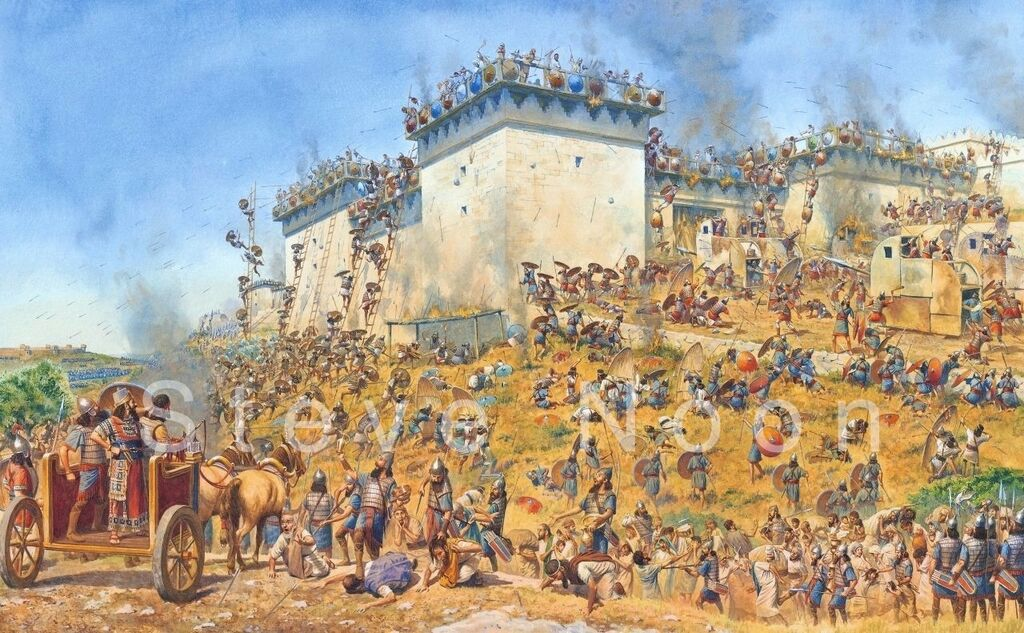
Ancient Siege of Lachish: Reconstructing the Assyrian Military Machine
In 701 BCE, the Neo-Assyrian Empire under King Sennacherib launched a massive campaign against the Kingdom of Judah. The siege and conquest of the strategic city of Lachish represents one of the most well-documented military operations of the ancient Near East, combining biblical accounts, Assyrian inscriptions, and modern archaeological excavations.
1. The Historical Context
Lachish, situated in the Shephelah region, was the second most important city in Judah and a crucial gateway to the Judean hill country and Jerusalem.
The Rebellion: King Hezekiah of Judah stopped paying tribute to the Assyrian Empire, leading Sennacherib to march his professional army to suppress the rebellion.
The Scale of the Invasion: Before reaching Lachish, the Assyrians had reportedly taken 46 fortified Judean cities, deporting hundreds of thousands of people and demonstrating an unmatched level of military organization.
2. The Assyrian War Machine
The Assyrian army was the most advanced and effective military force of its time, characterized by high professionalization, specialized divisions, and complex logistics.
Infantry & Archers: Highly trained close-combat troops, supported by archers and slingers who provided suppressive cover fire against enemy defenders.
Siege Engineers: A highly skilled engineering corps capable of building massive earthworks and operating heavy weaponry under fire.
Cavalry: Excellent cavalry units with mounted archers and spearmen who could strike with speed and mobility.
3. Constructing the Siege Ramp
The siege of Lachish required a massive, unprecedented engineering effort to overcome the city's hilltop fortifications.
The Scale of Materials: The Assyrian army constructed a giant wedge-shaped ramp using approximately 3 million stones, weighing around 20,000 tons in total.
Human Chains: The stones were quarried from a nearby hillside and passed from hand to hand by hundreds of forced laborers or prisoners of war, operating in round-the-clock shifts.
Protective Measures: Workers were protected from Judean arrows and slingstones by large, L-shaped wicker shields that were advanced daily.
Completion Time: Researchers estimate the ramp took just 20 to 25 days to construct.
4. Siege Tactics and the Breach
The Assyrians utilized multiple tactical methods simultaneously, a technique the ancient world had never seen at this scale.
Heavy Siege Engines: Wheeled battering rams were hauled up the finished ramp. The heavy wooden beams with metal tips were suspended on iron chains inside the mobile housing to batter the walls.
Suppressive Fire: Archers and slingers stood at the top of the ramp, neutralizing defenders on the city walls.
Countering Fire: When defenders threw down burning torches, Assyrian troops extinguished the flames using water carried in flexible hoses or skins.
5. The Archaeological & Historical Record
The events at Lachish are confirmed by multiple independent sources, making it one of the most thoroughly verified historical events from antiquity.
The Nineveh Reliefs: Sennacherib recorded his victory on a continuous frieze at his palace in Nineveh. These reliefs show the ramp, engines, and Lachish prisoners.
Physical Evidence: Excavations at Tel Lachish have revealed the actual siege ramp—the only one surviving from ancient Near Eastern antiquity—along with thousands of arrowheads, sling stones, and a piece of the iron chain from the Assyrian ram.
This Ancient Siege Broke Every Rule of War. This video provides a quick visual summary of the siege tactics and the military engineering used by the Assyrian army at Lachish.