Roman Glassmaking: The Secret Ingredients Behind the Dichroic Lycurgus Cup
The Lycurgus Cup, dating to the 4th century CE, is one of the most spectacular surviving artifacts of the Roman world. It is the only intact example of a complete Roman "cage cup" (diatretum) that exhibits dichroic properties—meaning it changes color depending on the direction of the light.
1. The Phenomenon of Dichroic Glass
The most striking feature of the Lycurgus Cup is its ability to shift colors based on the lighting:
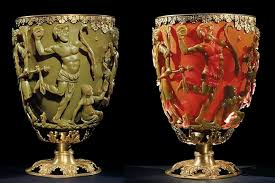
Reflected Light: When lit from the front, the cup appears opaque jade green.
Transmitted Light: When a light source shines from behind or through the chalice, it glows a fiery translucent ruby red.
The cup depicts the mythical Thracian King Lycurgus being entangled by vines. The colors are thought to reflect the narrative: the red representing the king's rage or the wine of the god Dionysus, and the green representing the vines imprisoning him.
2. The Secret Ingredients: Ancient Nanotechnology
For decades, the changing color of the glass puzzled scientists. When fragments were analyzed using transmission electron microscopy, researchers discovered that the Romans had infused the glass matrix with incredibly fine metallic particles.
Silver and Gold Nanoparticles: The glass contains trace amounts of silver and gold in a 7:3 ratio, along with about 10% copper.
Size of the Particles: The metallic particles are roughly 50 nanometers in diameter—less than one-thousandth the size of a grain of salt.
Dispersion: The particles are dispersed in colloidal form throughout the glass material.
3. The Science: Surface Plasmon Resonance
The color-changing effect operates on the principles of subatomic physics:
"The relative contributions of silver and gold to the colorant effect confirm that the dichroic effect is caused by colloidal metal."
When light hits the nanoparticles, it interacts with the free electrons on the surface, causing them to oscillate. This phenomenon—surface plasmon resonance—scatters the blue light and allows the red wavelengths to pass through, creating the distinctive ruby red color.
4. Intentional Craft or Serendipitous Discovery?
A central debate among historians and materials scientists is whether the Romans understood the nanotechnology or created the effect by chance:
The Concentration: The quantities are exceedingly small (330 parts per million of silver and 40 parts per million of gold), making it highly difficult to add to a large batch consistently.
The Chemical Catalyst: Researchers found that the glass contains antimony, which acted as a reducing agent to precipitate the metallic colloids during the heating process.
Accidental Contamination: Some experts suggest the effect may have started as an accident from recycling scrap metals or utilizing workshop residues, though the uniformity of the composition implies a highly specialized technique.
5. Crafting the Cup
The Lycurgus Cup represents an incredible feat of Roman glass manipulation and gem-cutting skills.
The Blank: The vessel was first cast or blown as a thick blank.
The Relief: Artisans carved away the exterior layers using abrasive tools, leaving the figural "cage" free-standing from the inner vessel wall.