Experts made the remarkable discovery after they discovered an unfinished construction
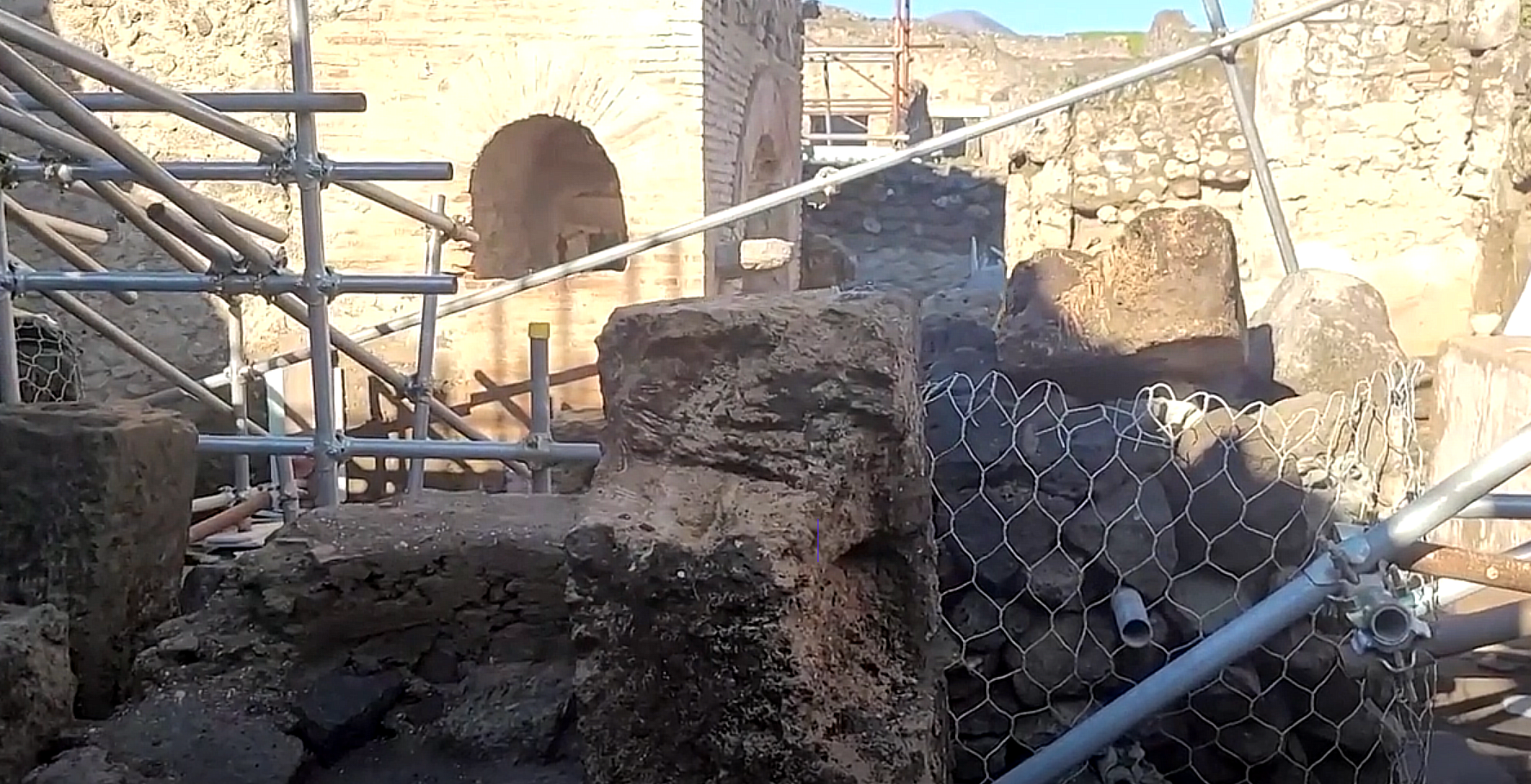
Scientists working at the ancient Roman city of Pompeii have revealed a construction site preserved exactly as it was when Mount Vesuvius erupted in 79 AD, offering an extraordinary glimpse into the production of Roman concrete, famed for its durability and self-repairing properties.
The excavation exposes a building project that was suddenly interrupted by the volcanic disaster. Researchers discovered rooms with partially built walls, stacks of premixed dry materials, and measuring tools, all arranged for the preparation of concrete.
“Examining the site felt like stepping back in time, standing alongside the workers as they mixed and applied their concrete,” said Admir Masic, a professor of civil and environmental engineering at the Massachusetts Institute of Technology and lead author of the study published in Nature Communications.
Roman concrete was a cornerstone of architecture, enabling the construction of iconic structures such as the Colosseum, the Pantheon, public baths, aqueducts, and bridges—engineering achievements unmatched in their era. Its ability to set underwater made it particularly essential for harbors, piers, and breakwaters.
The exact techniques used by the Romans had long been debated, and recent archaeological evidence is now challenging the instructions described in the 1st-century BCE architectural treatise by Vitruvius.
The Pompeii excavation revealed that the Romans employed a method called “hot mixing,” in which quicklime a form of dry limestone that has been heated is combined directly with water and a mixture of volcanic rock and ash. This reaction naturally raises the temperature of the mixture, a process that differs from the slaked-lime technique described by Vitruvius about a century earlier.
“Pompeii preserves buildings, materials, and even work in progress exactly as they were at the moment of the eruption. Unlike finished structures, which have endured centuries of repairs or weathering, this site captures the construction process as it happened,” explained Admir Masic, a professor of civil and environmental engineering at MIT. “For studying ancient technologies, nothing else compares. Its preservation offers a true snapshot of Roman building practices in action.”
The building under construction included domestic rooms alongside a functioning bakery, complete with ovens, grain-washing basins, and storage areas. Findings from the site indicated that Vitruvius’ method of using slaked lime was not applied in wall construction, suggesting it may have been outdated by the time this Pompeii project was underway.
“Consider how 100 years can transform technology. It’s similar to early telephones in the 1920s and 30s using rotary dialing and copper lines versus today’s smartphones with wireless digital networks,” Masic remarked.
The hot-mixing approach contributed to the concrete’s self-healing ability, allowing cracks to repair themselves chemically. This occurs because the concrete contains white remnants of lime, called lime clasts, which can dissolve and recrystallize when water enters cracks, sealing them naturally.
Romans industrialized concrete beginning in the 1st centuries BCE and CE. “This innovation allowed builders to construct enormous monolithic structures, complex vaults and domes, and harbors with underwater-curing concrete. Concrete fundamentally changed the scale and design of cities and infrastructure,” Masic said.
The new insights into Roman concrete may have applications for modern architecture. “Contemporary concrete generally lacks self-healing properties, which are increasingly important for durable, low-maintenance infrastructure. While the ancient process isn’t a direct replacement for modern standards, the principles we’ve uncovered can guide the design of next-generation, long-lasting, low-carbon concretes,” he added.