Spotted off the coast of Denmark, the “Svælget 2” is a cog, a kind of large trading vessel used in the Middle Ages. Experts say the 600-year-old discovery is “exceptionally well-preserved”
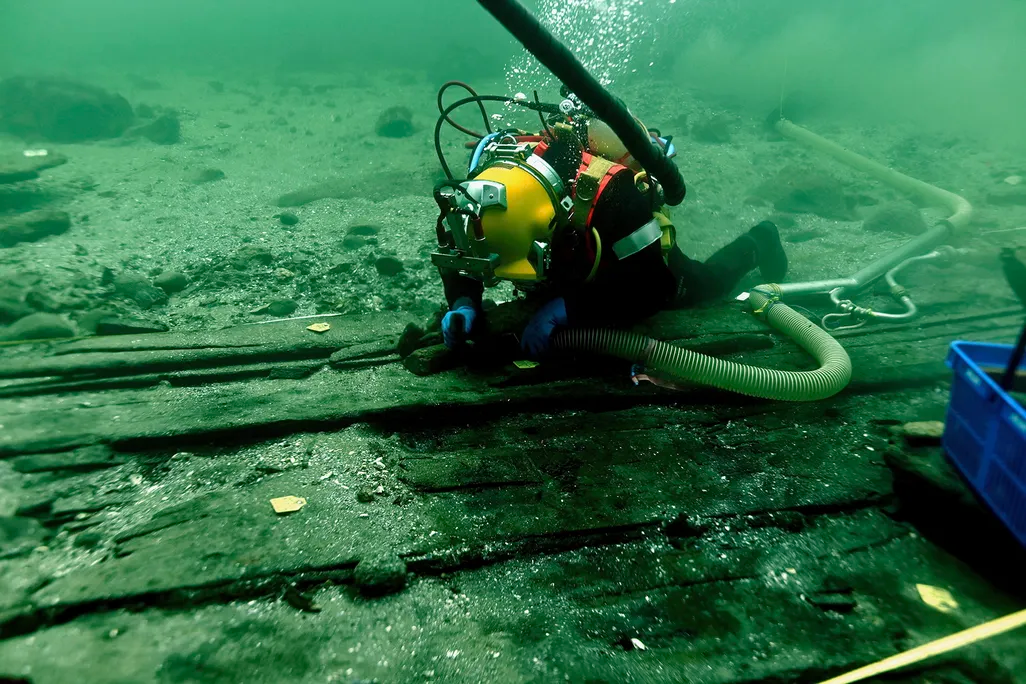
Divers swept away sand and silt to reveal the wreck.
Forty feet beneath the waters of Øresund, the strait between Denmark and Sweden, archaeologists have uncovered the wreck of a 600-year-old ship. Lavishly equipped and exceptionally well-preserved, the vessel is a medieval cargo ship, or cog, and is believed to be the largest of its kind ever discovered.
Maritime experts from Denmark’s Viking Ship Museum found the ship while mapping the seabed. The silt-covered vessel, named Svælget 2, measures roughly 92 feet in length, 30 feet in width, and 20 feet in height. Its estimated cargo capacity was 300 tons.
“This discovery marks a milestone in maritime archaeology,” said excavation leader Otto Uldum. “It is the largest cog known to us and offers a unique chance to study both the construction and daily life aboard the largest trading ships of the Middle Ages.”
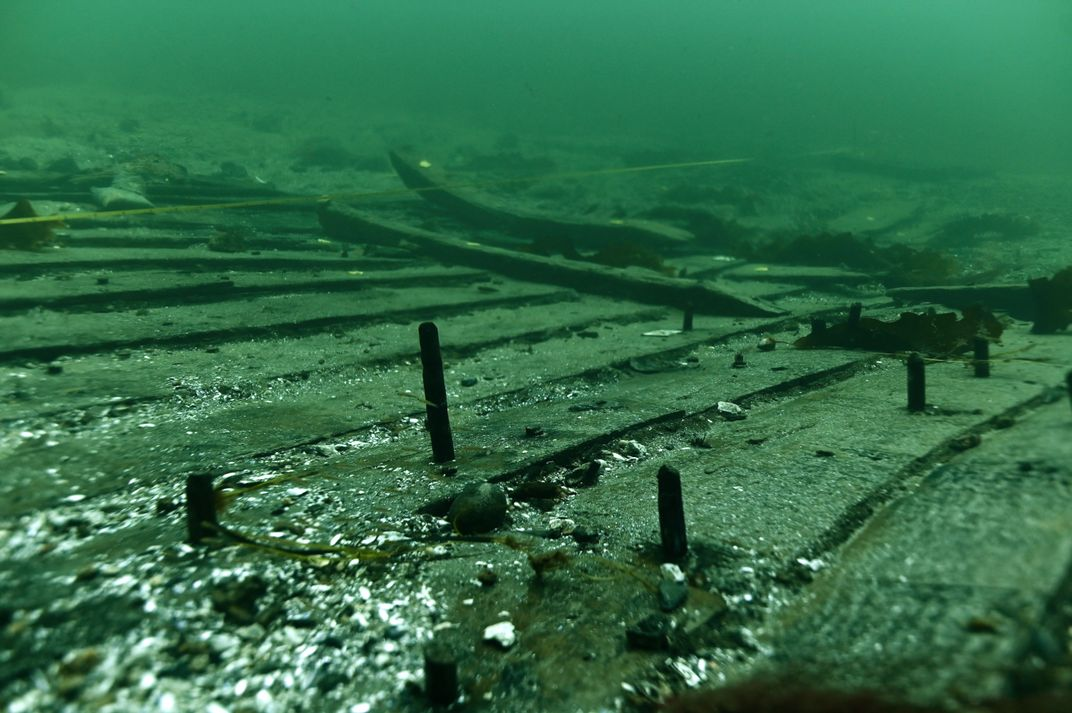
The ship's frame was made of wood from the Netherlands
Cogs first appeared around the tenth century as a secure and efficient way to transport large quantities of goods, according to Artnet’s Min Chen. Their deep cargo holds outmatched Viking ships like knarrs, and their tall sides made them difficult to board during naval conflicts. These large vessels were built to travel from the Netherlands, past Denmark, and into the Baltic Sea. Despite their size, a cog could be handled by a relatively small crew.
“The cog transformed trade in northern Europe,” said Otto Uldum. “It allowed goods to be moved on a scale never seen before.”
Shipbuilders constructed cogs as large as possible to carry heavy or bulky items such as timber, bricks, salt, and other staples. While no cargo was found in Svælget 2, archaeologists did recover personal items from the crew, including shoes, combs, and rosary beads.
The museum notes that the ship is exceptionally well-preserved. Buried in sand, its starboard side was shielded from erosion, preserving much of the rigging—the ropes and chains used to manage sails, secure masts, and protect cargo. “This provides an unprecedented opportunity to understand how cogs were outfitted for sailing,” Uldum added.
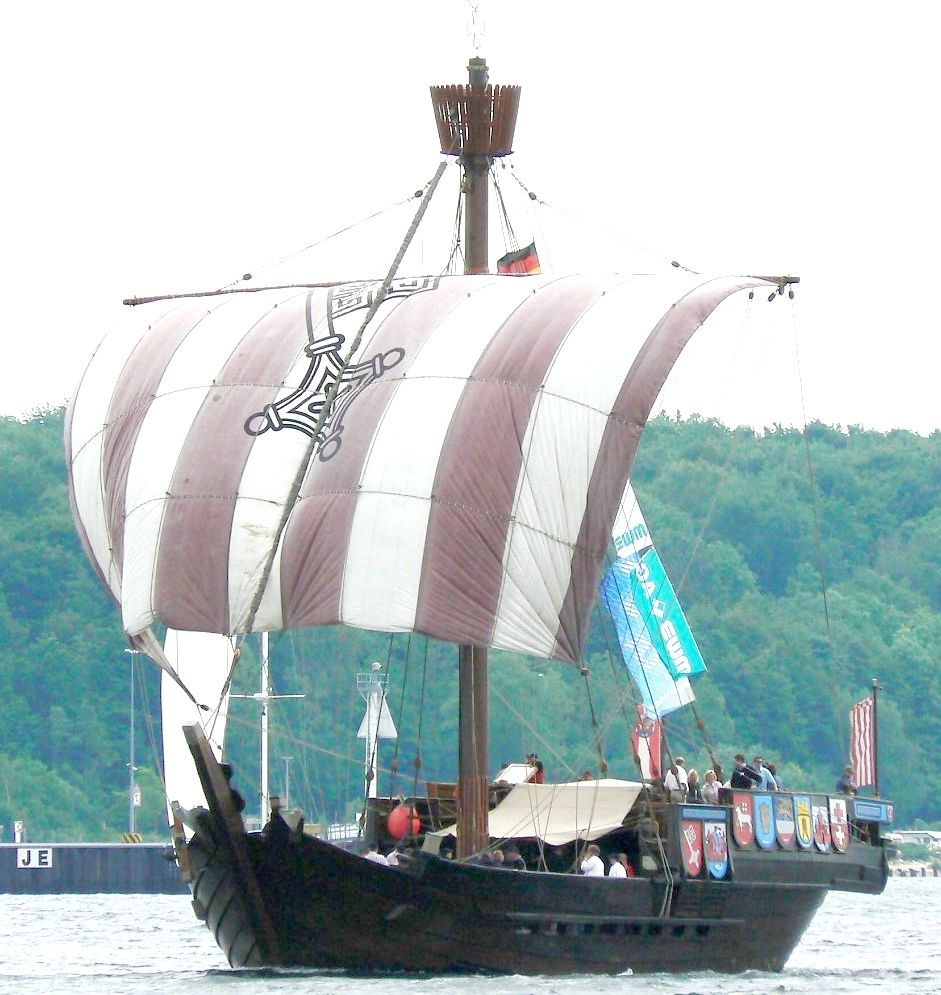
A replica of the "Bremen cog," a ship built in 1380 and found wrecked in Germany in the 1960s
Svælget 2 features other exceptionally well-preserved elements. At the stern, archaeologists discovered extensive remains of a castle—a covered deck where the crew would have taken shelter. While medieval records show that castles were common on cogs, no physical examples had ever been found.
“We have plenty of drawings of castles, but they have never been found because usually only the bottom of the ship survives,” said Uldum. “This time we have the archaeological proof.”
The ship also contained the remains of a brick galley, where the crew prepared meals. Built from 200 bricks and 15 tiles, this fireproof galley allowed cooking over an open flame. Nearby, divers recovered bronze cooking pots, wooden dishes, ceramic bowls, and remnants of meat and fish.
Dendrochronology shows that Svælget 2 was constructed around 1410. Its planks came from Pomeranian oak in modern-day Poland, and its frame wood originated in the Netherlands. The ship’s size reflects the strength of the medieval northern European trading economy, requiring a society capable of financing, building, and outfitting such massive vessels to meet demand for imported goods, Uldum explains.
Europe experienced an agricultural boom in the centuries leading up to Svælget 2, with its population increasing from 18 million in the seventh century to over 70 million by the 14th century, enabling more international trade.
“Perhaps the find does not change the story we already know about medieval trade,” Uldum said, “but it shows that it was through ships like Svælget 2 that this trade occurred. We now know, undeniably, that cogs could reach this size—that the ship type could be pushed to this extreme.”