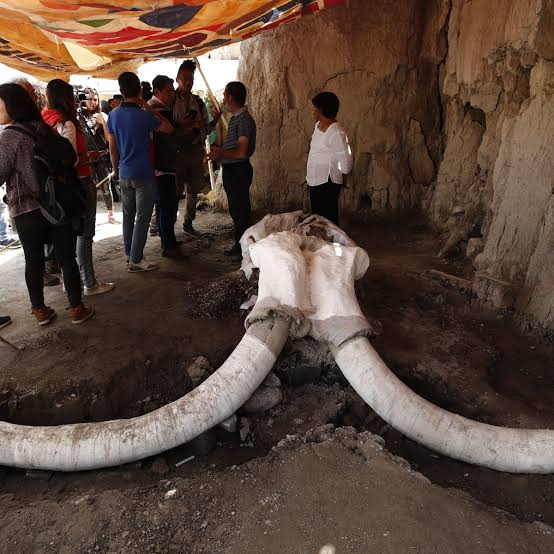
The idea of prehistoric “tar pits” immediately brings to mind famous fossil sites where natural asphalt trapped animals over long periods. In Xinjiang, geological features containing bitumen and other petroleum-related substances have also attracted scientific interest because of the region's complex environmental and geological history.
However, the description “Baicheng Tar Pits: Xinjiang's Mammoth Traps” should be treated carefully. The interpretation of a natural bitumen deposit as a prehistoric mammoth trap requires direct fossil and geological evidence. It should not be assumed merely because a site contains tar-like material or large-animal remains.
The scientific importance of such localities lies in their potential to preserve evidence about extinct animals, ancient environments, and geological processes.
What Are Tar Pits?
A tar pit is an area where natural petroleum or bitumen reaches the surface.
The material can be extremely sticky.
Animals that step into it may become trapped.
Their struggles can attract predators or scavengers, which may also become trapped.
Over long periods, this process can create unusually rich fossil deposits.
The Preservation of Fossils
Natural asphalt can preserve bones because it protects them from some forms of environmental exposure.
Fossils recovered from such deposits can include:
large herbivores,
predators,
birds,
and smaller animals.
The resulting collection may provide a detailed picture of an ancient ecosystem.
However, the interpretation of fossil assemblages requires careful study.
Not every animal found near bitumen died because it became trapped.
Some remains may have been transported by water or deposited through other processes.
Mammoths in Ice Age Eurasia
Different species of mammoths inhabited parts of Eurasia during the Pleistocene.
These enormous relatives of modern elephants adapted to a variety of environments.
The best-known species include the woolly mammoth, which became strongly associated with cold Ice Age landscapes.
Mammoths could survive in parts of northern and central Eurasia where they fed on grasses and other vegetation.
Their fossils provide important evidence about Pleistocene ecosystems.
Could Mammoths Become Trapped?
Large animals could potentially become immobilized in natural hazards such as:
mud,
marshes,
sinkholes,
ice,
and sticky petroleum deposits.
Once trapped, an animal might be unable to escape.
However, proving that a specific fossil animal died in this way requires geological and archaeological evidence.
Scientists examine:
the position of bones,
sediment layers,
associated fossils,
and the geological history of the deposit.
The Importance of Geological Context
A fossil without geological context provides limited information.
A bone discovered near a tar deposit does not automatically prove that the animal died there.
Researchers need to determine whether the remains were:
deposited directly,
transported,
disturbed,
or accumulated through multiple processes.
This is why careful excavation is essential.
Pleistocene Environments in Xinjiang
During the Ice Age, the landscapes of Central Asia experienced major environmental changes.
Climate affected:
glaciers,
rivers,
grasslands,
deserts,
and animal populations.
Large herbivores depended on the availability of vegetation, while predators depended on prey.
Fossil sites can therefore provide evidence for entire ecological communities.
Mammoths and Human History
Mammoths were important to prehistoric humans.
In different regions, humans hunted or scavenged mammoths and used their bodies as sources of:
meat,
fat,
hide,
bone,
and ivory.
Mammoth bones could also be used in construction or toolmaking.
However, the relationship between humans and mammoths varied across time and geography.
The discovery of mammoth remains near a prehistoric site does not automatically prove deliberate hunting.
Evidence such as cut marks, weapon damage, or controlled archaeological context is needed.
Why Fossil Trap Sites Are Important
Natural trap deposits can preserve multiple species from the same environment.
This allows scientists to reconstruct:
predator-prey relationships,
biodiversity,
climate,
vegetation,
and ecological change.
Large collections of animal remains may reveal which species lived together.
Archaeology, Paleontology, and Geology
The study of a possible fossil trap requires cooperation between several disciplines.
Paleontology identifies and studies extinct animals.
Geology investigates sediments, rock formations, and natural processes.
Archaeology examines evidence of human activity.
Together, these disciplines can determine whether a site represents:
a natural trap,
a human hunting location,
a transported fossil deposit,
or another type of geological formation.
Why Caution Is Necessary
Prehistoric sites often acquire dramatic descriptions.
Terms such as “mammoth trap” are memorable, but scientific interpretation must be based on evidence.
A proper investigation asks:
Are mammoth fossils actually present?
Are they found within the tar or associated sediments?
What geological processes formed the deposit?
Were humans involved?
Can the remains be securely dated?
Without these answers, a dramatic interpretation remains a hypothesis rather than established fact.
Conclusion
The concept of the Baicheng tar pits as prehistoric mammoth traps highlights the fascinating relationship between geology and Ice Age life in Xinjiang. Natural petroleum deposits have the potential to preserve valuable fossil evidence, but determining how individual animals died requires detailed scientific investigation.
Whether a specific deposit represents a true animal trap, a natural fossil accumulation, or another geological phenomenon, such sites are important because they can preserve evidence from landscapes that disappeared thousands of years ago.
The study of fossil deposits reminds us that archaeology is not only about ancient human societies. It also depends on understanding the animals, climates, and geological environments that shaped the world in which prehistoric people lived.