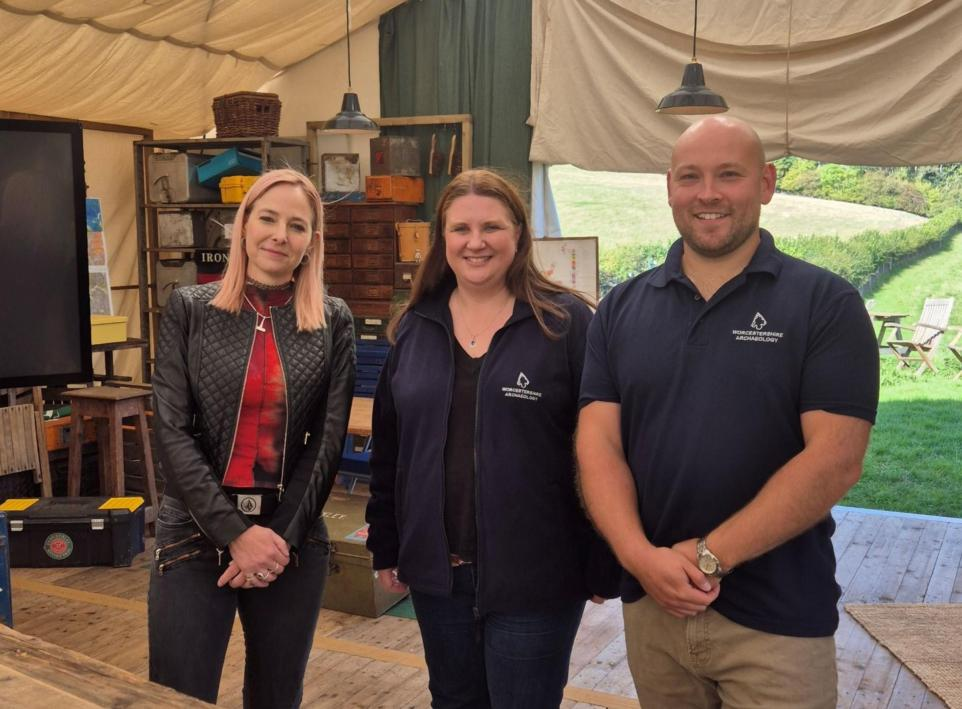
BBC crews have filmed an episode of a well-known television programme in Broadway following an archaeological discovery made ahead of planned development.
The village will appear in an episode of BBC Two’s Digging for Britain after excavations revealed evidence of 8,000 years of human activity.
Among the finds attracting national attention was a carved bone box recovered from the grave of a young woman, dating to the late Roman period.
The excavation was carried out by Worcestershire Archaeology and was commissioned and funded by Wychavon District Council in advance of development plans.
Jamie Wilkins, who led the excavation, described the discovery as “extraordinary,” noting not only the craftsmanship and preservation of the box, but also the insight it offers into the community that once lived there. He said he had never encountered an object like it before and quickly realised its significance.
Cllr Emma Kearsey, Wychavon’s executive board member for planning, infrastructure and urban design, said the work at Milestone Ground is transforming understanding of Broadway and Worcestershire’s history. She highlighted the bone box as a particularly compelling find and welcomed its inclusion on Digging for Britain so a wider audience can share in the discovery.
She added that further discoveries are expected at the site and that work is ongoing with Worcestershire Archaeology and Broadway Museum to share the story locally.
The new series of Digging for Britain, presented by Professor Alice Roberts, will be broadcast on BBC Two and BBC iPlayer from 7 January 2026.
A spokesperson for Wychavon District Council said the finely decorated box is believed to date to the late Roman period, based on its decorative style, a date that has since been confirmed through radiocarbon analysis of the associated burial.
Specialist analysis has also revealed an unexpected detail: the box was made from roe deer bone and may originally have been used to hold an ointment.
Its careful placement within the grave suggests it was a valued or deeply personal item for the individual who was buried there and for those who laid them to rest.
Although the bone box is the most striking discovery, archaeologists have also uncovered evidence of substantial prehistoric, Roman and Saxon activity at the site. This reinforces Broadway’s long-standing importance as a settlement located along a key route across the Cotswolds escarpment.
A multi-year programme of specialist study is now set to begin. Once completed, all finds and records from the excavation will be deposited with the county museum, in accordance with archaeological best practice.