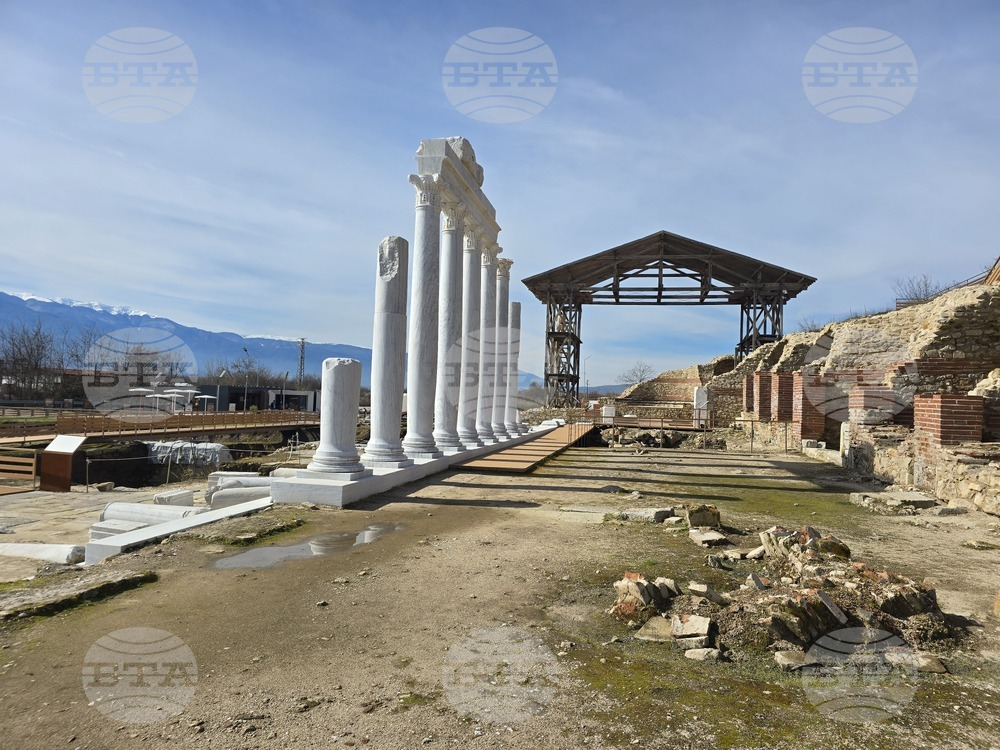
An anthropological study of burials from the Western necropolis of Heraclea Sintica has identified both a man and a woman of mixed European and African ancestry among the city’s inhabitants, according to Prof. Dr. Lyudmil Vagalinski, who leads excavations at the site. The remains were uncovered during rescue digs conducted by the National Archaeological Museum.
The anthropological analysis was carried out by Assoc. Prof. Dr. Victoria Russeva of the Bulgarian Academy of Sciences. One of the most notable burials belongs to a woman aged around 35–40, whose skeletal features indicate mixed European and African ancestry. She showed signs of scoliosis and early-stage spondylosis. Her grave, dated to the second half of the 4th century AD based on coins found within it, is among the latest in the necropolis.
Researchers also identified a man of mixed ancestry who lived to between 40 and 50 years old — a relatively advanced age for the time. Both individuals were interred in well-constructed graves, suggesting they were respected members of the community and fully integrated into the social fabric of the city.
Prof. Vagalinski noted that while similar cases have been documented in ancient Bulgarian burials, they are extremely rare. He sees the discovery as further proof that Heraclea Sintica was actively connected to the broader Roman world, which spanned three continents. Epigraphic evidence already indicates that settlers arrived from various Mediterranean regions, including as far away as Carthage.
The broader anthropological study examined 156 graves, with reliable data obtained for 137 individuals despite many cremations. The demographic profile reflects a harsh ancient reality: most inhabitants died before 40, and individuals over 60 were nearly absent.
Evidence of disease was also widespread. Researchers identified rare genetic conditions such as Klippel–Feil syndrome and Legg–Calvé–Perthes disease, along with severe bone and joint damage in several cases. Notably, at least one individual with serious skeletal impairment survived into adulthood — suggesting the presence of social care and communal support.
Further laboratory and chemical analyses, including dietary and origin studies, are ongoing and expected to deepen understanding of daily life and population diversity in Heraclea Sintica across the centuries.
It’s a reminder that the ancient Roman world wasn’t isolated or homogeneous — it was mobile, interconnected, and more diverse than people sometimes assume.