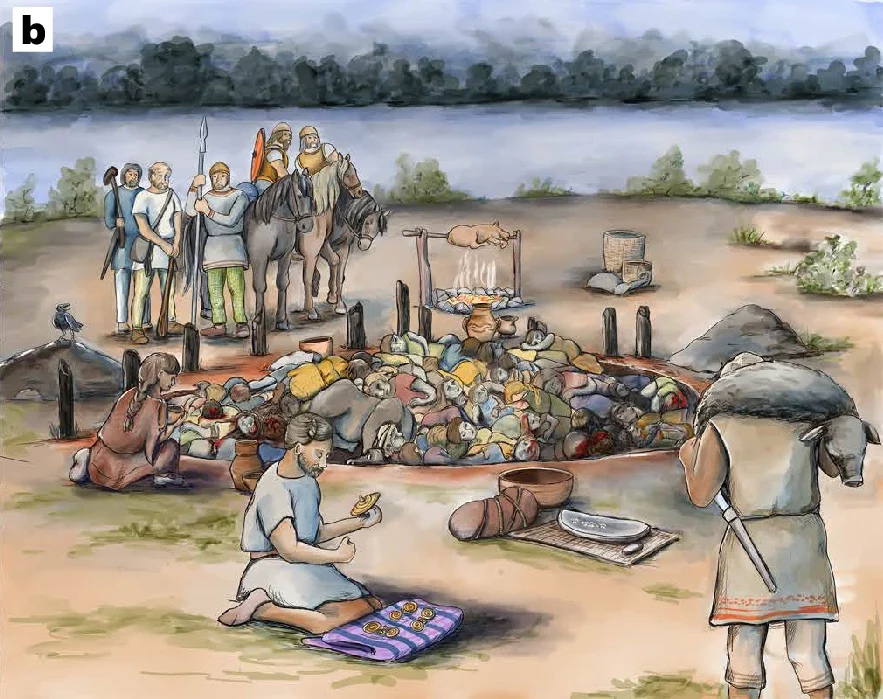
A major interdisciplinary study led by researchers including scholars from Leiden University has uncovered strong evidence of deliberate, gender- and age-targeted mass violence in prehistoric Europe. Published in Nature Human Behaviour, the research centers on one of the continent’s largest prehistoric mass graves, found at Gomolava in northern Serbia.
The grave contained 77 individuals buried together in a carefully prepared pit dating to around 800 BCE. Bioarchaeological analysis revealed an unusual demographic pattern: the majority of the victims were women and children. More than 70% of those whose sex could be determined were female, and over half were juveniles between one and twelve years old. This imbalance stands out sharply compared to other prehistoric European mass graves, which typically show more even male–female ratios.
Researchers argue this was not random slaughter. Instead, the demographic profile points to selective violence aimed at individuals central to lineage continuity and community stability.
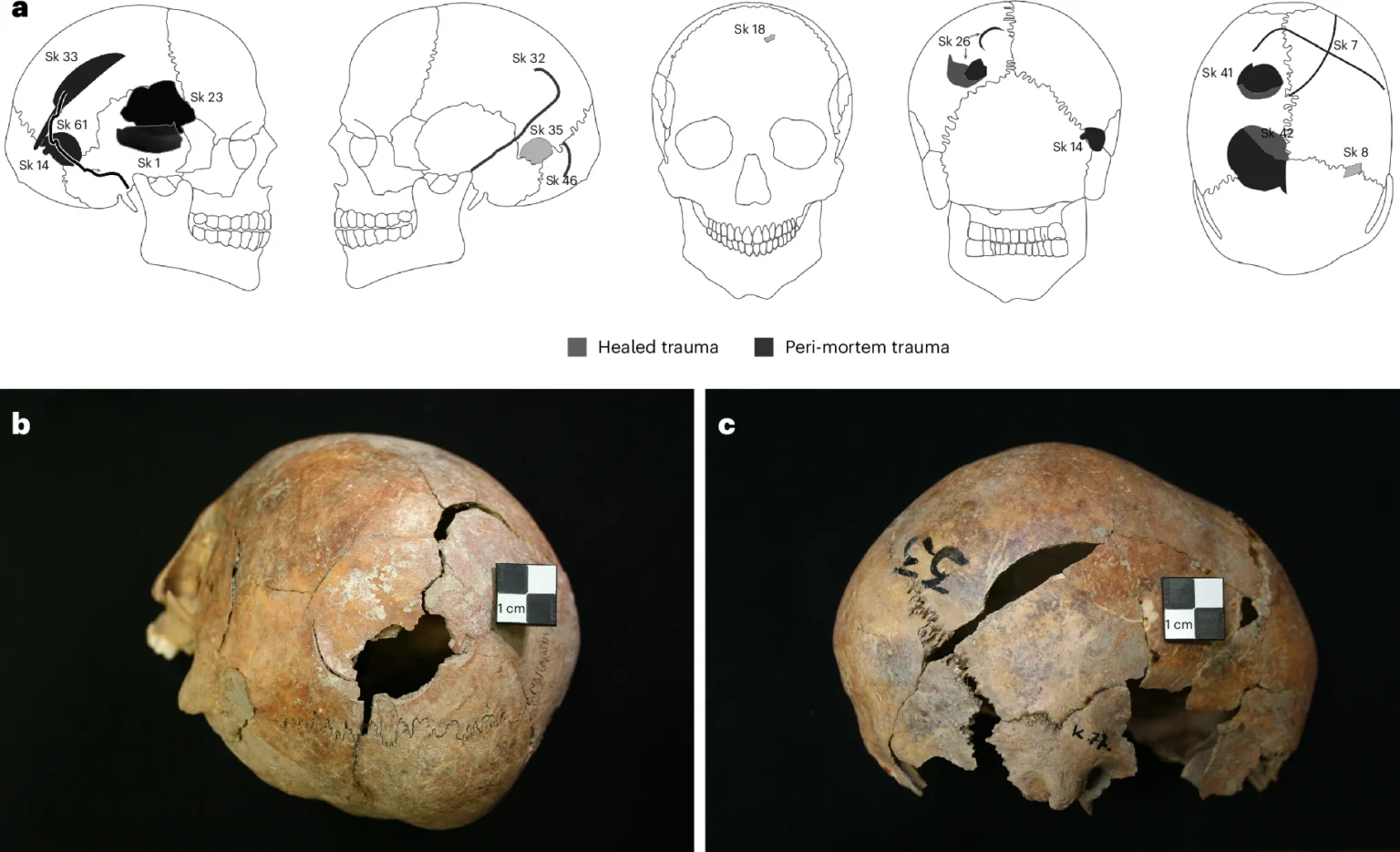
Skeletal analysis, CT scans, and trauma studies revealed clear signs of violent deaths. Many individuals suffered perimortem injuries—especially blunt force trauma and sharp-force wounds to the head—indicating coordinated attacks. Although only about 20% of skeletons preserved direct evidence of injury, researchers caution that many lethal injuries leave no trace on bone. Earlier suggestions of disease as a cause were ruled out after pathogen DNA testing found no evidence of epidemic infection.
The team combined osteology, radiocarbon dating, ancient DNA, isotopic analysis, and imaging techniques to reconstruct both the event and its broader context. Genetic testing showed that most individuals were not closely related; only one immediate family group—a mother and her two daughters—was identified. Strontium isotope data indicated many had grown up in different locations, some dozens of kilometers apart. Carbon and nitrogen isotopes revealed varied diets, reinforcing the conclusion that the victims came from multiple communities.
Together, the evidence suggests this was not the destruction of a single settlement, but a cross-regional episode of organized violence.
The massacre occurred during a turbulent ninth century BCE landscape, following the collapse of major Bronze Age political systems. Communities in the South Pannonian Plain were resettling fortified tells, establishing enclosed settlements, and renegotiating power structures. Gomolava, a long-occupied mound near the River Sava, held ancestral and strategic significance within these shifting networks.
Senior author Hannes Schroeder of the University of Copenhagen emphasized that systematically targeting women and children appears to have been a deliberate strategy designed to fracture lineages and weaken social resilience.
Rather than chaotic violence, the evidence points to calculated structural aggression—an act intended not just to kill, but to destabilize entire communities.