An international team of researchers has revealed striking new insights into one of Europe’s largest prehistoric mass killings, using advanced protein analysis on human tooth enamel preserved for around 2,800 years.
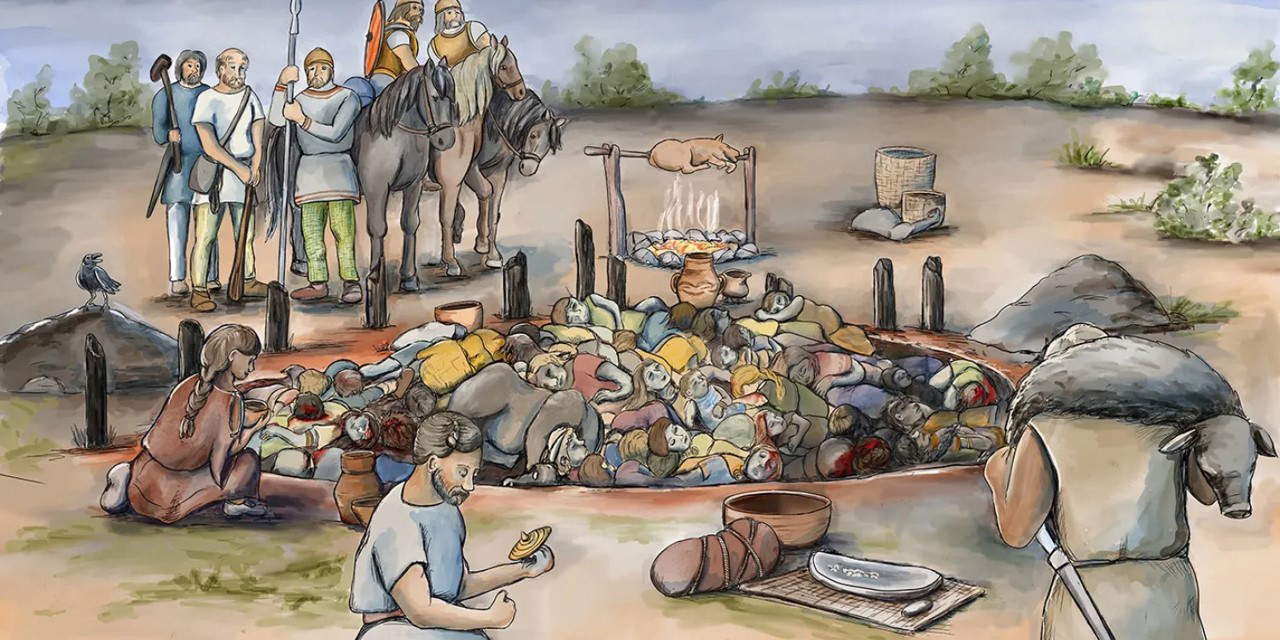
The study, published in Nature Human Behaviour, focused on a mass grave at Gomolava in the south Carpathian Basin. More than 77 individuals were buried in a single-event grave, and analysis confirmed that the vast majority were women and children—a demographic pattern rarely seen in European prehistory, highlighting unprecedented gender- and age-selective violence during the Iron Age.
The research was led collaboratively by experts from University College Dublin, the University of Edinburgh, the University of Copenhagen, Leiden University, University of Kiel, and the Museum of Vojvodina, with contributions from scholars across Europe.
Bioarchaeological evidence, including protein analysis, isotopes, and genetic studies, revealed that the victims were largely unrelated and grew up in different settlements, suggesting the killings were part of a broad regional conflict rather than a localized incident. Remarkably, the grave also contained personal belongings jewelry, bronze ornaments, ceramic vessels and the remains of up to 100 animals, indicating careful preparation and commemoration of the victims.
Researchers from the University of Nottingham, including Professor Rob Layfield, Barry Shaw, and Professor Neil Oldham, specialized in detecting molecular traces of the X and Y chromosomes in the tiny fragments of ancient tooth enamel. Tooth enamel, the hardest substance in the human body, preserves proteins exceptionally well, allowing the team to extract molecular information thousands of years old.
Professor Layfield emphasized the importance of developing and simplifying these analytical methods so that the wider archaeological community can access them to answer similar historical questions.
Dr Linda Fibiger of the University of Edinburgh highlighted the wider significance: “The brutal killings and subsequent commemorating of the event can both be read as a powerful bid to balance power relations and assert dominance over land and resources. The study sheds new light on targeted gender and age selective killings as a way of enacting mass violence and assertion of power in prehistoric Europe.”
The project was supported by the European Research Council (ERC) grant “The Fall of 1200 BC,” while the Nottingham work received funding from the Arts and Humanities Research Council (AHRC) under the Research Infrastructure for Conservation and Heritage Science (RICHeS) programme.
This study not only illuminates the scale and sophistication of Iron Age violence in Europe but also demonstrates how cutting-edge biomolecular techniques can uncover previously inaccessible details about prehistoric lives and deaths.