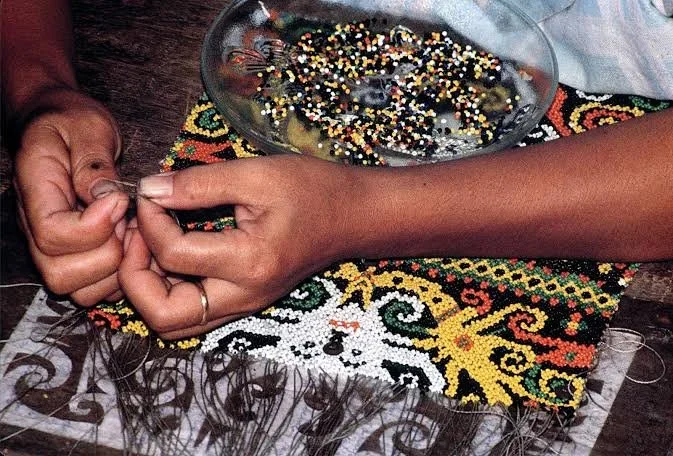
Beadwork has played an important role in personal decoration, cultural expression, trade, and social identity across many societies. Beads made from shell, stone, bone, glass, ceramic materials, and other substances have been used in necklaces, bracelets, clothing, ceremonial objects, and decorative accessories. In coastal villages, access to marine resources could support the production of shell beads and other ornaments, while maritime exchange might introduce materials from distant regions. Archaeological evidence of beadwork production can therefore illuminate both local craft activities and the wider economic networks connecting coastal communities.
The production of beads often involves several stages. Raw materials must first be collected or acquired, then shaped, drilled, polished, and sometimes decorated. The techniques depend on the material being used. Shell may be cut into blanks and ground into a desired shape, while stone beads may require repeated abrasion and drilling. Glass beads can involve specialized heating and shaping techniques, depending on the period and production tradition. Each stage can leave distinctive traces, including unfinished pieces, broken beads, drilling debris, polishing materials, and tools.
Archaeologists can use these production remains to distinguish manufacturing sites from locations where finished beads were simply worn, traded, or discarded. A settlement containing many finished ornaments may have participated in bead consumption or exchange without producing them locally. By contrast, concentrations of unfinished beads, raw materials, drilling fragments, and specialized tools provide stronger evidence of production. The spatial arrangement of these remains can help researchers identify particular working areas within a village.
Coastal environments may have provided access to shell species suitable for beadmaking. However, not every shell found at a coastal site was used for ornament production. Shells could have been collected for food, used as tools, or deposited naturally by marine processes. Researchers must examine modifications such as perforations, grinding, shaping, and polishing to determine whether a shell was intentionally transformed into a bead. Microscopic analysis can sometimes reveal tool marks that indicate how the object was manufactured.
The circulation of bead materials can also reveal connections between coastal communities and distant trading networks. Beads made from materials unavailable locally may have arrived through exchange, migration, or other forms of movement. Chemical and mineralogical analysis can help identify the origins of some raw materials, although provenance is not always precise. If similar bead styles appear at several sites, researchers may investigate whether they reflect shared production traditions, trade, imitation, or independent development.
Beads could carry meanings beyond their physical value. They might communicate age, social affiliation, wealth, marital status, religious beliefs, or membership in a particular community. Their significance would depend on local customs and the context in which they were worn or exchanged. A bead found in a burial, for example, may have been included as personal property, a ritual offering, or part of a broader funerary arrangement. Its meaning cannot be established from its material or shape alone.
Gender is an important but difficult dimension of beadwork research. In some societies, particular forms of ornament production or wearing may have been associated with women, men, or specific social roles. However, archaeologists should not assume that beadmaking was universally women's work or that the presence of beads in a burial identifies the gender of the person who produced them. Craft activities may have been shared across households, organized through apprenticeships, or performed by specialists whose roles changed over time.
The concept of a gendered economy helps researchers examine how production, exchange, and access to resources were organized among people with different social responsibilities. If independent evidence suggests that certain individuals or groups controlled bead production or trade, researchers can investigate how this work contributed to household income and community relationships. Yet identifying such patterns requires more than finding beads in a particular type of domestic space. Architectural context, burial evidence, historical sources, and comparisons with other crafts may all be necessary.
The scale of production is another important question. Some households may have made beads for personal use or local exchange, while specialized workshops could have produced larger quantities for distribution beyond the village. Repeated production debris, standardized manufacturing techniques, and evidence of substantial raw-material supply may suggest more intensive activity. Even so, large numbers of beads can accumulate through long-term use or repeated deposition, so production volume must be evaluated in relation to chronology and context.
Archaeological science can help reconstruct the techniques involved. Microscopic examination of drill holes may reveal whether holes were made from one side or both, while surface analysis can identify polishing and abrasion. Experimental replication can test how different tools and materials produce particular marks. These findings may help researchers identify technological traditions and compare manufacturing practices between coastal communities.
Beadwork also connects material culture with the movement of people and ideas. Changes in bead styles may reflect new trade contacts, shifting preferences, technological innovations, or cultural interaction. The arrival of imported beads does not necessarily mean that a community adopted the social meanings associated with them elsewhere. Local people could reinterpret foreign materials and incorporate them into their own traditions.
The archaeology of beadwork production in coastal villages offers a way to investigate the relationship between craft skills, local resources, trade, and social identity. By studying raw materials, manufacturing debris, finished ornaments, and their archaeological contexts, researchers can explore how beads were made and exchanged. A careful approach to gender interpretation is essential, allowing archaeologists to investigate differences in labor and social roles without imposing assumptions that the evidence cannot support.