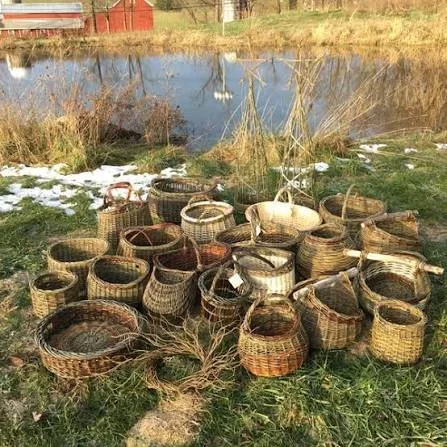
Basketry has been one of the most versatile forms of craft production throughout human history. Woven containers, mats, traps, screens, and other objects could be made from flexible plant materials gathered from nearby environments. Willow, in particular, has characteristics that make it suitable for weaving when its branches are prepared correctly. In wetland landscapes, where suitable plants may have been abundant, communities could develop specialized basketry traditions that supported domestic life, fishing, farming, storage, and trade. Archaeological investigations of possible willow weaving workshops can reveal how people transformed renewable plant resources into useful products.
Willow branches are generally flexible when young and can be processed to create strips or rods suitable for weaving. Depending on the species and intended product, branches may be harvested, sorted, soaked, peeled, or otherwise prepared before use. Skilled craftspeople can manipulate these materials into strong structures by interlacing them in repeated patterns. Different weaving techniques produce different textures and levels of flexibility, allowing baskets to be adapted for carrying heavy loads, storing food, collecting plants, or transporting goods.
Wetlands could provide favorable conditions for obtaining weaving materials. Riverbanks, marshes, and other moist environments may support willow growth, although the distribution of suitable species depends on local climate, hydrology, and soil conditions. Wetland communities could also obtain reeds, rushes, grasses, and other fibers for related crafts. The availability of several plant materials would allow craftspeople to select the most appropriate resources for each object.
Identifying an ancient basketry workshop is difficult because plant materials usually decay unless preservation conditions are favorable. In waterlogged, oxygen-poor deposits, woven objects may survive for long periods. In dry or well-aerated soils, however, baskets and willow rods may disappear almost completely. Archaeologists may therefore encounter indirect evidence such as impressions left in clay, fragments of plant fibers, concentrations of prepared branches, specialized working areas, or tools associated with plant processing.
Plant identification can help determine which materials were used. Microscopic examination of preserved wood may reveal anatomical features that distinguish willow from other woody plants, although species-level identification is not always possible. Botanical remains recovered through careful excavation can also indicate which plants grew near the site. Researchers must distinguish raw materials gathered for weaving from vegetation that entered the deposit naturally through flooding, wind, or other environmental processes.
The organization of a workshop may be reflected in the distribution of materials and equipment. Repeated concentrations of prepared rods, cutting tools, discarded plant fragments, and finished basketry could suggest a place where weaving occurred regularly. If these materials are found within a defined working area, researchers may be able to reconstruct the stages of production, from gathering and preparation to weaving and repair. Nevertheless, plant debris can accumulate during ordinary household activity, so the presence of basketry remains does not necessarily indicate a specialized workshop.
Impressions left by woven materials can be especially informative. When wet clay or other soft substances harden around a basket, the weave may leave a recognizable pattern on the surface. Such impressions can preserve details about the direction of the fibers, the spacing of the rods, and the construction technique. They may also reveal that baskets were used in activities beyond carrying objects, such as lining containers, supporting clay during production, or separating materials.
Experimental archaeology helps researchers interpret these traces. By recreating baskets with different plant materials and weaving techniques, researchers can compare the resulting impressions and structural patterns with archaeological examples. Experiments can also explore how different harvesting and preparation methods affect flexibility and durability. Although experimental results cannot prove that an ancient craftsperson used a particular method, they can help identify techniques consistent with the surviving evidence.
Basketry production may have been closely connected to other economic activities. Farmers could use baskets for gathering crops, while fishing communities might manufacture traps, nets, and containers suited to wet environments. Traders could use woven packaging to transport food or other goods. A workshop's products might therefore support several parts of the local economy, even if the craft itself required relatively simple equipment.
The social organization of basketry production is another important consideration. Weaving skills could be transmitted within households or learned through apprenticeship and observation. Some communities may have produced baskets mainly for their own needs, while others may have developed specialized production for exchange. Differences in object quality, weaving complexity, and the distribution of finished products may offer clues about the scale of production, although they cannot independently identify the gender, status, or identity of individual craftspeople.
Wetland environments can also preserve evidence of the relationship between craft production and landscape management. Repeated harvesting may have influenced the availability of useful plants, while seasonal flooding could affect when branches were accessible. Communities with detailed knowledge of local vegetation could plan harvesting around growth cycles and environmental conditions. Such practices demonstrate how craft traditions depended on ecological knowledge as well as manual skill.
The archaeology of willow weaving workshops highlights the importance of perishable technologies that are often underrepresented in the archaeological record. Through botanical analysis, preserved basketry, impressions, tools, and spatial evidence, researchers can investigate how communities gathered plant materials and organized production. Even where the woven objects themselves have disappeared, their traces can reveal the role of basketry in domestic life, wetland economies, and the development of specialized craft knowledge.