The Spatial Signatures of Itinerant Metalworkers in Rural Landscapes
Metalworking was an important craft in many ancient societies, providing tools, weapons, ornaments, agricultural equipment, and objects used in domestic and religious activities. While some metalworkers operated permanent workshops in towns or established settlements, others may have traveled between rural communities to repair objects, produce small items, or provide specialized services. These mobile craftspeople, often described as itinerant metalworkers, present a particular challenge for archaeologists because their work may have left only temporary traces in the landscape.
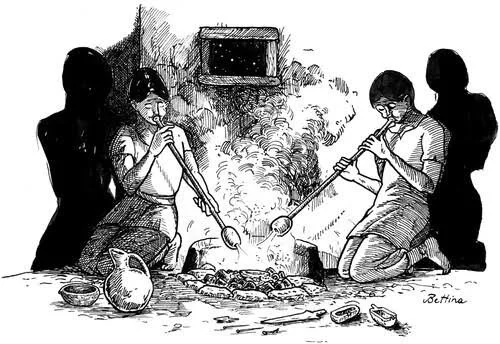
Unlike a permanent workshop, a temporary metalworking site may contain few substantial structures. A craftsperson could establish a small hearth, prepare a working surface, use portable tools, and leave after completing a particular task. Such an activity might occur in a village courtyard, beside a farmstead, near a rural gathering place, or within a temporary shelter. After the worker departed, the site could return to its ordinary use, leaving behind only small fragments of production debris.
The spatial signatures of these activities can include slag, charcoal, metal droplets, furnace or hearth remains, fragments of crucibles, tuyère pieces, and discarded metal objects. Slag forms during certain metallurgical processes and can provide evidence of heating, smelting, or metalworking. Small droplets of metal may result from casting or hammering, while crucible fragments can indicate that metals were heated in specialized containers. Tuyères, which are tubes or fittings used to direct air into a fire, may indicate installations that required controlled airflow.
However, these materials do not all indicate the same process. Smelting involves extracting metal from ore, whereas smithing generally involves shaping or repairing metal that has already been produced. Casting requires melting metal and pouring it into a mold, while other activities may involve heating, joining, or finishing objects. The presence of slag or a hearth must therefore be interpreted in relation to the materials and equipment found nearby.
The location of metalworking debris can provide clues about how production was organized. Small concentrations of charcoal, metal fragments, and heat-affected soil near a rural dwelling might indicate a short period of craft activity. Several isolated concentrations distributed across a settlement could suggest that metalworking took place in different locations or at different times. Yet such a pattern does not automatically prove that itinerant workers were involved. Multiple household workshops, discarded material moved from its original location, or repeated use of the same area could create a similar distribution.
Archaeologists can investigate these possibilities by mapping artifacts and features in detail. Geographic information systems allow researchers to compare the distribution of metalworking remains with houses, roads, water sources, agricultural areas, and communal spaces. If production traces occur at several settlements along a plausible travel route, the pattern may support the possibility of mobile craft services. Reliable dating is essential, because sites that appear connected geographically may have been active in entirely different periods.
Metallurgical analysis can help identify the type of work performed. Researchers may examine the chemical composition of slag, crucibles, metal fragments, and finished objects to determine which materials were processed. Microscopic examination can reveal evidence of heating, hammering, corrosion, and other manufacturing processes. Such analysis may also distinguish local production from the repair or recycling of imported metal objects.
The raw materials used by a metalworker can provide further information about the relationship between rural settlements and wider economic networks. Iron, copper, tin, lead, and other metals were obtained through different geological and commercial systems. A craftsperson might carry finished metal stock, recycle broken objects, or obtain materials from local customers. The presence of metal from a distant source would not necessarily mean that the worker traveled to that source; materials could have passed through several intermediaries before reaching a rural workshop.
Itinerant metalworking may have offered practical advantages to communities that lacked permanent specialists. Farmers needed tools repaired, households required metal fittings, and local authorities might need equipment maintained. Traveling craftspeople could provide these services without requiring every settlement to support a full-time metalworker. In return, they might receive food, lodging, raw materials, payment, or other forms of compensation, depending on the economic practices of the society.
The social position of itinerant craftspeople remains difficult to reconstruct archaeologically. Metalworking required specialized knowledge, but the status of practitioners varied across cultures and periods. Some may have been independent craftspeople, while others could have been attached to larger households, estates, military organizations, or political authorities. The archaeological evidence may reveal the nature of their work more clearly than their legal or social position.
Seasonality could also influence mobile craft activity. Agricultural communities might have had greater demand for repairs before planting or harvesting, while certain gatherings and markets could bring customers together at particular times of the year. However, such patterns must be demonstrated through archaeological and historical evidence rather than assumed from the rural setting alone.
The study of itinerant metalworkers illustrates how small concentrations of debris can reveal connections between technology and movement. By combining spatial analysis, metallurgical science, chronology, and settlement archaeology, researchers can investigate whether metalworking occurred in temporary locations and how those activities supported rural communities. Although proving that a particular craftsperson traveled from place to place may be difficult, the distribution of production evidence can help reconstruct the broader systems through which technical knowledge and metal goods circulated beyond permanent urban workshops.