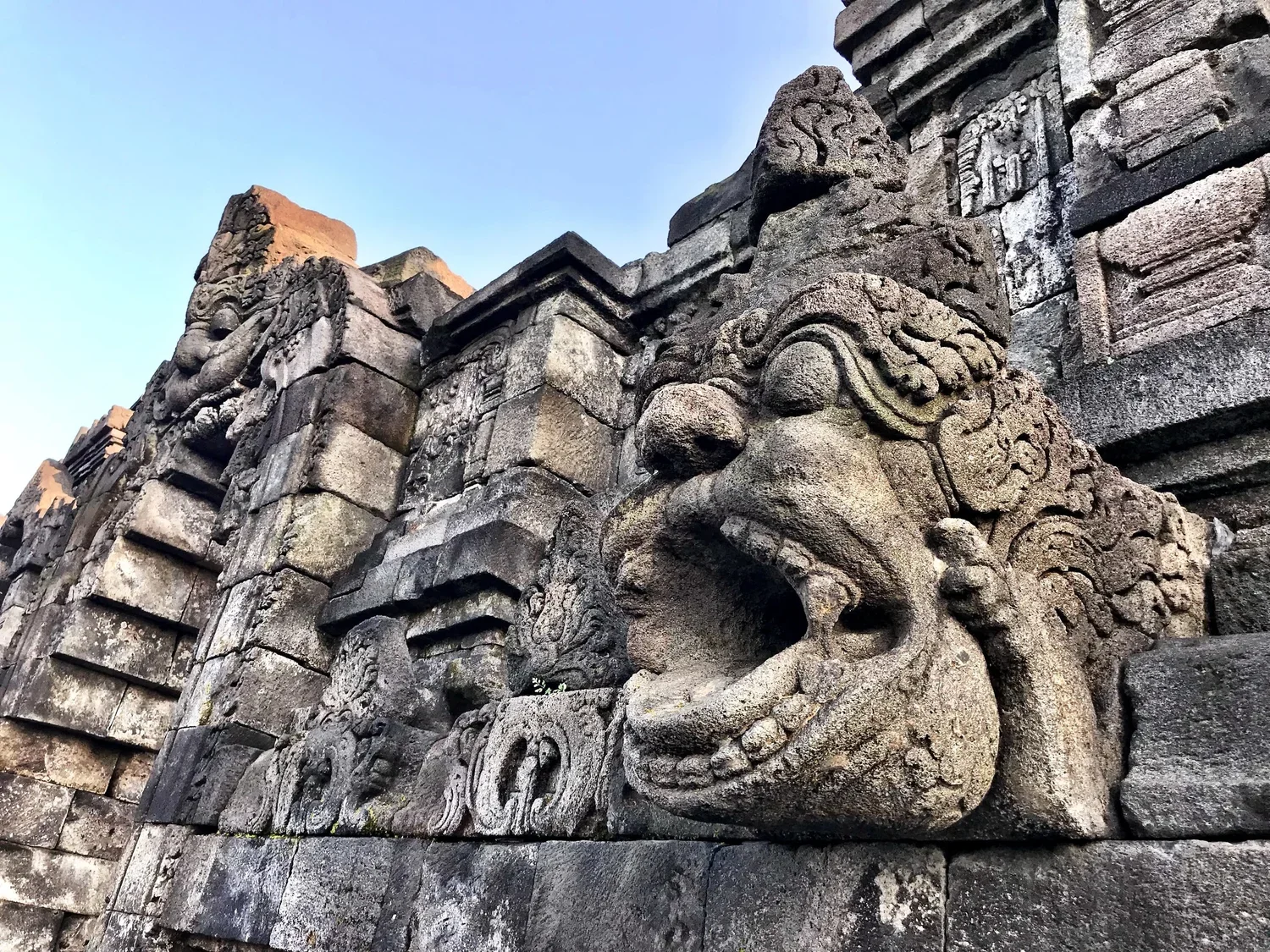
Candi Borobudur, built in Central Java during the 8th and 9th centuries under the Sailendra Dynasty, is the largest Buddhist monument in the world. Constructed as a colossal step-pyramid mandala out of millions of andesite stone blocks, it features nine stacked platforms that pilgrims ascend pathwise to simulate the journey to enlightenment. While its architectural scale is famous, its deep historical value is preserved in its 2,672 individual narrative relief panels. These relief carvings wrap around the lower galleries, covering a surface area of over 2,500 square meters.
These stone panels are organized into distinct narrative cycles that guide the viewer as they perform ritual circumambulation (pradaksina). The journey begins at the hidden base with the Kamavibhangga, which illustrates the law of karma by depicting scenes of daily life, earthly desires, and their subsequent punishments or rewards in the afterlife. Higher levels present the Lalitavistara, a highly detailed biography of the historical Buddha from his descent from heaven to his first sermon, followed by the Gandavyuha, which follows the young seeker Sudhana on his quest for ultimate wisdom.
Beyond their spiritual meaning, the Borobudur reliefs function as an invaluable visual encyclopedia of 9th-century Javanese society. Because the ancient artists modeled their historical scenes on the world around them, the panels provide precise depictions of Javanese palace architecture, domestic village houses, traditional clothing, musical instruments, and agricultural tools. One famous panel depicts a large, double-outrigger maritime vessel—now known as the "Borobudur Ship"—confirming Java's role as a major maritime trade superpower in the ancient Indian Ocean network.