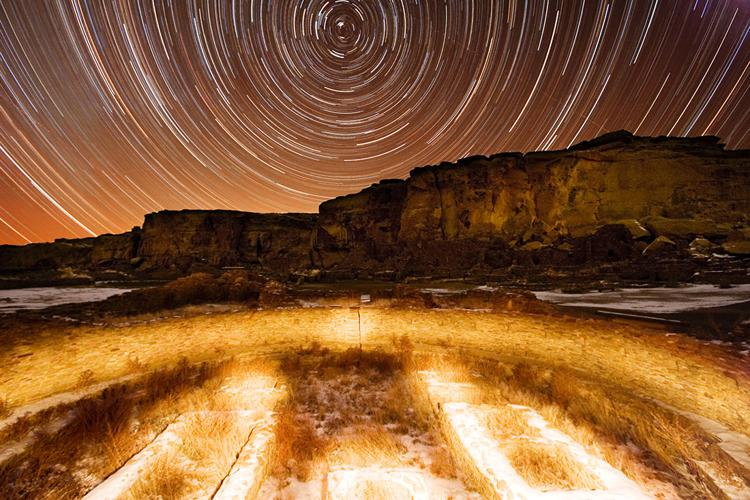
Chaco Canyon, located in the high desert of northwestern New Mexico, was the ceremonial and economic heart of the Ancestral Puebloan culture between 850 and 1150 CE. While the "Great Houses" like Pueblo Bonito are architectural marvels, their true genius lies in their relationship with the sky.
The Chacoans didn't just live in the canyon; they turned the entire landscape into a massive, functioning calendar, aligning their massive stone structures with the complex cycles of the Sun and the Moon.
1. The Solar Marker: The Sun Dagger
The most famous astronomical feature at Chaco is the Sun Dagger, located at the top of Fajada Butte. It consists of three large stone slabs leaning against a cliff face, positioned in front of two spiral petroglyphs.
Solstice Precision: On the Summer Solstice, a single "dagger" of light pierces the center of the larger spiral. On the Winter Solstice, two daggers of light perfectly frame the large spiral.
Equinox Alignment: On the Spring and Autumn Equinoxes, a smaller light dagger passes exactly through the center of the smaller spiral.
The Looming Loss: Unfortunately, due to erosion and ground shifting caused by modern foot traffic in the 1980s, the slabs have moved slightly, and the "Sun Dagger" no longer aligns as perfectly as it once did.
2. Lunar Major Standstill: A 18.6-Year Cycle
What sets Chaco Canyon apart from many other ancient sites is its obsession with the Moon. Unlike the Sun, which has a simple annual cycle, the Moon follows a complex 18.6-year cycle known as the Lunar Major Standstill.
The Chimney Rock Alignment: At the Great House of Chimney Rock (a Chacoan outlier), the Moon rises exactly between two natural rock pillars only during the Lunar Major Standstill.
Architectural Records: Analysis of several Great Houses shows that their walls were aligned to the moon's maximum and minimum rising and setting points. This suggests the Chacoans possessed a multi-generational record-keeping system, as no single person could master this cycle without decades of observation.
3. Pueblo Bonito: The Cardinal Axis
Pueblo Bonito, the largest of the Great Houses with over 600 rooms, is a masterclass in cardinal alignment.
The Midday Line: The main north-south wall of Pueblo Bonito is aligned so precisely that at solar noon, the wall casts no shadow. This wall also perfectly bisects the "D-shaped" structure.
The East-West Alignment: The front wall of the complex aligns perfectly with the sunrise and sunset on the Equinoxes. Standing on the central axis, an observer would see the sun rise and set directly along the line of the building's facade.
4. The Great North Road
The Chacoans constructed an elaborate system of "roads," but these were not for standard travel—they were often perfectly straight, ignoring the terrain.
Directional Intent: The Great North Road runs almost perfectly north for 35 miles from Chaco Canyon. It doesn't connect to any major trade center; instead, it leads toward the northern horizon.
Symbolic Path: Archaeologists believe this was a "spirit road," representing the path to the Sipapu (the place of origin in Puebloan cosmology), further emphasizing that for the Chacoans, the "correct" direction was determined by the stars and the cardinal points.
5. The "Kiva" and the Cosmic Circle
The Kiva is a circular, semi-subterranean ceremonial room found throughout Chaco. The largest, Great Kiva Casa Rinconada, is a textbook of astronomical engineering.
The Summer Solstice Window: On the morning of the Summer Solstice, a beam of light from a specific window strikes a unique niche in the interior wall.
Acoustics and Astronomy: Much like the Neolithic stone circles, these kivas likely used sound and light together to create a sensory experience that synchronized the community with the movements of the heavens.
6. Why the Sky?
For the Ancestral Puebloans, astronomy was a survival skill. In the harsh environment of the San Juan Basin, knowing the exact day to plant or harvest was the difference between life and death. However, the sheer precision of Chaco suggests it was also a power move by the elite—if the priests could "predict" the sun and moon, they could claim divine legitimacy for the city’s role as a pilgrimage center.
The abandonment of Chaco Canyon around 1150 CE coincided with a massive, fifty-year drought. It seems that when the "celestial clock" failed to bring the rains, the social contract of Chaco finally broke.