Viking runestones are far more than just "tombstones." They were the social media, legal deeds, and public monuments of the Viking Age (c. 800–1100 CE). While the Vikings are often portrayed as a culture of oral tradition, these thousands of carved stones across Scandinavia—particularly in Sweden—provide a permanent, first-person record of their lives, travels, and beliefs.
1. The Anatomy of a Runestone
A typical runestone follows a remarkably consistent formula, making them a standardized form of public communication.
The Commemoration: Most begin with "[Name] raised this stone in memory of [Name]."
The Relationship: They specify the bond (e.g., "his brother," "her husband," "a good comrade").
The Deed: This is where the personal story shines—detailing a successful trade voyage, a death in battle, or even the building of a bridge.
The Prayer: Later stones often end with a Christian appeal: "May God help his soul."
2. The Travel Logs: "He Died in the East"
Runestones serve as a map of the Viking world. They are often categorized by where the subject traveled or died:
The Greece Runestones: Mentioning members of the Varangian Guard who served the Byzantine Emperor in Constantinople (which the Vikings called Miklagard).
The England Runestones: Commemorating those who took part in the Danegeld (extorting money from English kings) or fell in battles across the British Isles.
The Ingvar Runestones: A tragic group of nearly 30 stones in Sweden dedicated to men who died during a disastrous expedition into the Caspian Sea region (the "Land of the Saracens") led by Ingvar the Far-Travelled.
3. The Art of the Carver: The Younger Futhark
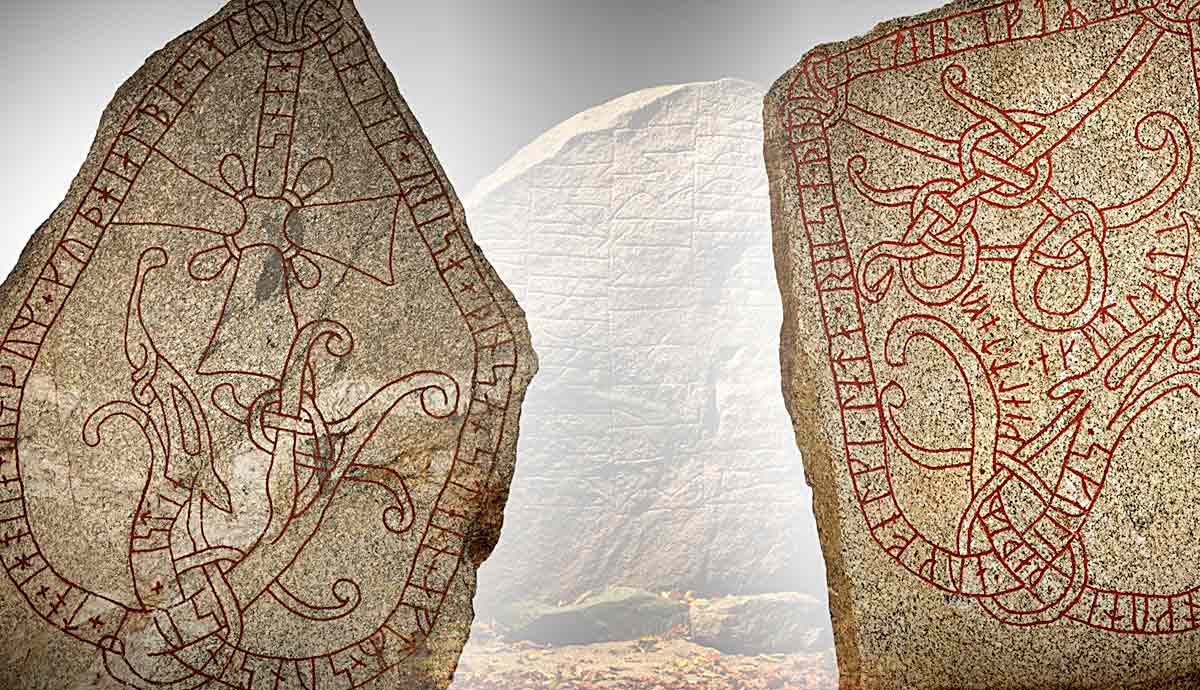
Runestones were not just written; they were designed. The text was usually carved inside a serpent-band (a long, winding dragon or snake body) that framed the stone.
The Alphabet: They used the Younger Futhark, a 16-character alphabet. Because 16 letters weren't enough to represent all sounds, one rune often stood for multiple sounds (e.g., 'u' could represent u, o, y, or ø), making them a phonetic puzzle for modern linguists.
The Colors: Today we see grey granite, but originally, these stones were vibrantly painted in red, black, and white. The paint was made from minerals like ochre and lead, making the stones visible from great distances.
The Signatures: Famous "Runemasters" like Öpir or Fot actually signed their work, proving that skilled carvers were highly sought-after professionals.
4. The Transition: From Thor to Christ
Runestones capture the exact moment Scandinavia shifted from Norse Paganism to Christianity.
Pagan Symbols: Early stones feature Thor’s Hammer (Mjölnir) or scenes from myths, such as Sigurd the Dragon Slayer.
The Great Cross: As the 11th century progressed, the center of the serpent-band was increasingly filled with an ornate Christian cross.
The Jelling Stone: Commissioned by Harald Bluetooth, this massive stone is often called "Denmark's Baptismal Certificate" because it explicitly claims he "made the Danes Christian."
5. Women on the Stones
Contrary to the "all-male warrior" stereotype, women appear frequently on runestones, often as powerful figures.
The Inheritors: Stones like the Estrid stones show that women had legal rights to inherit property and manage estates while their husbands were away.
The Bridge Builders: Many stones mention women commissioning the building of bridges. In the Viking Age, building a bridge was considered a "pious work" that helped the soul of a deceased loved one cross into the afterlife—and it served the practical purpose of improving local infrastructure.
6. Reading Between the Lines
Runestones offer rare glimpses into Viking personality. Some stones praise a man for being "the least stingy with food," highlighting the cultural importance of hospitality. Others describe a fallen warrior as "the best of land-holders," showing that even in a culture of raiders, being a successful, fair farmer was a point of immense pride.
The runestones were meant to stand "as long as the stone lives," and they have succeeded. They turn the "anonymous Viking" into an individual with a name, a family, and a specific legacy.