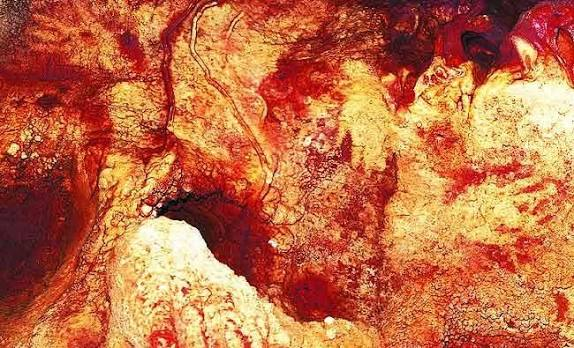
Cueva de Maltravieso, located in Cáceres in western Spain, is one of the most remarkable prehistoric cave art sites in Europe. The cave is particularly famous for its large collection of hand stencils, created when prehistoric people placed their hands against a cave wall and sprayed or blew pigment around them.
The result was a striking negative image: the outline of a human hand preserved against the stone.
Some scientific dating has suggested that certain hand stencils and related red pigment features are older than approximately 64,000 years. If this interpretation is correct, the images would predate the widespread arrival of Homo sapiens in western Europe.
This would make Neanderthals the most likely creators.
The possibility has made Cueva de Maltravieso one of the central sites in the debate over whether Neanderthals possessed symbolic and artistic traditions.
The Cave and Its Archaeological Importance
Cueva de Maltravieso is located in Extremadura, a region of western Spain with a rich prehistoric landscape.
The cave contains numerous examples of prehistoric imagery, including:
hand stencils,
red painted marks,
geometric forms,
and other symbolic images.
The abundance of hand representations makes the site particularly important.
Hands are among the most direct forms of prehistoric imagery because they preserve a physical connection between the artist and the image.
A painted bison represents an observed animal.
A hand stencil, however, records the actual outline of a human hand.
For modern observers, this creates a particularly powerful connection with prehistoric individuals.
How Were Hand Stencils Created?
The basic process of creating a hand stencil involved placing a hand against the rock surface.
Pigment was then applied around it.
When the hand was removed, the covered area remained unpainted, producing a negative silhouette.
The pigment may have been applied by:
blowing powdered pigment directly,
using the mouth to spray a mixture,
blowing pigment through a hollow tube,
or using another spraying method.
The technique required deliberate preparation.
The artist needed:
A suitable pigment.
A method of preparing it.
A suitable cave surface.
A source of illumination.
A technique capable of applying pigment around the hand.
The resulting image was therefore the product of intentional planning.
The Significance of Red Pigment
Many of the hand stencils at Maltravieso were created using red pigments.
Red ochre, composed largely of iron oxides, was widely available in prehistoric environments and could be processed into powder.
The color red appears repeatedly in prehistoric archaeology.
It has been found in:
cave paintings,
burials,
decorated objects,
body-related practices,
and other symbolic contexts.
The widespread use of red does not necessarily mean that it had the same meaning everywhere.
Different prehistoric communities may have used the color for different purposes.
Nevertheless, its repeated selection suggests that pigments were culturally important materials.
Dating the Hand Stencils
The proposed early dates at Maltravieso are based primarily on scientific analysis of mineral deposits associated with painted surfaces.
Thin carbonate formations can develop on cave walls over long periods.
If a mineral layer forms on top of a painted image, the underlying artwork must be older than that layer.
Some uranium-thorium dating results have provided minimum ages of more than 60,000 years for certain painted features.
The famous date of approximately 64,000 years is particularly important because it would place the artwork before Homo sapiens became widespread in western Europe.
Why the Date Matters
The identity of the artist depends heavily on chronology.
If the hand stencil was created after modern humans became established in the region, Homo sapiens could be the creator.
If it was demonstrably created tens of thousands of years earlier, Neanderthals become the most likely candidate.
This makes accurate dating essential.
The debate is not simply about the age of a painting.
It concerns the cognitive and cultural capabilities of an entire human population.
Neanderthals as Artists
Traditional portrayals often described Neanderthals as primitive relatives of modern humans who lacked sophisticated symbolic behavior.
Modern archaeology has challenged this stereotype.
Neanderthals:
manufactured complex stone tools,
controlled fire,
hunted large animals,
adapted to diverse environments,
used pigments,
and may have produced ornaments and symbolic markings.
The hand stencils of Maltravieso, if securely attributed to Neanderthals, would provide especially powerful evidence because they involve deliberate representation.
Creating a hand stencil means using one's own body as part of the artistic process.
Why Hands Were Important
The exact meaning of prehistoric hand stencils is unknown.
However, researchers have proposed several possibilities.
Hands may have represented:
personal identity,
group membership,
ritual participation,
communication,
social presence,
or a symbolic connection with a particular place.
A hand stencil could also be understood as a form of physical trace.
The person who created it may have wanted to leave evidence that they had entered and interacted with that particular space.
It is also possible that hand images had meanings that modern researchers cannot reconstruct.
The Cave as a Symbolic Space
Creating art inside a cave required people to enter a dark environment.
This was not an activity that occurred accidentally.
People needed to carry light and prepare materials.
The journey itself may have been meaningful.
Some cave art is located in areas that are difficult to reach, suggesting that the physical environment was part of the experience.
The underground world may have had cultural or symbolic importance.
However, archaeologists must remain cautious.
A difficult location does not automatically prove the existence of religion or ritual.
It does demonstrate deliberate human movement into spaces beyond those necessary for ordinary daylight activities.
Individual Variation in Hand Stencils
At prehistoric sites, hand stencils can potentially preserve information about different individuals.
The size and shape of hands may vary according to:
age,
biological development,
and individual anatomy.
However, identifying the exact sex or identity of an individual from a stencil alone is extremely difficult.
Earlier attempts to classify prehistoric hand stencils simply as male or female based on finger proportions are now treated with considerable caution.
Human hand shapes vary substantially.
Maltravieso in the History of Cave Art
The hand stencils of Maltravieso belong to a much broader global tradition.
Hand images have been discovered in prehistoric caves in:
Europe,
Indonesia,
Australia,
and other regions.
This demonstrates that the human impulse to leave bodily marks on rock surfaces developed in different cultural contexts.
The technique is simple in concept but powerful in effect.
A prehistoric individual could place a hand against stone and leave a recognizable human presence that survived for tens of thousands of years.
Conservation and Preservation
Cave art is extremely fragile.
Changes in humidity, temperature, and carbon dioxide can affect ancient surfaces.
Human contact can also cause serious damage.
Modern conservation practices therefore limit access to sensitive areas.
Researchers increasingly rely on:
high-resolution photography,
3D documentation,
digital scanning,
and non-invasive scientific analysis.
These technologies allow the artwork to be studied while reducing the risk of physical damage.
Conclusion
Cueva de Maltravieso provides one of the most compelling examples of prehistoric hand imagery in Europe.
The possibility that some of its hand stencils are more than 64,000 years old has made the cave central to the reassessment of Neanderthal behavior.
If the early dating is confirmed and correctly interpreted, the images demonstrate that Neanderthals deliberately entered caves, prepared pigments, used their own bodies as artistic subjects, and created lasting visual marks.
Whether viewed as art, communication, ritual, identity, or another form of symbolic behavior, the hand stencils remain a remarkable connection to prehistoric individuals.
Tens of thousands of years later, the outlines of their hands still survive on the walls of Cueva de Maltravieso.