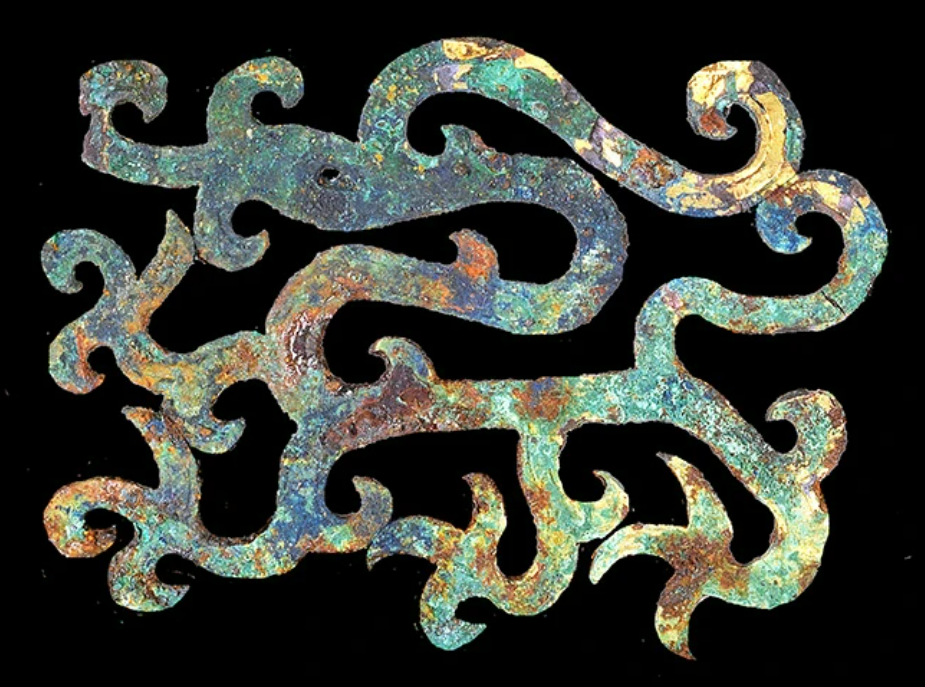
Archaeologists in Gunma Prefecture have unveiled a remarkable discovery: fragments of gilt‑bronze armor featuring a dragon motif, believed to date back to the fifth century.
The seven pieces were recovered from a kofun burial mound in Takasaki and are being praised for their exceptional craftsmanship by the Meiji University Museum. Experts suggest the fragments may be related to the renowned saddle fittings from the Konda-Maruyama kofun in Osaka Prefecture, which hold national treasure status. The museum acquired the pieces from a Tokyo art dealer in December 2024.
When reconstructed, the dragon-adorned plate measures approximately 35 centimeters long and 22 centimeters wide. It consists of an openwork gilt‑bronze dragon riveted onto an iron backing. Its shape indicates it was likely part of the neck guard of armor, and no other examples of decorated neck guards from this period have been discovered in Japan, making this one of the largest known examples of dragon-themed armor or ornamentation from the fifth century.
Curator Keizo Kutsuna noted that the dragon design closely mirrors the motifs on the fifth-century saddle fittings from the Konda-Maruyama site. Some researchers theorize that the original equestrian equipment may have come from northeast China or the Korean Peninsula. Kutsuna suggested that both sets of artifacts could have been created by the same craftsmen around the same time.
Because the ornamental plates added weight to the armor, it is believed they were not intended for combat but instead functioned as symbols of authority, highlighting the wearer’s status and prestige.
The fragments were kept in a labeled box indicating they came from the Watanuki kofun site in Takasaki, with reports that they were excavated before World War II. Researchers are still investigating the exact mound of origin, with candidates including the 94-meter-long Fudoyama mound and the now-vanished 115-meter-long Iwahana-Futagoyama mound, both part of the Watanuki tumulus cluster.
The find has been recognized as highly significant by scholars. Toru Wakasa, archaeology professor at Meiji University, noted that the discovery suggests a powerful local ruler in fifth-century Gunma possessed gilt-bronze artifacts of exceptional quality. Tatsuya Hashimoto of Kagoshima University highlighted the rarity of decorated neck guards, emphasizing that this could reshape debates regarding the production sites of national treasure saddle fittings. Meanwhile, Takehiro Hatsumura of the Gangoji Institute for Research of Cultural Property pointed out that the fittings appear custom-made for the neck guard, suggesting they may have been produced in a Japanese workshop, potentially alongside the Konda-Maruyama saddle fittings.
The fragments are currently on display at the Meiji University Museum in Tokyo’s Chiyoda Ward, featured in an exhibition showcasing the institution’s new acquisitions of the year.