French marine archaeologists have uncovered a massive underwater wall off the coast of Brittany, dating back to around 5,000 BC.
They suggest it may have been constructed by a Stone Age society whose disappearance beneath rising seas inspired local legends of sunken cities.
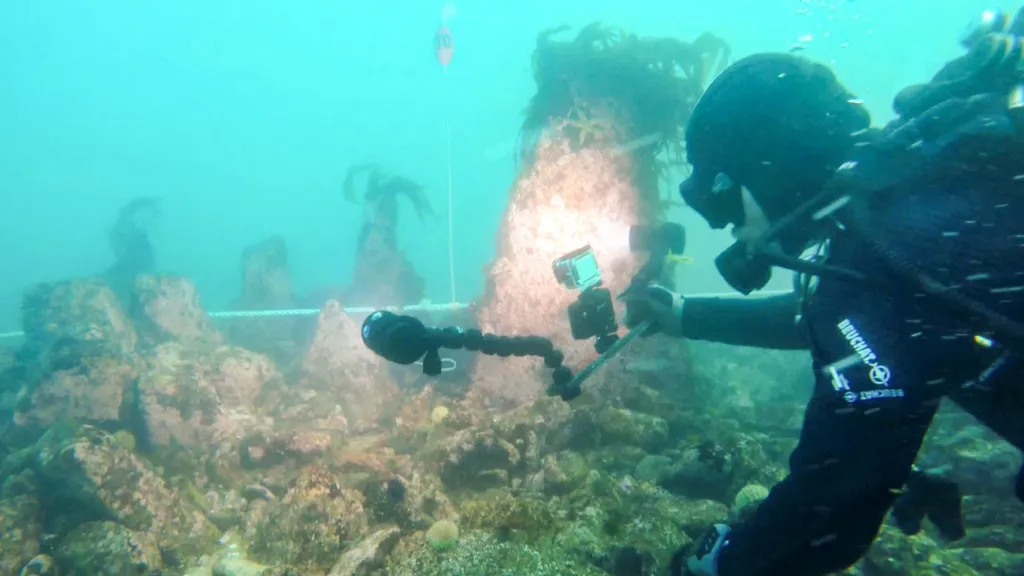
The structure, measuring 120 metres (394 ft) long, is the largest underwater construction ever found in France. Archaeologists believe it functioned either as a fish trap or as a dyke to protect against rising sea levels. When originally built on the Île de Sein at Brittany’s western tip, the wall would have stood along the shoreline, between the high and low tide marks. Today, the site lies beneath nine metres of water, as the island has shrunk considerably since then.
The wall averages 20 metres in width and 2 metres in height. At regular intervals, divers found large granite standing stones, or monoliths, rising above the structure in two parallel lines. These monoliths were likely placed on the bedrock first, with the wall then constructed around them using slabs and smaller stones. If the fish-trap theory is correct, the protruding monoliths may have supported a net made from sticks and branches to catch fish as the tide receded.
With an estimated total mass of 3,300 tonnes, the wall would have required a sizable, organized community to build. Its survival for around 7,000 years attests to the structure’s solidity. Archaeologist Yvan Pailler commented that it was likely created either by a sedentary hunter-gatherer society taking advantage of abundant resources or by Neolithic populations arriving in the region around 5,000 BC.
The wall’s monoliths are similar to but predate the iconic menhirs scattered across Brittany and associated with Neolithic culture. Pailler suggests there may have been a transfer of knowledge on quarrying, shaping, and transporting stones between Mesolithic hunter-gatherers and incoming Neolithic farmers.
The discovery followed the work of local geologist Yves Fouquet, who identified the structure while studying undersea depth charts created with modern radar technology. “Just off Sein, I saw this 120-metre line blocking an undersea valley. It couldn’t be natural,” he told Le Monde.
Archaeologists first explored the site in the summer of 2022 but had to wait until the following winter when seaweed growth receded before fully mapping the wall.
In a paper published in the International Journal of Nautical Archaeology, researchers speculate that such submerged sites may have inspired Breton legends of lost cities, including Ys, thought to lie in the nearby Bay of Douarnenez. They note: “The abandonment of a territory developed by a highly structured society has likely remained embedded in people’s memories. The rapid submersion, along with the desertion of fishing structures, protective works, and settlements, must have left a lasting impression.”