Dunadd Fort is one of the most important archaeological sites associated with the emergence of the early medieval Gaelic kingdom of Dál Riata in western Scotland. Rising dramatically above the flat expanse of Moine Mhòr, or the “Great Moss,” in Kilmartin Glen, Argyll, Dunadd was more than a defensive hillfort. It appears to have functioned as a major political and ceremonial center between approximately the sixth and eighth centuries CE.
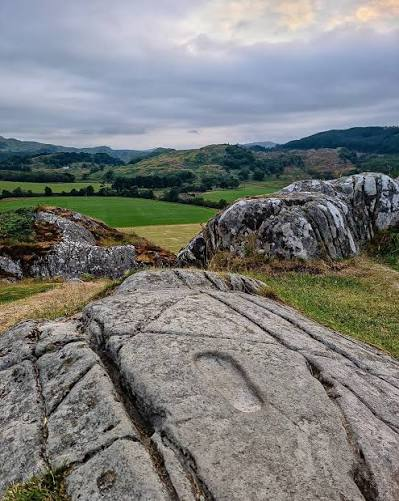
What makes Dunadd particularly remarkable is the survival of unusual carvings on the rock itself, including human footprints, a boar, an ogham inscription, and other markings. The footprints have often been interpreted as possible evidence for royal inauguration ceremonies, although archaeologists appropriately treat this interpretation as a hypothesis rather than an absolute certainty. Historic Environment Scotland describes Dunadd as a royal power center of the Gaelic kings from approximately AD 500 to AD 800.
A Strategic Hill in Argyll
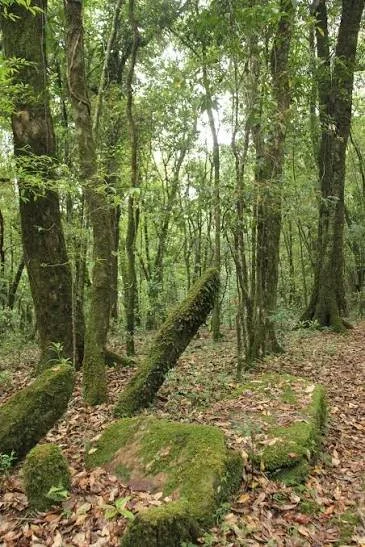
Dunadd rises from the Kilmartin Glen landscape on a prominent rocky outcrop. Its position was strategically valuable because the surrounding landscape included waterways, fertile areas, routes through western Scotland, and access toward the sea.
The fort could therefore serve several purposes simultaneously:
defense;
administration;
elite residence;
craft production;
ceremonial activity;
and political display.
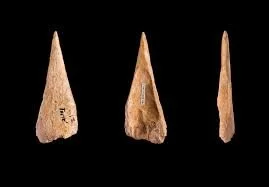
Archaeological discoveries demonstrate that the site was connected to long-distance exchange. Imported pottery from Gaul and Germanic glass vessels have been identified, while evidence for fine metalworking demonstrates that Dunadd participated in sophisticated craft production.
Dunadd and Dál Riata
Dál Riata was an early Gaelic kingdom whose territories included parts of western Scotland and northeastern Ireland.
Dunadd is particularly important because it appears to have been one of the kingdom's principal political centers.
Historic Environment Scotland notes that the site was already a major power center by the time it was mentioned in AD 683. It may also have been associated with traditions concerning St Columba and the wider networks of the early Christian Gaelic world.
The Mysterious Footprints
The most famous features at Dunadd are the carved human footprints.
The footprints are cut into the rock and are large enough to accommodate a human foot.
Their purpose remains uncertain.
One influential interpretation is that they formed part of a royal inauguration ritual.
In such a ceremony, a new ruler may have symbolically stood upon the footprint, demonstrating his relationship with the territory over which he would rule.
This interpretation fits broader traditions in which rulers were ceremonially connected to the land.
However, archaeology cannot prove every detail of the ceremony. The footprints may have had another symbolic or ritual function.
The Boar Carving
Another important carving is the image of a boar.
Boars held significant symbolic associations in Iron Age and early medieval Celtic cultures.
They could represent:
strength;
courage;
martial power;
elite identity;
and hunting.
The presence of a boar at a major royal center may therefore have carried ideological significance.
The Ogham Inscription
Dunadd also contains an ogham inscription.
Ogham was an early medieval writing system primarily associated with Ireland and the western Celtic world.
Its presence provides important evidence for literacy and cultural connections between western Scotland and Ireland.
The inscription is particularly significant because it demonstrates that Dunadd's occupants participated in the intellectual and cultural networks of the early medieval Gaelic world.
Christianity and the Royal Center
Evidence from Dunadd suggests that Christianity became part of the site's cultural environment.
Archaeological finds have provided indications of Christian activity and literacy.
This is important because the period between the sixth and eighth centuries was one of significant religious transformation in Scotland.
Christianity did not simply replace existing traditions overnight. Instead, religious change unfolded through complex interactions among local communities, elite institutions, monasteries, and political rulers.
Dunadd as a Symbol of Kingship
Dunadd's importance therefore extended beyond military defense.
The site embodied political authority.
A ruler who controlled Dunadd could potentially demonstrate control over:
territory;
trade;
military resources;
skilled craftsmen;
religious connections;
and royal ceremony.
The rock carvings were part of this symbolic landscape.
Archaeological Significance
Excavations have revealed evidence of occupation, craft production, imported goods, fortification, and elite activity.
The archaeological record demonstrates that Dunadd was connected to a wider world rather than functioning as an isolated hillfort.
Its significance lies in its ability to illuminate the formation of early medieval political society in Scotland.
Conclusion
Dunadd Fort: Argyll's Inauguration Rock Carvings represents one of Scotland's most important archaeological windows into early medieval kingship.
Its footprints, boar carving, ogham inscription, fortifications, imported objects, and craft evidence collectively suggest a sophisticated political center.
The site cannot tell us exactly how every inauguration ceremony occurred, but its archaeological remains strongly demonstrate that Dunadd was a place where political authority, ritual symbolism, craftsmanship, literacy, and territorial power came together.