Kilmartin Glen in Argyll contains one of the most remarkable concentrations of prehistoric monuments in Scotland. Spread across a relatively compact landscape are chambered cairns, stone circles, standing stones, burial monuments, carved rocks, and later archaeological remains.
The importance of Kilmartin Glen does not come from a single spectacular monument. Instead, its significance lies in the relationship among dozens of monuments arranged across the landscape.
The monuments demonstrate that prehistoric communities were deliberately organizing space, memory, burial, ritual, and movement thousands of years ago.
A Landscape of Monuments
Kilmartin Glen contains an extraordinary concentration of prehistoric archaeological features.
These include:
chambered cairns;
Bronze Age burial cairns;
stone circles;
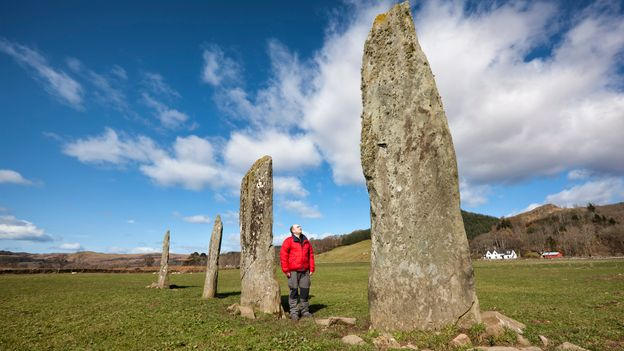
standing stones;
stone alignments;
rock art;
and later settlements.
Historic Environment Scotland describes the glen as one of Scotland's richest prehistoric landscapes, with an especially dense concentration of carved stone surfaces and Neolithic and Bronze Age monuments.
The Linear Cemetery
One of the most striking features is the line of burial cairns extending approximately two kilometers along the valley.
The group includes:
Glebe Cairn;
Nether Largie North Cairn;
Nether Largie Mid Cairn;
Nether Largie South Cairn;
and Ri Cruin Cairn.
These monuments belong broadly to the Late Neolithic and Bronze Age periods, with dates extending roughly from 5,000 to 3,500 years ago.
Nether Largie South
Nether Largie South is particularly important because it is older than the other cairns in the linear cemetery.
Its original form was a Clyde-type chambered cairn dating to the Neolithic period.
The central chamber was divided into compartments and was probably used for multiple burials.
Later, approximately 4,000 years ago, the monument was enlarged into a large round cairn incorporating additional Bronze Age burial cists.
This transformation demonstrates that monuments could remain meaningful for centuries.
Ritual Continuity
One of the most important lessons from Kilmartin Glen is that prehistoric monuments were not necessarily abandoned after their initial construction.
Later communities sometimes modified, reused, expanded, or built new monuments near earlier ones.
This suggests that prehistoric people were interacting with an inherited landscape.
Ancient monuments could therefore function as places of:
memory;
ancestry;
territorial identity;
ceremony;
and social authority.
Rock Art
Kilmartin Glen is also famous for its prehistoric rock art.
Many carved rocks contain:
cup marks;
cup-and-ring motifs;
grooves;
spirals;
and other abstract designs.
Their precise meanings remain uncertain.
Archaeologists have proposed that such carvings may have had ritual, symbolic, territorial, or commemorative functions.
Because no written explanations survive, interpretations must remain cautious.
Standing Stones
Standing stones and alignments add another dimension to the landscape.
Their deliberate placement suggests that prehistoric communities were concerned with the organization of space.
Some monuments are positioned so that they are visually connected to others.
This intervisibility is one of the most important characteristics of Kilmartin Glen.
The Importance of Visibility
The monuments were not necessarily designed to be viewed individually.
Instead, many formed part of a broader visual landscape.
A person moving through the glen could encounter:
standing stones;
cairns;
carved rocks;
hills;
and other monuments.
This could create a powerful ceremonial experience.
Social Organization
Building large monuments required considerable labor.
Workers had to:
quarry or collect stone;
transport heavy materials;
prepare the site;
construct chambers or walls;
organize burials;
and maintain the monuments.
Such projects imply substantial cooperation.
They therefore provide evidence for organized communities capable of coordinating labor over long periods.
Burial and Social Status
Some later Bronze Age burials appear to have been associated with high-status individuals.
For example, rare axe-head carvings at Nether Largie Mid and North have been interpreted in connection with elite status because axes could represent wealth and prestige.
Conclusion
Kilmartin Glen: Argyll's 5,000-Year Megalithic Landscape is best understood not as one archaeological monument but as a carefully structured prehistoric environment.
Its cairns, stone circles, standing stones, and rock art reveal how ancient communities used the landscape to express beliefs about death, ancestry, identity, and social organization.
The extraordinary survival of these monuments makes Kilmartin Glen one of Scotland's most valuable archa