Erlitou is one of the most important Bronze Age archaeological sites in China. Located in the central Yellow River region, the site has played a major role in debates about the origins of early Chinese states, bronze technology, urban planning, and the possible archaeological background of the legendary Xia Dynasty.
The term “Proto-Shang” is sometimes used to describe Erlitou's importance as a society that preceded or stood near the emergence of the Shang state. However, the precise political identity of the Erlitou culture remains debated. Archaeologists can study its cities, palaces, workshops, tombs, and artifacts, but connecting the site directly to a dynasty described in later historical texts requires interpretation.
Regardless of this debate, Erlitou demonstrates that a highly organized Bronze Age society existed in the Yellow River region before the rise of the mature Shang civilization at sites such as Anyang.
The Erlitou Site
The Erlitou archaeological site is located near the Luo River in present-day Henan Province.
The settlement flourished during the early Bronze Age and eventually developed into a major urban center.
Excavations have revealed evidence of:
large planned buildings,
palace complexes,
roads,
bronze workshops,
craft-production areas,
tombs,
and residential zones.
This level of organization suggests the presence of a powerful central authority capable of coordinating labor and controlling important resources.
A Planned Urban Landscape
One of Erlitou's most important features is its apparent urban planning.
The settlement was not simply a collection of unrelated houses.
Different areas appear to have served different functions.
Some were associated with elite architecture, while others were connected with craft production or ordinary residential activity.
Roads and organized spatial arrangements suggest deliberate planning.
The construction of such an urban center required the coordination of:
labor,
raw materials,
transportation,
food supplies,
and political authority.
The Palace Complexes
Large rammed-earth structures discovered at Erlitou are among the site's most significant features.
These buildings have often been interpreted as palace complexes.
Rammed-earth construction involved placing layers of earth into a form and compacting them repeatedly.
The resulting walls or foundations could be extremely durable.
Constructing a large rammed-earth building required a substantial labor force.
The ability to mobilize this labor suggests increasing political centralization.
Bronze Technology at Erlitou
Erlitou provides important evidence for the development of bronze technology in early China.
Bronze is an alloy produced primarily from copper combined with tin or other metals.
The production of bronze objects required several stages:
locating and acquiring raw materials;
mining or obtaining metal ores;
processing the materials;
producing molds;
melting and combining metals;
casting the final object.
Each stage required specialized knowledge.
The Importance of Bronze Vessels
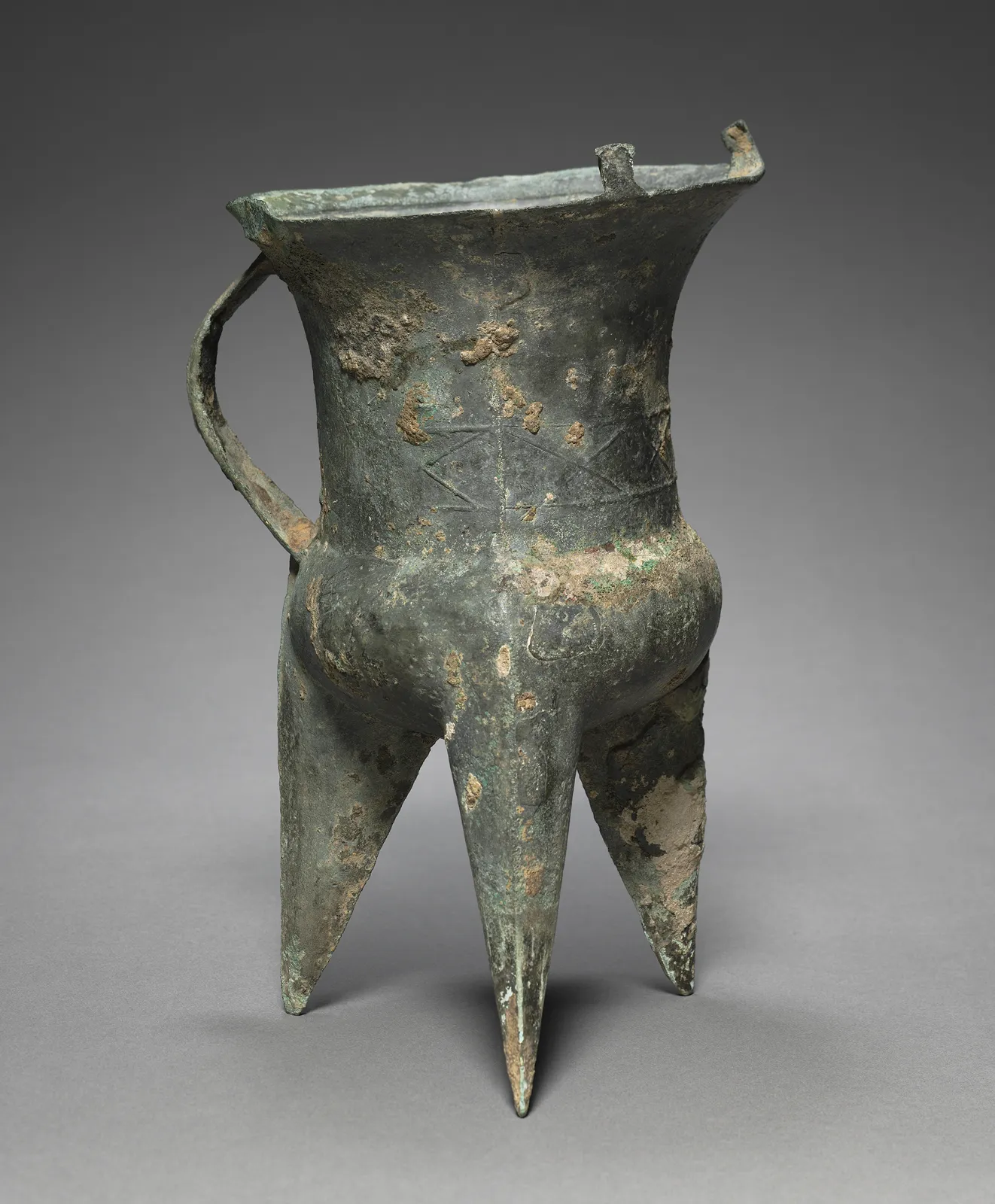
Among the most significant Erlitou artifacts are early bronze ritual vessels.
In later Shang society, bronze vessels became deeply associated with elite power and ceremonial practices.
The presence of early examples at Erlitou demonstrates that this technological and social tradition had important roots before the mature Shang period.
Bronze was valuable not only because it was useful but because its production required access to rare materials and specialized craftsmen.
Control over bronze production could therefore strengthen political authority.
Turquoise and Elite Craftsmanship
Erlitou is also famous for sophisticated objects incorporating turquoise.
One of the best-known discoveries is a bronze decorative object inlaid with turquoise pieces.
The creation of such an artifact required advanced craftsmanship.
The artisan needed to:
shape the bronze object;
prepare small turquoise pieces;
arrange them into a design;
and securely attach them to the surface.
Such luxury objects were likely associated with elite individuals or ceremonial activities.
Was Erlitou the Capital of the Xia Dynasty?
One of the most controversial questions surrounding Erlitou concerns its possible relationship to the Xia Dynasty.
Later Chinese historical traditions describe the Xia as the first dynasty of ancient China, followed by the Shang and Zhou.
However, unlike the Shang Dynasty, which is supported by direct written evidence from oracle bones, no surviving inscription has definitively identified Erlitou as the capital of the Xia.
Some scholars believe Erlitou may represent an archaeological manifestation of the Xia or a related political tradition.
Others argue that archaeology cannot securely connect the site to the later dynastic name.
This debate demonstrates an important principle in archaeology: historical traditions and material evidence can be compared, but they should not automatically be treated as identical.
Craft Specialization
The society at Erlitou contained evidence of specialized craft production.
Producing bronze, turquoise ornaments, ceramics, and other objects required skilled workers.
Craft specialization suggests that not every member of society was producing the same goods.
Some individuals may have focused primarily on particular technologies.
This requires a larger economic system capable of supporting workers who were not constantly engaged in food production.
Social Hierarchy
The differences between elite buildings, luxury objects, and ordinary areas suggest the existence of social hierarchy.
Certain individuals or groups had access to:
larger buildings,
prestige goods,
specialized labor,
and valuable materials.
The development of social inequality is a major feature of early state formation.
As societies became larger and more politically centralized, elite groups often gained increasing control over resources and ceremonial authority.
Erlitou and the Rise of the Chinese Bronze Age
Erlitou occupies an important chronological position between earlier Neolithic communities and the highly developed Shang state.
It provides evidence for a period when:
cities were becoming more complex,
bronze technology was expanding,
elite architecture was developing,
and political authority was becoming increasingly centralized.
These developments helped create the foundations for later Bronze Age civilizations.
Conclusion
Erlitou is one of the key archaeological sites for understanding the origins of complex society in ancient China.
Its palace complexes, planned urban spaces, specialized workshops, bronze technology, and luxury artifacts reveal a powerful Bronze Age society that existed before the rise of the mature Shang Dynasty.
Whether Erlitou can be identified directly with the Xia Dynasty remains debated. Yet its importance does not depend entirely on that question.
The site demonstrates that long before the oracle bones of Anyang, societies in the Yellow River region were already building monumental architecture, organizing specialized production, and developing the political structures that would shape the history of ancient China.