Introduction
The Evros River, known as the Maritsa in its broader international course, flows through southeastern Europe before reaching the Aegean Sea. Its delta, located in northeastern Greece, is an important wetland environment shaped by river deposits, coastal processes, and changing water levels.
During the Byzantine period, the wider region occupied a strategic position between the Balkans, Constantinople, and the northern Aegean. Administrative officials, military authorities, religious institutions, and merchants relied on written communication to manage people, property, and resources.
One of the most valuable material traces of this administrative system is the Byzantine lead seal, commonly known as a molybdobullon. These small objects were attached to documents and packages to authenticate their origin or authority.
The possibility of Byzantine seals preserved in Evros delta mud raises questions about administration, communication, and archaeological preservation. A particular concentration of seals in the delta should not be considered verified without documented finds.
1. The Byzantine Importance of the Evros Region
The Evros region formed part of a strategically important landscape connecting the Aegean with the Balkans and the interior of the Byzantine Empire.
River corridors supported movement, agricultural activity, and communication between settlements.
The wider region experienced changing political and military conditions throughout the Byzantine period.
Its proximity to maritime routes and continental transportation networks made it relevant to imperial administration and regional commerce.
However, the precise administrative importance of individual locations in the delta varied over time.
2. Understanding Byzantine Lead Seals
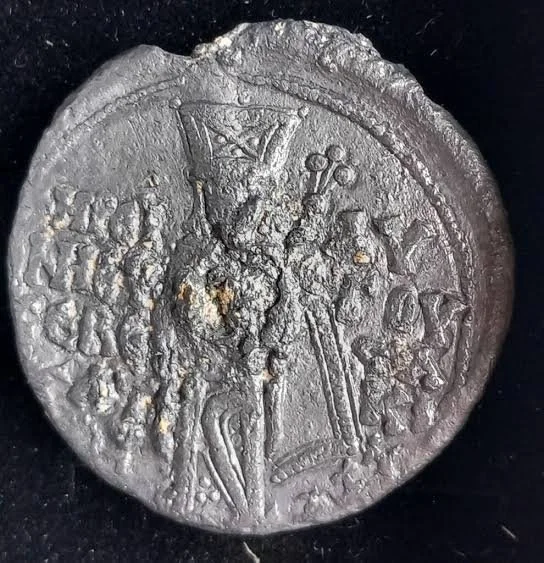
Byzantine lead seals were small metal objects used to authenticate correspondence and official documents.
They were generally produced by stamping a piece of lead with engraved dies.
The resulting object often contained an inscription and an image, such as a religious figure, cross, imperial symbol, or portrait.
A channel through the seal allowed a cord to pass through it, securing the seal to a document or container.
The seal helped indicate who issued the communication and whether it had been tampered with.
3. Who Used Byzantine Seals?
Lead seals were used by a wide range of individuals and institutions.
Imperial officials, military commanders, administrators, bishops, monasteries, landowners, and other authorized persons could possess seals.
Their inscriptions may identify an office, title, personal name, or religious affiliation.
Some seals provide information about administrative structures that are otherwise poorly documented.
Their study can therefore contribute to reconstructing the political and social organization of the Byzantine Empire.
4. Why Lead Seals Might Enter Delta Sediments
Objects can become buried in river deltas through several processes.
Flooding may transport materials from upstream settlements and deposit them within mudflats or channels.
Erosion can expose older archaeological deposits and move artifacts into new sediment layers.
A seal may also have been lost near a river crossing, settlement, landing area, or administrative building.
Its discovery in delta mud does not necessarily mean that it was deliberately deposited in water.
The distinction between intentional deposition and accidental loss requires contextual evidence.
5. Preservation in Waterlogged Mud
Fine-grained delta sediments can preserve small artifacts by covering them relatively quickly.
Lead is a corrosion-resistant metal under some burial conditions, but it can still deteriorate through chemical reactions and environmental changes.
The composition of the surrounding sediment, groundwater chemistry, oxygen availability, and salinity can influence preservation.
Objects recovered from waterlogged deposits require careful cleaning and conservation because exposure to air may alter their condition.
6. Reading the Inscriptions
Byzantine seals often contain inscriptions that provide information about their owners.
These may include names, official titles, administrative responsibilities, and religious references.
The inscriptions can be difficult to read because of corrosion, damage, incomplete impressions, or worn lettering.
Researchers use high-resolution photography, microscopic examination, and three-dimensional recording to document details.
Comparisons with published seal catalogues can help identify known individuals or administrative offices.
7. Dating and Historical Interpretation
The iconography, lettering, titulature, and manufacturing characteristics of a seal can help establish its approximate date.
Some seals can be associated with specific officials or historical events through comparison with written records.
However, a seal's date does not automatically establish when it entered the delta sediments.
River movement and later disturbance can transport objects far from their original location.
Stratigraphic evidence and sediment analysis are therefore essential for reconstructing the circumstances of deposition.
8. What a Seal Collection Could Reveal
A group of seals from a well-documented archaeological context could reveal patterns of administration and communication.
Different officials may be represented, indicating contact between regional and central authorities.
Religious seals could provide information about ecclesiastical administration, while military seals might reveal the presence of officials responsible for defense and logistics.
The distribution of seals across the delta could also help identify historical settlement areas or communication corridors.
Such conclusions require a securely documented assemblage rather than isolated objects with uncertain find locations.
9. Protecting the Evros Delta Archaeological Landscape
The Evros delta is an environmentally sensitive wetland.
Flooding, erosion, agricultural activity, drainage, construction, and coastal changes can affect archaeological deposits.
Underwater and wetland archaeology require specialized survey methods that account for low visibility, unstable sediments, and difficult access.
Systematic recording and cooperation between archaeologists and environmental specialists can help protect the region's cultural heritage.
Conclusion
Byzantine lead seals provide valuable evidence for administration, identity, and communication within the medieval eastern Mediterranean.
Their possible preservation in the Evros delta offers an interesting opportunity to investigate the relationship between river landscapes and historical institutions.
Although a particular collection of forgotten seals requires archaeological verification, securely excavated examples could help reconstruct regional authority, trade, and ecclesiastical networks during the Byzantine period.