Introduction
The region of Drama, in northeastern Greece, contains a rich archaeological landscape associated with prehistoric settlement, agricultural development, and later cultural traditions.
Its position near the fertile plains of eastern Macedonia and the surrounding mountainous areas provided access to agricultural land, freshwater, stone resources, and routes connecting different communities.
One important category of prehistoric domestic equipment is the grinding stone. These tools were used to process grains, seeds, pigments, and other materials.
The possibility of Neolithic grinding stones discovered inside a small hut near Drama raises questions about household production and early agricultural life. Although a specific hut assemblage requires archaeological documentation, the wider region offers a meaningful context for investigating early farming technology.
1. The Neolithic Landscape of Eastern Macedonia
The Neolithic period brought major changes to communities across southeastern Europe.
Farming, animal domestication, pottery production, and more permanent settlement patterns became increasingly important.
Eastern Macedonia contains several archaeological sites associated with Neolithic communities.
The region's fertile plains and access to natural resources supported agricultural settlement.
Archaeological investigations have provided evidence of domestic buildings, storage activities, food preparation, and craft production.
2. The Importance of Grinding Technology
Grinding stones were essential tools in early agricultural societies.
They allowed people to process cereals and other plant materials into smaller particles or flour.
This made grains easier to cook and incorporate into different foods.
Grinding could also be used to process seeds, pigments, minerals, and other substances.
The development of grinding technology was therefore closely connected to changes in food production and household organization.
3. Types of Neolithic Grinding Stones
Grinding equipment varied in shape and construction.
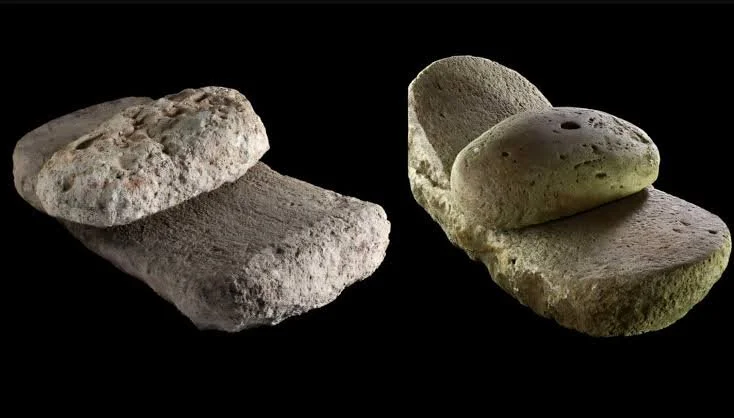
A common arrangement involved a lower grinding slab and an upper handstone used to move back and forth across its surface.
Other tools included mortars and pestles, which were used through repeated downward pressure.
The materials could include sandstone, limestone, and other locally available rocks.
The size and shape of the equipment depended on the intended task and the traditions of the community.
4. Identifying Grinding Stones Archaeologically
Grinding stones can be recognized through their working surfaces.
Repeated abrasion may produce smoothing, grooves, depressions, and changes in surface texture.
Researchers examine these features to distinguish intentional use from natural weathering.
Microscopic analysis can reveal polish and wear patterns associated with grinding particular materials.
Residue analysis may also identify starch grains, plant tissues, pigments, or other substances preserved on the surface.
However, a worn stone is not automatically a grinding tool. Its function must be established through several forms of evidence.
5. Grinding Stones Inside Domestic Buildings
The discovery of grinding equipment within a house or hut can provide important information about domestic activity.
Its position may help identify areas used for food preparation or storage.
A grinding stone found near a hearth, storage containers, and plant remains may suggest a food-processing area.
However, the object could also have been stored, reused as building material, or abandoned during a later occupation phase.
Researchers must examine its relationship to the building's floor and associated artifacts.
6. Reconstructing Neolithic Food Preparation
Grinding stones can provide evidence of how prehistoric communities processed their food.
The recovery of cereal remains, including charred grains and plant fragments, can help identify cultivated crops.
Starch analysis and microscopic residue examination may provide additional information about the materials processed.
The relationship between grinding equipment and storage facilities can also reveal how households organized food production.
These findings contribute to understanding the transition toward agricultural economies.
7. Household Production and Labor
Grinding grain was often a repetitive and physically demanding activity.
The presence of grinding equipment in domestic spaces suggests that food processing formed an important part of everyday household labor.
The size and number of grinding stones may provide clues about the scale of production.
However, it is difficult to assign particular activities to specific individuals based solely on archaeological tools.
Researchers should consider household size, settlement organization, and evidence of shared facilities before drawing conclusions about labor organization.
8. Dating the Neolithic Assemblage
Dating a grinding stone directly is generally difficult because stone itself is not suitable for conventional radiocarbon dating.
Researchers instead use associated organic materials, stratigraphic relationships, and diagnostic artifacts.
Charred seeds or charcoal from a secure context may provide radiocarbon dates.
Pottery styles and settlement sequences can help establish the broader chronological framework.
The possibility of an object being reused over several generations must also be considered.
9. Conservation and Further Research
Grinding stones can survive for long periods, but their surfaces may be damaged by weathering, agricultural activity, and modern handling.
Researchers record the shape, dimensions, material, and microscopic wear before applying conservation treatments.
Residue sampling should be conducted carefully to avoid contamination.
Comparisons with grinding equipment from other Neolithic settlements in Macedonia and the Balkans can help identify regional similarities and differences.
Conclusion
Neolithic grinding stones provide important evidence of food preparation and household technology in prehistoric communities around Drama.
Their surfaces, residues, and archaeological contexts can reveal how early farmers processed cereals and other materials.
Although a specific hut assemblage requires verification, the study of grinding equipment contributes to a broader understanding of domestic life, agricultural development, and the organization of labor in Neolithic eastern Macedonia.