Introduction
The Cyclades form one of the most recognizable island groups in the Aegean Sea. Their communities have depended on maritime resources for thousands of years, developing fishing practices adapted to rocky coastlines, offshore reefs, and changing marine conditions.
Fishing equipment was an essential part of this maritime economy. Nets, hooks, lines, weights, and traps allowed communities to exploit different species and habitats.
One particularly interesting archaeological subject is the recovery of ancient fishing-net sinkers near the reefs of Syros. Although the title refers to a rare fishing net, it is important to distinguish preserved net material from the stone or ceramic weights that may have once supported it.
A specific ancient net discovered off a Syros reef should not be treated as verified without a published archaeological record. Nevertheless, the region provides a strong context for examining ancient fishing technology and underwater preservation.
1. Syros and the Maritime Cyclades
Syros occupies a central position within the Cycladic island group.
Its coastline includes natural bays, rocky shores, and underwater environments that have supported fishing and maritime movement.
The island has a long history of human settlement, with archaeological evidence from prehistoric and later periods.
Its maritime position connected it to neighboring islands and wider Aegean trade networks.
Fishing would have remained important across different historical periods, although the equipment and methods changed over time.
2. Fishing Technology in the Ancient Aegean
Ancient fishing relied on a variety of methods.
These included hook-and-line fishing, netting, spearfishing, traps, and the use of barriers in shallow coastal waters.
Different techniques were suited to different fish species and environmental conditions.
Nets could be used in open water or near the shore, depending on their design.
Archaeological evidence for fishing includes net weights, hooks, fish remains, and representations of fishing activities in ancient art.
3. What Are Fishing-Net Sinkers?
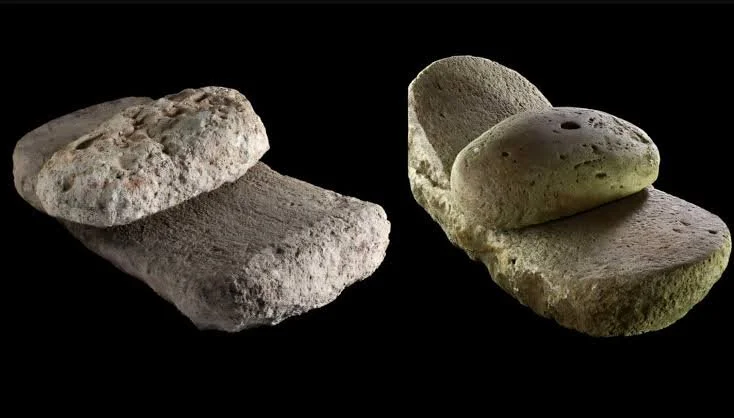
Fishing-net sinkers are weights attached to nets to help them remain submerged or maintain their intended shape.
They can be made from stone, lead, ceramic, or other materials.
Their size and design vary according to the type of net and the fishing method.
Some weights have perforations through which cords could pass. Others may have grooves, notches, or other features for attachment.
The presence of a weight does not always establish its function. Similar objects could have served as loom weights, line weights, or other equipment.
4. Can Ancient Fishing Nets Survive Underwater?
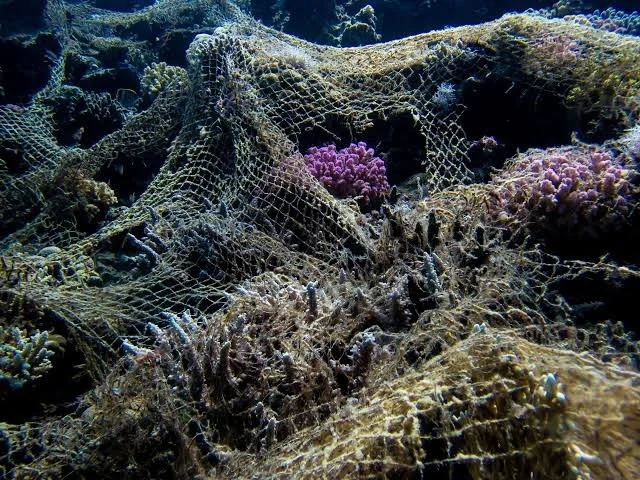
Fishing nets made from organic fibers are vulnerable to decay.
Materials such as flax, hemp, wool, and other plant or animal fibers can deteriorate rapidly in oxygen-rich marine environments.
Preservation is more likely in exceptional conditions, including waterlogged sediment with low oxygen availability.
Even when the net itself disappears, its weights and associated equipment may survive.
Occasionally, organic impressions or mineralized traces can provide indirect evidence of the original net structure.
5. Archaeological Evidence of Fishing Near Reefs
Reef environments can attract fish because they provide shelter, feeding grounds, and areas of biological diversity.
Ancient communities may have used these locations for fishing, although reconstructing specific techniques requires evidence.
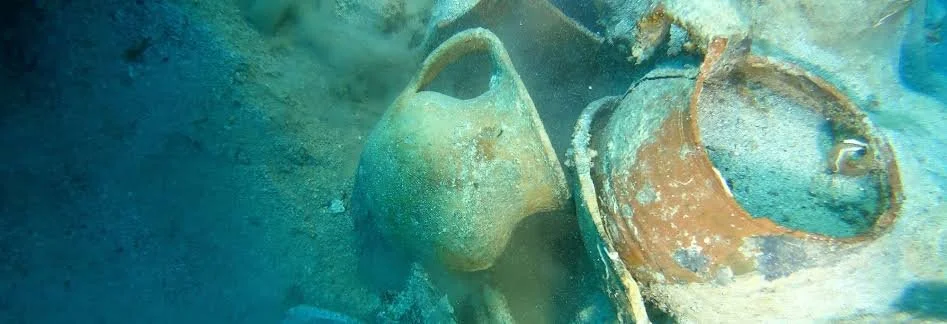
Underwater surveys can identify concentrations of artifacts, stone structures, anchors, and other remains.
Fishing weights discovered near reefs may indicate fishing activity, but they could also have been lost during maritime travel or deposited through later disturbance.
Their interpretation depends on distribution patterns and associated finds.
6. Identifying the Function of Net Weights
Researchers examine the shape, dimensions, material, and wear patterns of suspected net weights.
Perforations and grooves may indicate how cords were attached.
Comparisons with known fishing equipment can help establish whether an object was designed for a net, fishing line, or another activity.
Microscopic analysis may reveal abrasion caused by repeated contact with rope or other materials.
The archaeological context is equally important because fishing weights are often found in settlements, harbors, shipwrecks, and coastal deposits.
7. Reconstructing Ancient Fishing Practices
The study of fish remains can complement evidence from fishing equipment.
Archaeologists identify fish species through skeletal characteristics and investigate the size distribution of recovered remains.
This may provide information about which species were exploited and whether fishing focused on particular habitats or seasons.
The combination of net weights, hooks, fish bones, and coastal settlement evidence can help reconstruct local fishing economies.
However, fish remains from household deposits do not necessarily reveal the exact equipment used to catch them.
8. Underwater Archaeological Methods
The investigation of suspected fishing equipment near Syros would require systematic underwater survey.
Divers may record artifacts and seabed features using photography, measurements, and mapping.
Photogrammetry can produce three-dimensional records of objects and their surrounding environment.
Side-scan sonar and other remote sensing methods may help identify larger concentrations or unusual seabed structures.
If organic material survives, specialists must recover it under controlled conditions to prevent deterioration after removal from seawater.
9. Fishing, Trade, and Island Communities
Fishing contributed to the economic resilience of island communities.
It provided food, supported local exchange, and supplemented agricultural production.
Some communities may have traded preserved fish or other marine products, although the scale and organization of these activities varied.
Fishing technology also reflected local environmental knowledge passed between generations.
The archaeological study of weights and other equipment can therefore reveal more than the mechanics of fishing. It can illuminate the relationship between people, maritime resources, and island economies.
Conclusion
Fishing-net sinkers and other underwater remains offer important evidence of ancient maritime activity around Syros and the wider Cyclades.
Although organic nets are rarely preserved, their weights, associated equipment, and surrounding fish remains can help reconstruct fishing practices.
A specific submerged net discovery would require careful verification, but the archaeological potential of the region is considerable. Combining underwater survey, material analysis, and environmental reconstruction can reveal how Cycladic communities adapted their fishing technologies to the Aegean's diverse marine environments.