Introduction
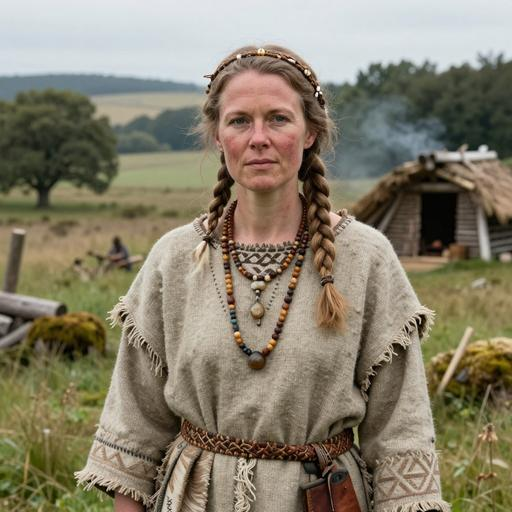
The Funnelbeaker culture, often abbreviated as TRB from its German name Trichterbecherkultur, marks the definitive, monumental transition to agriculture and sedentary life across Southern Scandinavia and the North European Plain (flourishing from roughly 4300 BCE to 2800 BCE). Characterized by their iconic ceramic flasks featuring flared, funnel-shaped necks, these people were the first true farmers of Denmark, northern Germany, and southern Sweden.
Beyond their pottery, the Funnelbeaker population transformed the prehistoric landscape by constructing thousands of monumental stone megaliths, including massive dolmens, long barrows, and complex passage graves designed for collective burials. For over a century, a central question dominated Scandinavian archaeology: were the local Mesolithic Ertebølle hunter-gatherers slowly convinced to drop their fishing harpoons and adopt farming through cultural contact, or did the Funnelbeaker complex represent an intrusive wave of foreign agriculturalists who physically displaced the indigenous population?
Because these monumental stone tombs often contained highly commingled, fragmented skeletal remains accumulated over centuries, separating cultural adoption from demographic migration required the precision of genome-wide ancient DNA sequencing.
The Anatolian Blueprint and Hunter-Gatherer Resilience
To map the genetic landscape of Scandinavia's first farmers, international paleogenomic teams extracted and sequenced ancient DNA from dozens of individuals interred within Funnelbeaker passage graves and earth barrows across Denmark and Sweden. The genomic results provided an absolute, unambiguous verdict: the Funnelbeaker people were genetically distinct from the indigenous Mesolithic hunter-gatherers who preceded them in Scandinavia.
Instead, their DNA carried an overwhelming genetic affinity with Anatolian Neolithic Farmers who had migrated into Southern Europe from the Near East millennia earlier. The Funnelbeaker expansion into Denmark was a physical, demographic migration of farmers bringing their cattle, emmer wheat, and barley northward.
However, the paleogenomic timeline also revealed an intricate, localized story of population interaction. Unlike other parts of Europe where incoming farmers rapidly marginalized local foraging groups, the genomic data from Scandinavia showed that the Funnelbeaker farmers lived alongside the indigenous Ertebølle hunter-gatherers for several centuries with very minimal genetic mixing.
Over time, however, a slow, steady absorption took place. Skeletons from later Funnelbeaker phases display a gradual, progressive rise in Western Hunter-Gatherer (WHG) ancestral components, particularly in their maternal lines. This indicates that while the paternal social structure of the farming communities remained tied to their agricultural roots, they gradually integrated local foraging women into their communities.
This stable, agricultural lifestyle and its stone-building traditions thrived for nearly fifteen hundred years, creating a wealthy, spiritually organized society that dominated the Baltic and North Sea coasts until they faced an abrupt genetic collapse around 2800 BCE.
Conclusion
The paleogenomic unmasking of the Funnelbeaker culture fundamentally redefines how historians view the spread of the Neolithic revolution to the furthest edges of Northern Europe. It demonstrates that the transition to farming in Scandinavia was driven by a determined, physical migration of populations bearing an Anatolian genetic signature.
These people were the visionary architects who erected the stone dolmens that still dot the modern Danish landscape today. Although their distinct genetic lineage and material culture were ultimately overwhelmed by the sudden Bronze Age migrations of steppe-derived pastoralists, the Funnelbeaker people left an enduring legacy, ensuring that agriculture became the permanent economic foundation of Northern Europe.