The Grotte du Renne, or Reindeer Cave, at Arcy-sur-Cure in Burgundy, is one of the most important and controversial archaeological sites in the study of Neanderthal behavior.
Its importance comes from an unusual combination of evidence.
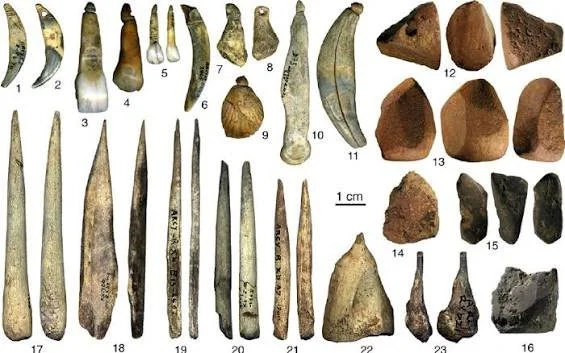
The cave contains Neanderthal remains alongside a rich Châtelperronian archaeological assemblage that includes personal ornaments, worked bone, animal teeth, and other objects that appear to reflect symbolic or socially meaningful behavior.
The site therefore became central to one of paleoanthropology's biggest questions:
Were Neanderthals capable of symbolic culture comparable in some respects to that of early modern humans?
The answer is complicated because the archaeological association between Neanderthal fossils and Châtelperronian artifacts has been debated for decades.
The Location of Grotte du Renne
Grotte du Renne forms part of the larger cave complex at Arcy-sur-Cure in the Yonne region of Burgundy.
The Arcy-sur-Cure massif contains approximately fifteen caves and rock shelters with archaeological evidence spanning a remarkably long period, from the Middle Paleolithic through the Upper Paleolithic, Mesolithic, and Neolithic.
Grotte du Renne is therefore part of a much larger archaeological landscape.
The Châtelperronian
The Châtelperronian is an archaeological tradition associated with western Europe approximately 45,000–40,000 years ago.
It is particularly important because it occurs during the period when Neanderthals and modern humans were interacting in Europe.
The tradition contains distinctive stone tools, including backed points, as well as bone tools and ornaments at certain sites.
Grotte du Renne contains an especially rich Châtelperronian assemblage.
The Neanderthal Remains
Human remains recovered from the Châtelperronian layers include numerous fossils attributed to Neanderthals.
Later research has strengthened the Neanderthal attribution of remains from the site.
A 2023 study identified additional Neanderthal dental and hyoid remains from the Châtelperronian-associated Layer X. The authors found that the newly studied dental material displayed characteristics consistent with Neanderthals.
This matters because the identity of the people responsible for the archaeological material is central to the debate.
The Ornaments
Grotte du Renne contains numerous personal ornaments.
These include:
pierced animal teeth,
pendants,
modified shells,
bone objects,
and other decorative artifacts.
Such objects are important because personal ornaments can communicate information about social identity.
A necklace, pendant, bead, or decorated object may indicate:
group membership,
personal identity,
social status,
age,
gender,
or participation in cultural traditions.
Archaeologists therefore often regard ornaments as potential evidence of symbolic behavior.
What Does "Symbolic Behavior" Mean?
The term requires caution.
A symbol is something whose meaning extends beyond its immediate physical function.
For example, a decorated object may communicate identity.
But archaeologists cannot directly observe what prehistoric people thought.
They can only infer from material evidence.
Therefore, finding ornaments does not automatically tell us exactly what they meant.
It does, however, demonstrate that people modified objects in ways that appear to have had purposes beyond simple mechanical utility.
Why the Site Became Controversial
The major question is not whether the cave contains ornaments.
It does.
The question is:
Who made them?
If the Châtelperronian artifacts were made by Neanderthals, then Grotte du Renne would provide powerful evidence that Neanderthals independently practiced complex symbolic behavior.
But if the artifacts entered the layers later through disturbance or mixing, then the association between Neanderthals and the ornaments becomes much weaker.
This is why stratigraphy and dating are so important.
The Chronological Problem
Radiocarbon dating studies raised concerns about the age and integrity of some materials at Grotte du Renne.
A major 2010 PNAS study examined the chronology of the cave and questioned whether some of the associations between Neanderthal remains and Châtelperronian artifacts were as straightforward as previously believed.
This generated a major scholarly debate.
Some researchers argued that younger material may have entered older archaeological layers.
Others argued that contamination and other methodological issues affected the radiocarbon results and that the archaeological associations remained genuine.
The Case for Neanderthal Symbolism
Researchers defending the authenticity of the association point to several lines of evidence.
First, the Neanderthal remains occur within the Châtelperronian sequence.
Second, the assemblage contains an unusually large number of ornaments.
Third, the material appears to have spatial and stratigraphic organization.
Fourth, similar evidence for Neanderthal symbolic behavior has been reported from other European sites.
The cumulative case is therefore stronger than any individual artifact.
The Case for Caution
Skeptical interpretations emphasize the possibility of archaeological mixing.
Caves are dynamic environments.
Sediments can move.
Animals can disturb deposits.
Water can transport small objects.
Later human activity can disturb earlier layers.
Excavations themselves can also introduce complications, especially when early archaeological techniques were less precise than modern methods.
These possibilities mean that archaeological context must be evaluated carefully.
The 2023 Discoveries
The discovery and identification of additional Neanderthal remains from Layer X strengthened the importance of the Grotte du Renne sequence.
Researchers identified two dental remains and a greater horn of a hyoid from the Châtelperronian-attributed horizon. The dental evidence showed clear Neanderthal affinities.
This does not automatically resolve every question about symbolic behavior.
But it strengthens the biological association between Neanderthals and the Châtelperronian layers.
The Human Hyoid
The hyoid bone is particularly interesting.
The hyoid is involved in the anatomy of the throat and plays an important role in speech and swallowing.
A Neanderthal hyoid from Grotte du Renne contributes to broader research into Neanderthal vocal and anatomical capabilities.
However, possession of a human-like hyoid does not prove the existence of modern language.
Speech involves many anatomical and neurological systems.
Nevertheless, the fossil adds another piece to the complex puzzle of Neanderthal biology.
Neanderthals and Personal Ornamentation
If Neanderthals produced the ornaments at Grotte du Renne, the implications are substantial.
It would demonstrate that symbolic practices were not an exclusive invention of Homo sapiens.
Instead, different human populations may have developed symbolic traditions independently or through interaction.
This would challenge simplistic models in which modern humans possessed symbolic cognition while Neanderthals lacked it.
Cultural Transmission
Another possibility is cultural transmission.
Neanderthals may have learned some practices from modern humans.
This possibility is especially interesting because the Châtelperronian occurs during the period when different human populations were present in Europe.
However, distinguishing independent invention from cultural transmission is extremely difficult.
Similar objects do not automatically demonstrate direct contact.
The Importance of Context
The central lesson of Grotte du Renne is therefore methodological.
Archaeologists cannot interpret an object simply because it is interesting.
They need to establish:
where it was found,
what layer contained it,
what other materials occurred nearby,
how old the layer is,
whether the deposit was disturbed,
and which human population can reasonably be associated with it.
This is why Grotte du Renne has generated so much scholarship.
It is not simply a cave with ornaments.
It is a test case for archaeological reasoning.
A Changing View of Neanderthals
Modern research increasingly rejects the image of Neanderthals as intellectually primitive.
Evidence from different sites indicates that Neanderthals:
controlled fire,
hunted large animals,
produced sophisticated tools,
used pigments,
occasionally used ornaments,
cared for injured individuals,
and occupied diverse environments.
Grotte du Renne adds one of the most controversial dimensions: symbolic material culture.
The Broader Arcy-sur-Cure Context
The importance of Grotte du Renne is amplified by the surrounding caves.
The Arcy-sur-Cure region contains archaeological sequences spanning multiple periods, including Mousterian, Châtelperronian, Aurignacian, Gravettian, Proto-Solutrean, Magdalenian, Mesolithic, and Neolithic occupations.
The region therefore provides an unusually long record of human activity.
Grotte du Renne is one chapter within this much larger story.
Conclusion
Grotte du Renne remains one of the most important sites in the debate over Neanderthal symbolic behavior.
Its combination of Neanderthal fossils and a rich Châtelperronian assemblage containing personal ornaments has challenged traditional assumptions about the cognitive abilities of Neanderthals.
At the same time, chronological and stratigraphic questions mean that the evidence must be presented carefully.
The strongest academically responsible conclusion is not that every question has been definitively solved.
Rather, Grotte du Renne demonstrates that Neanderthal cultural behavior was considerably more complex than older models assumed, and that symbolic practices during the Middle-to-Upper Paleolithic transition cannot be understood simply as an exclusive achievement of Homo sapiens.