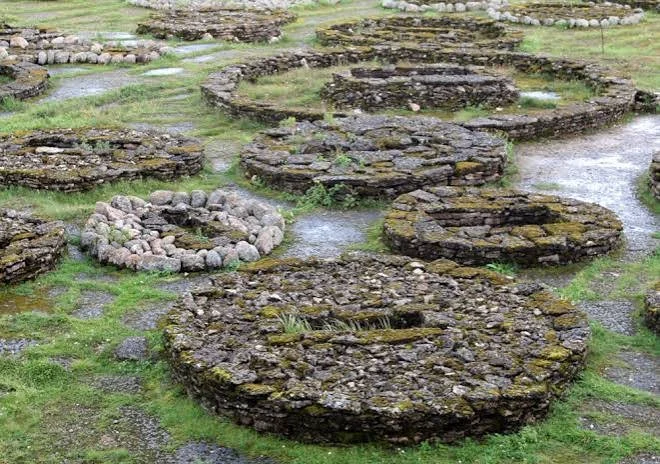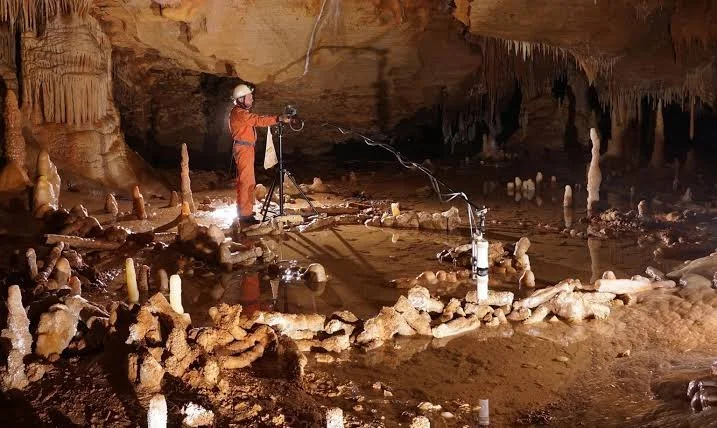
Deep beneath the limestone landscape of southwestern France lies one of the most extraordinary archaeological discoveries associated with Neanderthals: a series of deliberately constructed circular and semi-circular structures made from broken stalagmites.
These mysterious formations occur deep inside Bruniquel Cave, far beyond the zone that would naturally receive sunlight.
Their age is approximately 176,000 years, placing them in the Middle Pleistocene and long before the widespread appearance of anatomically modern humans in Europe.
The structures therefore provide extraordinary evidence that Neanderthals entered deep cave environments and deliberately modified them.
The discovery challenged older assumptions about Neanderthal capabilities.
Rather than simply occupying the entrances of caves, Neanderthals were capable of traveling deep underground, organizing materials, constructing structures, and apparently using fire in an environment where there was no natural daylight.
The findings were reported in Nature in 2016. Researchers concluded that the annular constructions were anthropogenic because of their regular geometry, arrangement of broken stalagmites, and traces of fire. Uranium-thorium dating placed them at approximately 176,500 years old.
The Discovery of the Cave
Bruniquel Cave is located in southwestern France.
The cave had long been known locally, but its deepest passages were not immediately accessible to modern explorers.
In 1990, speleologists discovered a passage leading far into the cave.
What they encountered was extraordinary.
The passage contained structures that clearly did not resemble ordinary geological formations.
Thousands of fragments of stalagmites had been deliberately broken and arranged into patterns.
The Structures
The most famous features are approximately six structures, including circular and semi-circular arrangements.
They were constructed from pieces of stalagmite, a mineral deposit formed when water containing dissolved minerals drips onto a cave floor.
The builders had broken the stalagmites and transported the fragments.
They then arranged them into carefully organized structures.
The regularity of these formations is crucial.
Natural geological processes can create circles, terraces, and unusual mineral formations.
However, the Bruniquel structures display characteristics consistent with deliberate construction.
The Extraordinary Depth
Perhaps the most remarkable aspect of Bruniquel is not simply the structures themselves.
It is where they were built.
The constructions lie approximately 336 meters from the original entrance.
At such a depth, natural sunlight could not reach them.
This means that the Neanderthals who constructed them had to enter the cave deliberately.
They would have required artificial illumination.
The presence of fire-related evidence makes this especially significant.
Evidence of Fire
Researchers identified traces of burning associated with the structures.
This suggests that fire was used inside the deep cave.
Fire would have served several purposes.
It could provide:
illumination,
warmth,
protection,
and perhaps a role in activities carried out at the site.
The requirement for lighting is particularly important.
A person cannot easily transport and arrange hundreds of heavy mineral fragments in total darkness.
The builders therefore had to plan their movement through the cave.
Uranium-Thorium Dating
Dating cave structures can be difficult.
Traditional radiocarbon dating is generally ineffective for materials much older than approximately 50,000 years.
Researchers instead used uranium-thorium dating.
This method is particularly useful for carbonate materials such as stalagmites.
The dating placed the formation of the structures at approximately 176,500 years ago, with an uncertainty range of several thousand years.
This date is extraordinarily significant.
It places the constructions within a period when Neanderthals were the dominant hominin population in western Europe.
Who Built Them?
The original research strongly associated the structures with Neanderthals.
The reason is chronological.
The structures are approximately 176,000 years old.
At this time, Neanderthals were present in Europe, whereas modern humans had not yet established the later widespread European populations associated with the Upper Paleolithic.
The archaeological evidence therefore provides a strong case that the builders were Neanderthals.
What Were the Structures Used For?
This is one of the most difficult questions.
The structures' purpose remains uncertain.
Archaeologists have proposed several possibilities.
They could have been associated with:
ritual behavior,
social gatherings,
symbolic activity,
practical activities,
controlled fire use,
or some combination of these.
It is tempting to call them "ritual structures."
However, archaeology cannot demonstrate ritual intention simply from the presence of a constructed circle.
The responsible conclusion is that the structures demonstrate organized and intentional construction, while their precise function remains unknown.
Why Were Stalagmites Chosen?
The builders did not simply pile random stones.
They used broken stalagmites.
The material was available inside the cave, but choosing and arranging it required deliberate action.
The structures demonstrate several stages of behavior:
selecting material;
breaking stalagmites;
transporting pieces;
arranging them;
maintaining their geometric pattern;
potentially using fire around or near them.
This represents a substantial investment of time and energy.
Neanderthal Cognitive Abilities
Bruniquel is important because it contributes to the debate over Neanderthal cognition.
For much of the history of paleoanthropology, Neanderthals were portrayed as less sophisticated than modern humans.
That view has changed dramatically.
Evidence from different sites demonstrates Neanderthal abilities involving:
controlled fire,
complex hunting,
bone tools,
pigments,
personal ornaments,
burial practices,
and spatial organization.
Bruniquel adds another dimension:
deep subterranean construction.
Planning and Cooperation
Constructing the structures required more than individual strength.
The work probably required coordination.
Someone had to identify suitable stalagmites.
Someone had to break or manipulate them.
The fragments had to be moved through difficult terrain.
The structures then had to be assembled according to a pattern.
Even if only a small group participated directly, the activity suggests social coordination.
The Cave as a Different World
The deep cave environment may have had psychological significance.
Entering the cave meant leaving the ordinary world.
The deeper sections would have been:
dark,
enclosed,
acoustically unusual,
difficult to navigate,
and physically challenging.
The experience would have been dramatically different from ordinary outdoor life.
This does not prove that the structures had religious significance.
But it demonstrates that Neanderthals deliberately entered an environment with no obvious everyday necessity for habitation.
The Meaning of the Rings
The rings are especially important because geometry is involved.
The structures contain repeated circular or semi-circular arrangements.
Geometric organization implies intentionality.
This is different from simply lighting a fire or occupying a natural shelter.
The builders transformed an underground environment.
They created something that did not previously exist.
A Challenge to Old Stereotypes
The discovery fundamentally changed how many researchers and members of the public think about Neanderthals.
The stereotype of Neanderthals as primitive cave-dwellers is inadequate.
Bruniquel demonstrates that at least some Neanderthals:
traveled deep underground,
manipulated difficult materials,
constructed organized structures,
used fire underground,
and operated in groups.
The cognitive and social implications are considerable.
Conclusion
Bruniquel Cave is one of the most remarkable archaeological sites associated with Neanderthals.
Approximately 176,000 years ago, people entered deep darkness beneath the French landscape and constructed geometric arrangements from broken stalagmites.
We do not yet know exactly why.
That uncertainty is part of what makes the discovery so fascinating.
The evidence does not permit us to invent a specific ritual or belief system.
But it does demonstrate something extraordinary:
Neanderthals were capable of deliberately transforming deep subterranean environments.
The rings at Bruniquel therefore stand as physical evidence of planning, cooperation, technological ability, and behavior far more complex than older stereotypes of Neanderthals allowed.