The caves of Arcy-sur-Cure form one of the most remarkable prehistoric archaeological landscapes in France.
Located in the Yonne department of Burgundy, the Arcy-sur-Cure and Saint-Moré cave systems contain a remarkable sequence of human activity stretching across multiple prehistoric periods.
The phrase "continuous occupation" requires some qualification.
Archaeologists have documented evidence ranging from the Middle Paleolithic through the Upper Paleolithic, Mesolithic, and Neolithic, but this should not be interpreted as proof that people lived continuously inside the caves without interruption for hundreds of thousands of years. Rather, Arcy-sur-Cure provides an exceptionally long and rich sequence of repeated occupations.
This distinction is crucial.
The archaeological importance of Arcy-sur-Cure lies precisely in its extraordinary chronological depth.
The Arcy-sur-Cure Landscape
The caves are located along the Cure River in Burgundy.
The river helped create the limestone karst landscape in which the caves formed.
The resulting system includes numerous caves and rock shelters.
Archaeologists currently recognize approximately fifteen prehistoric caves and shelters in the Arcy-sur-Cure/Saint-Moré massif.
Together, these sites preserve an extraordinary archaeological record.
A Long Human History
The archaeological record includes occupations from:
the Middle Paleolithic,
Mousterian traditions,
Châtelperronian,
Aurignacian,
Gravettian,
Proto-Solutrean,
Magdalenian,
Mesolithic,
and Neolithic periods.
This sequence represents a huge span of human history.
Different human populations returned to the same landscape repeatedly.
They did not necessarily share the same technologies, economies, or cultural practices.
But they were all attracted to the same geological and environmental setting.
Why Caves Were Valuable
Caves offered several advantages.
They provided:
shelter,
protection from weather,
relatively stable temperatures,
places to process food,
locations for temporary camps,
and sometimes spaces for symbolic activities.
But caves were not necessarily permanent homes.
Many prehistoric groups probably used caves as part of broader seasonal settlement systems.
A cave could be occupied for a few days, abandoned, and revisited generations later.
This helps explain how archaeological layers can accumulate over extremely long periods.
Middle Paleolithic Occupation
The earliest major phases at Arcy-sur-Cure include Middle Paleolithic occupations.
These are strongly associated with Neanderthals.
Mousterian stone tools and faunal remains provide evidence of hunting and resource processing.
The caves therefore preserve evidence of European Neanderthal lifeways before the later arrival and expansion of Homo sapiens.
The Châtelperronian Transition
One of the most famous developments in the Arcy-sur-Cure sequence is the Châtelperronian.
This period is especially important because it occurs around the transition between the Middle and Upper Paleolithic.
At Grotte du Renne, Neanderthal remains occur alongside Châtelperronian artifacts.
This has generated extensive debate about Neanderthal symbolic behavior and interactions with modern humans.
The cave therefore provides a direct connection between archaeology, human evolution, and questions about cultural change.
The Aurignacian
Above the Châtelperronian sequence are Aurignacian deposits.
The Aurignacian is strongly associated with early modern humans in Europe.
It is characterized by technological innovations involving stone and bone tools as well as ornaments and other forms of material culture.
The presence of Aurignacian material at Arcy-sur-Cure demonstrates that the caves continued to be used during the later stages of the Upper Paleolithic.
The Gravettian
Later deposits include the Gravettian.
The Gravettian is famous throughout Europe for:
blade-based stone technology,
hunting equipment,
personal ornaments,
ivory objects,
and female figurines at some sites.
Its presence at Arcy-sur-Cure demonstrates the repeated return of human groups to the region during a period of major climatic and cultural change.
Cave Art
Perhaps the most spectacular aspect of Arcy-sur-Cure is its prehistoric rock art.
The Grande Grotte and Grotte du Cheval preserve decorated surfaces.
This makes Arcy-sur-Cure one of the major prehistoric art landscapes in France.
The art includes representations of animals and other forms of prehistoric imagery.
Its existence demonstrates that the caves were not used solely for practical activities.
At least some spaces acquired symbolic or artistic importance.
The Grande Grotte
The Grande Grotte is particularly significant.
Its decorated walls preserve evidence of Paleolithic artistic activity.
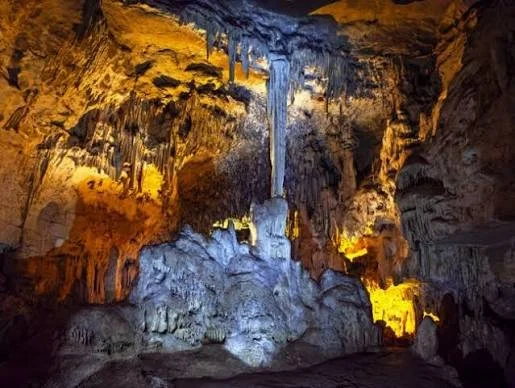
The cave environment itself contributes to the experience.
Darkness, acoustics, narrow passages, and unusual rock formations could have shaped how prehistoric people perceived the underground environment.
The artwork therefore cannot be separated completely from the physical cave.
The location of an image matters.
Its placement, visibility, accessibility, and relationship to other images may all provide clues about its significance.
The Cave as Archive
Arcy-sur-Cure can be thought of as a natural archive.
Each generation left traces.
Stone tools accumulated.
Bones were deposited.
Fire altered sediments.
Pigments remained on walls.
Ornaments were lost.
Later populations covered earlier deposits.
Over thousands of years, these layers became a chronological record.
Archaeologists effectively read the cave from bottom to top.
Archaeological Stratigraphy
Stratigraphy is one of the most important methods in archaeology.
In undisturbed deposits, deeper layers are generally older than layers above them.
At Arcy-sur-Cure, stratigraphy allows researchers to separate different phases of human occupation.
This is especially important because the same cave could be occupied by completely different human groups thousands of years apart.
Without stratigraphy, artifacts from different periods could easily be confused.
The Diversity of Finds
Arcy-sur-Cure has produced a remarkably diverse collection of archaeological material.
The French Ministry of Culture identifies evidence including:
stone industries,
bone industries,
ornaments,
pottery,
animal remains,
human remains,
and rock art.
This diversity allows researchers to reconstruct multiple dimensions of prehistoric life.
Stone tools reveal technology.
Bones reveal diet and hunting.
Ornaments reveal social or symbolic practices.
Pottery reveals later Neolithic lifeways.
Rock art reveals visual culture.
Human remains reveal biological history.
The Importance of Human Remains
Human fossils are particularly valuable because they allow researchers to identify the populations associated with particular layers.
At Grotte du Renne, for example, Neanderthal remains are associated with Châtelperronian layers.
This helps connect biological and cultural evidence.
The identification of human remains can therefore change interpretations of an entire archaeological layer.
Occupation Versus Continuous Occupation
The phrase "continuous occupation" should be used carefully.
Arcy-sur-Cure was not necessarily inhabited continuously.
There may have been:
long periods of abandonment,
short visits,
seasonal occupations,
population changes,
environmental changes,
and shifts in the preferred use of individual caves.
What is continuous is the archaeological sequence of repeated human presence.
This is arguably more scientifically interesting than literal uninterrupted habitation.
Why Did People Keep Returning?
The repeated use of Arcy-sur-Cure probably resulted from several factors.
Geography
The Cure River provided water and resources.
Shelter
The caves offered protection.
Animal resources
The surrounding environment supported hunting.
Landscape familiarity
Once a location became known as a useful resource area, later groups could return to it.
Symbolic significance
Decorated caves may have retained cultural importance long after their original creation.
A Changing Human Landscape
The people who used Arcy-sur-Cure did not necessarily think about the landscape in the same way.
A Neanderthal hunting group might have viewed a cave primarily as a temporary shelter or processing site.
Later Upper Paleolithic people may have incorporated it into a larger symbolic landscape.
Neolithic communities could have used the region differently again.
Thus, the same physical landscape acquired different meanings over time.
Arcy-sur-Cure and Human Evolution
The archaeological sequence is particularly valuable for studying the transition between different human populations.
It preserves evidence associated with:
Neanderthals → transitional cultural traditions → modern human Upper Paleolithic traditions → later prehistoric communities
This does not mean that cultural change occurred in a simple linear progression.
Different populations could overlap.
Technologies could persist.
Ideas could spread.
Local traditions could survive.
The archaeological record is therefore a history of interaction and change rather than a simple ladder of progress.
The Importance of Conservation
The caves are fragile environments.
Prehistoric pigments can be damaged by changes in humidity, temperature, microorganisms, and human activity.
This is why many important prehistoric caves around the world have restricted access.
The goal is to preserve archaeological evidence for future research.
The original caves at some major French sites have therefore been protected while replicas, digital resources, or controlled visits provide public access.
A Research Laboratory for Prehistory
Arcy-sur-Cure has also played an important role in the development of French prehistoric archaeology.
The caves have been investigated since the nineteenth century, while major scientific excavations in the twentieth century greatly expanded knowledge of the sequence.
The site remains an active research environment.
New methods—including:
improved dating,
ancient DNA,
paleoproteomics,
microscopic analysis,
3D documentation,
sediment analysis,
and advanced imaging—
continue to change how archaeologists interpret old collections.
Why Arcy-sur-Cure Is Exceptional
Few archaeological landscapes preserve such a broad sequence in such close geographic proximity.
The significance is not based on one spectacular object.
It comes from accumulation.
A stone tool here.
An animal bone there.
A Neanderthal tooth.
A Châtelperronian ornament.
A later Upper Paleolithic tool.
A painted animal on a cave wall.
A Neolithic artifact.
Together, these traces create a long narrative.
Conclusion
Arcy-sur-Cure is best understood not as a place of literally uninterrupted human habitation but as a remarkably long archaeological record of repeated human occupation.
Its caves preserve evidence extending from the Middle Paleolithic through the Upper Paleolithic, Mesolithic, and Neolithic.
Few places provide such an opportunity to observe how human behavior changed across such a long span of prehistory.
The site connects Neanderthals, early modern humans, later hunter-gatherers, and Neolithic communities within one landscape.
Its caves preserve technology, subsistence, human remains, ornaments, and some of France's important prehistoric art.
Arcy-sur-Cure therefore demonstrates that archaeology is not simply the study of isolated ancient objects.
It is the reconstruction of relationships across time.
A cave used by one population thousands of years ago could later become a shelter for another, a symbolic space for another, and an archaeological archive for us.
That extraordinary continuity of human presence—punctuated by periods of absence and change—is what makes Arcy-sur-Cure one of France's most valuable prehistoric landscapes.