Noisetier Cave, or Grotte du Noisetier, is a prehistoric cave site in the Aure Valley of the French Pyrenees that contributes important evidence to the study of Neanderthal lifeways, Middle Paleolithic technology, animal exploitation, and the behavior of human groups living in mountainous environments. Its archaeological significance, however, requires an important clarification. Despite the title used here, Noisetier Cave is not established as a Gravettian site containing the famous type of Upper Paleolithic "Venus" figurines. The principal archaeological record from the cave is associated with the Middle Paleolithic and Mousterian traditions, generally attributed to Neanderthals.
This distinction is important because the Gravettian is a much later Upper Paleolithic cultural tradition, generally associated with anatomically modern humans in Europe and famous for its female figurines, ivory objects, ornaments, and distinctive lithic technologies. Noisetier Cave instead belongs primarily to a much earlier archaeological world in which Neanderthal groups exploited mountain environments, processed animal carcasses, manufactured stone tools, and used caves as temporary occupation and activity locations.
The site is nevertheless extremely valuable because it helps reconstruct a part of European prehistory that is sometimes overshadowed by spectacular Upper Paleolithic art.
The Location of Noisetier Cave
Noisetier Cave is located in the Aure Valley of the Hautes-Pyrénées, in southwestern France. The cave is situated within a limestone landscape characteristic of the Pyrenean region.
Its popular French name, Grotte du Noisetier, refers to the hazel trees growing near its entrance.
The cave itself is relatively small compared with famous decorated caves such as Chauvet or Lascaux. Its archaeological importance does not come from monumental paintings but from the quantity and variety of evidence preserved within its deposits.
Excavations and investigations have documented Mousterian lithic material together with substantial faunal remains.
A Neanderthal Rather Than Gravettian Site
The chronological distinction is essential.
The Mousterian is broadly associated with Neanderthals across much of Europe during the Middle Paleolithic.
The Gravettian, by contrast, belongs to the later Upper Paleolithic.
These traditions differ in chronology, technology, subsistence patterns, and archaeological context.
Noisetier Cave's principal evidence belongs to the Mousterian tradition.
Consequently, it would be inaccurate to describe its archaeological record as a collection of Gravettian Venus figurines.
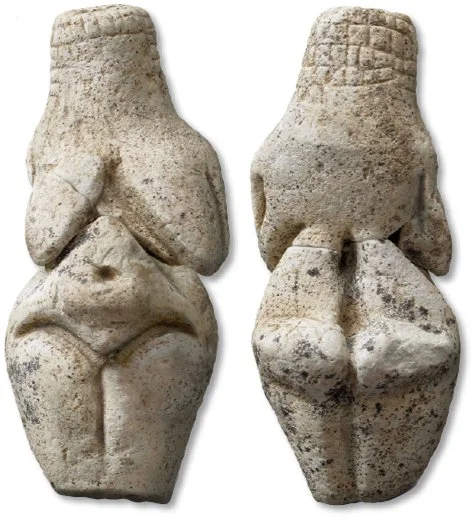
The famous European "Venus" figurines are instead associated with Upper Paleolithic contexts at sites such as Willendorf, Dolní Věstonice, Lespugue, Laussel, and Brassempouy.
The distinction is not merely terminological. It changes our interpretation of the people who occupied the cave.
What Archaeologists Found
The archaeological deposits of Noisetier Cave contain numerous stone artifacts and animal remains.
The faunal assemblage is particularly important.
More than 10,000 large-animal fossil remains and tens of thousands of identifiable small-rodent remains have been reported from the site. Mountain-adapted animals such as chamois and ibex are prominent, while deer and large bovines are also represented.
These remains allow archaeologists to investigate several questions:
What animals were hunted?
Which parts of carcasses were transported?
How were animals butchered?
How were bones processed?
Did carnivores later modify the remains?
What seasons might the cave have been occupied?
How did Neanderthals exploit mountainous environments?
Neanderthal Hunting and Butchery
Cut marks on animal bones provide evidence for human processing.
When stone tools are used to remove flesh, tendons, or other tissues, microscopic marks can remain on the bone.
These marks can be studied through taphonomic analysis, which examines what happened to archaeological remains between the death of an animal and their discovery by archaeologists.
At Noisetier Cave, human activity appears to have played a major role in the accumulation and modification of some animal remains, particularly deer and bovines.
This contributes to a broader picture of Neanderthal subsistence.
Neanderthals were not simply opportunistic scavengers wandering through Europe.
They were capable hunters who could exploit difficult environments and transport, butcher, and process animal resources.
The Mountain Environment
The Pyrenean setting is particularly significant.
Mountain environments present both opportunities and challenges.
Animals such as ibex and chamois are well adapted to steep terrain.
Successfully hunting them requires knowledge of:
seasonal movements,
feeding areas,
migration routes,
cliffs and slopes,
weather conditions,
and animal behavior.
The presence of mountain fauna at Noisetier therefore tells us something about the ecological knowledge of the site's inhabitants.
Neanderthals were capable of living in landscapes that demanded detailed environmental familiarity.
Stone Tools
The stone tools from Noisetier belong primarily to the Mousterian technological tradition.
Mousterian assemblages commonly include tools such as scrapers and other flaked implements.
The production of stone tools required knowledge of raw materials, fracture mechanics, and the intended function of different tool forms.
A tool could be used for:
cutting meat,
processing hides,
working wood,
shaping other materials,
or other tasks.
The archaeological record therefore represents not simply "stones," but evidence of technical decision-making.
Bone Retouchers
One particularly interesting category of material from Noisetier is bone retouchers.
A bone retoucher is an animal-bone fragment that was used to modify stone tools.
When a stone tool needed reshaping or sharpening, a Neanderthal could strike its edge with a hard piece of bone.
Repeated impacts leave characteristic marks.
The discovery of such evidence is important because it demonstrates a relationship between animal exploitation and stone-tool production.
An animal carcass did not necessarily provide only food.
Its bones could subsequently become tools used to manufacture or maintain other tools.
This illustrates a sophisticated pattern of resource recycling.
What About Venus Figurines?
The title's reference to "Gravettian Venus figurines" deserves particular clarification.
The European Gravettian is indeed famous for numerous female figurines, often referred to collectively as "Venuses." However, the term "Venus" is a modern archaeological label and should not be interpreted as proof that prehistoric people worshipped a goddess equivalent to the Roman Venus.
The meaning of these figurines remains uncertain.
Possible interpretations include:
representations of individuals,
symbolic female figures,
fertility-related imagery,
social identities,
ancestors,
teaching objects,
or objects whose meaning varied according to context.
Archaeologists generally avoid assuming a single universal interpretation.
Noisetier Cave should therefore not be used as evidence for Gravettian Venus traditions without additional archaeological evidence.
Why the Correction Matters
Correct chronology is fundamental to prehistoric archaeology.
Imagine placing a medieval castle into the Bronze Age simply because both are located in France.
The geographic association would be true, but the historical interpretation would be completely wrong.
The same principle applies to prehistoric caves.
A cave may contain evidence from several periods, but individual artifacts must be associated with the appropriate archaeological layers.
At Noisetier, the strongest evidence concerns Neanderthal Mousterian occupation and animal exploitation, not Gravettian figurine production.
The Importance of Noisetier Cave
Noisetier's significance therefore lies elsewhere.
It provides evidence for:
Neanderthal hunting,
mountain adaptation,
Mousterian technology,
carcass processing,
bone-tool production,
environmental exploitation,
and prehistoric occupation of the Pyrenean region.
It reminds us that prehistoric archaeology is not only about spectacular art.
Much of what archaeologists know about ancient humans comes from apparently ordinary materials: broken bones, stone flakes, damaged tools, hearth residues, and microscopic marks.
These traces allow researchers to reconstruct behavior that occurred tens of thousands of years ago.
Conclusion
Noisetier Cave should not be presented as a confirmed Gravettian Venus-figurine site. Its principal archaeological identity is instead that of a Middle Paleolithic/Mousterian site associated with Neanderthals.
That correction does not diminish its importance.
Quite the opposite.
The cave provides an opportunity to examine how Neanderthals lived in a demanding mountain environment, hunted animals, processed carcasses, produced stone tools, and used animal bones as technological resources.
Its story demonstrates an essential principle of archaeology: the most important discoveries are not always the most visually spectacular.
A small cave filled with fragments of stone and bone can reveal an extraordinary amount about the intelligence, adaptability, and daily lives of people who lived in Europe long before the appearance of the Gravettian artists.