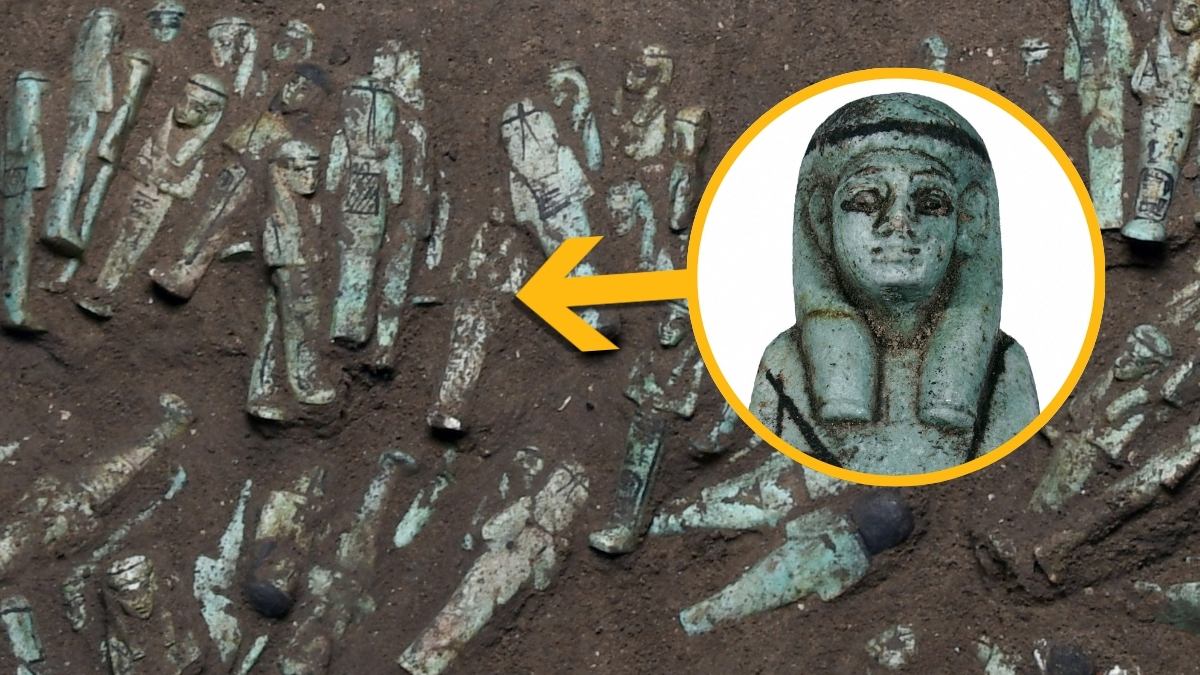
A significant discovery has been made in Tanis, the ancient Egyptian capital in the Nile Delta. Archaeologists uncovered 225 funerary figurines inside a tomb an extremely rare find that also helped resolve a long-standing archaeological question.
French Egyptologist Frédéric Payraudeau explained that this is the first time since 1946 that figurines have been found in their original position within a royal tomb in the Tanis necropolis. He noted that such intact discoveries are almost unheard of even in the Valley of the Kings near Luxor, where most tombs were looted long ago. The only comparable case was the famous discovery of Tutankhamun’s tomb in 1922.
Payraudeau, who heads the French excavation mission at Tanis, said the team made the remarkable find on October 9. Before this, archaeologists had already explored three corners of a narrow burial chamber that contained a massive, unidentified sarcophagus.
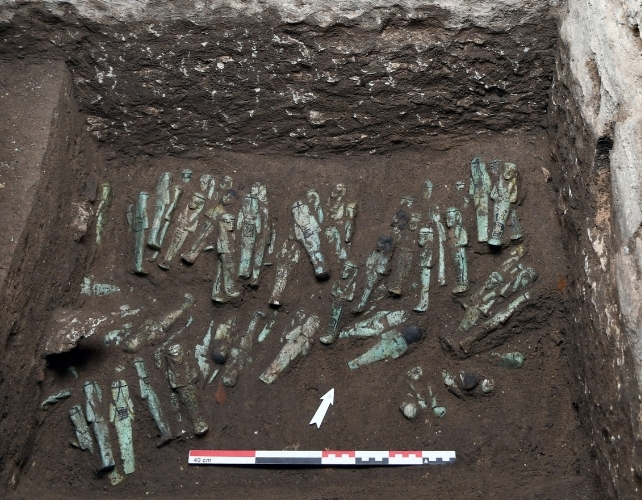
Hundreds of funerary figurines found in an ancient royal tomb.
When the team first spotted three or four figurines together, they immediately realized the discovery would be extraordinary, Payraudeau said. Excited, he ran to inform his colleagues and officials, but the timing added pressure it was the day before the weekend, and work usually ended at 2 pm. Determined not to stop, the team set up lights and worked through the night. Over the course of ten days, they carefully excavated all 225 small green funerary figurines, ensuring each piece was meticulously preserved.
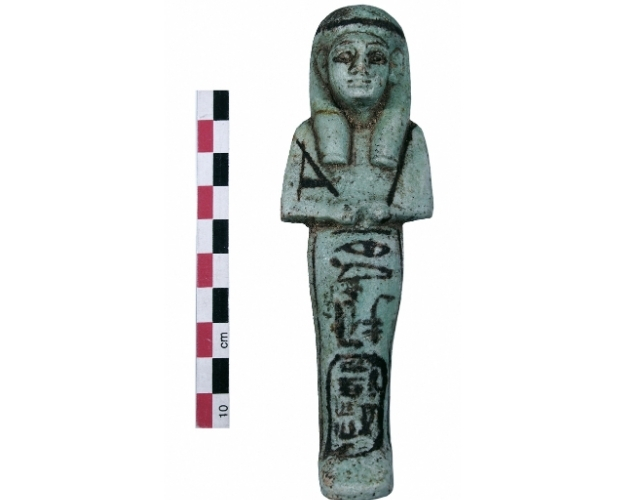
A funerary statuette, known as an ushbati, found in the royal necropolis of Tanis.
The 225 funerary figurines were carefully arranged in a star shape along the sides of a trapezoidal pit, with additional figures placed in horizontal rows at the bottom, Payraudeau explained. Known as ushabti, these small statuettes were meant to serve as attendants for the deceased in the afterlife. Remarkably, more than half of them are female, which is considered highly unusual.
Tanis, located in the Nile Delta, was founded around 1050 BC as the capital of the Egyptian kingdom during the 21st dynasty. By this time, the Valley of the Kings—looted over the years during the reigns of pharaohs like Ramses—had been largely abandoned, and the royal necropolis was relocated to Tanis.
The discovery also solved a long-standing mystery regarding the identity of the tomb’s occupant: Pharaoh Shoshenq III, who ruled from 830 to 791 BC. This was particularly surprising because the largest sarcophagus at a different tomb in Tanis also bears his name. Payraudeau noted that a pharaoh’s burial plans were often uncertain, as successors could alter or move the tomb, and in Shoshenq III’s case, his four-decade reign had been marked by a bloody civil war between Upper and Lower Egypt, making disruptions more likely.
Another possibility is that the sarcophagus had been relocated after looting, though its size—3.5 by 1.5 metres—makes such a move difficult to imagine. Once the study of the figurines is complete, they are set to be displayed in an Egyptian museum, offering the public a rare glimpse into the elaborate funerary practices of Tanis.