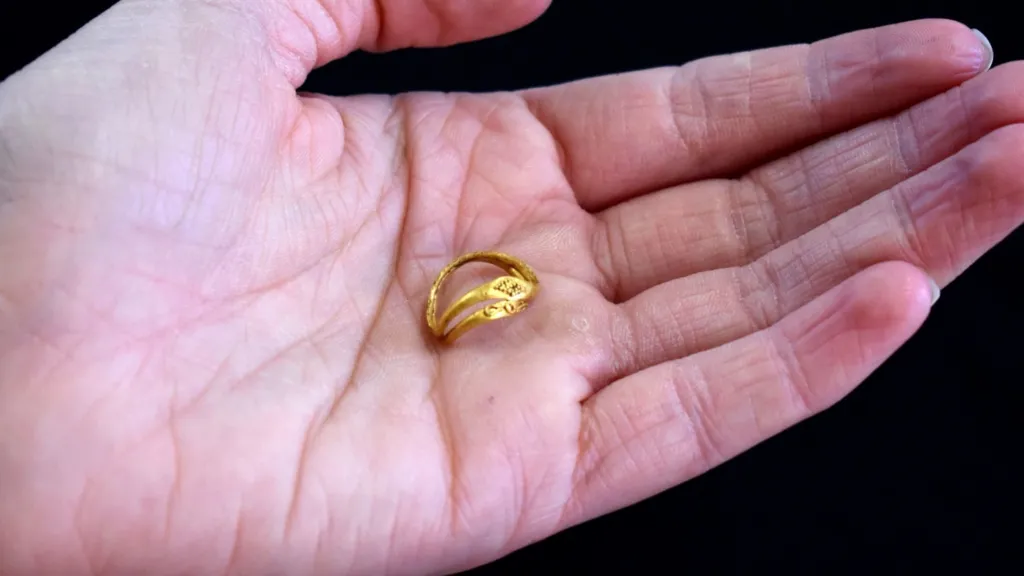
A striking pair of interlinked Roman gold rings, along with almost 100 fragments of marble, has been uncovered during excavations in Britain’s oldest recorded city.
Archaeologists in Colchester also found a sizeable piece of Roman flue tile—typically used in bathhouses or other elite buildings—alongside extensive Roman structural remains. The Colchester Archaeological Trust said the discoveries beneath St Nicholas Square are “only the tip of the iceberg.”
“It’s a bit like keyhole surgery,” said Adam Wightman of the trust. “We get brief chances to dig down and glimpse these early structures.”
Status and grandeur
The archaeological work took place between October 2023 and June 2025, ahead of redevelopment plans for St Nicholas Square. The excavations were carried out by the Colchester Archaeological Trust on behalf of Colchester City Council, and the site had not been investigated since the mid-1950s.
Wightman told the BBC that the recent findings confirm the presence of “very large, substantial Roman buildings,” likely rising several storeys high.
Eight pieces of Roman marble, varying in size and colour—including red, blue, and yellow—were among the materials recovered.
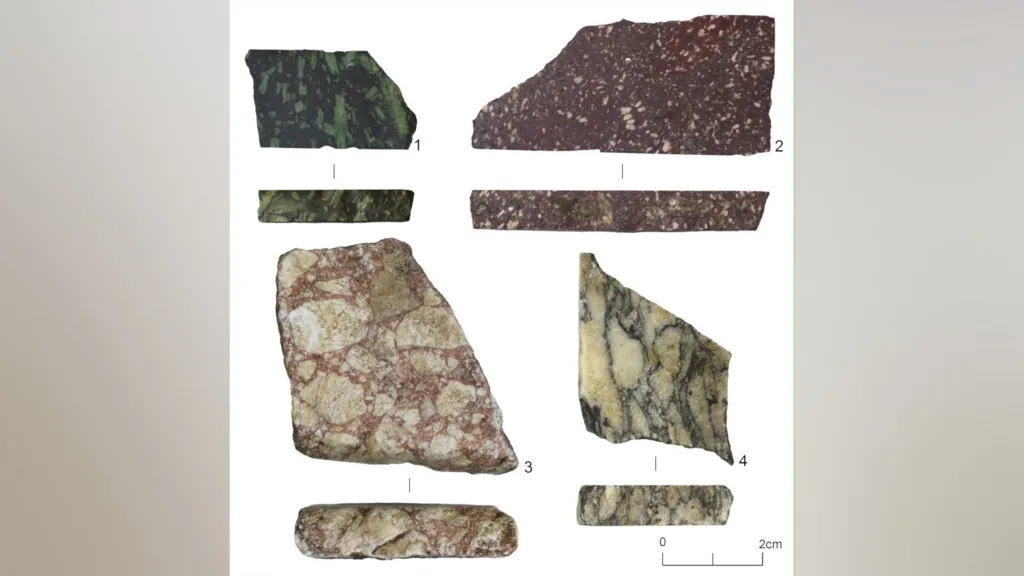
Almost 100 pieces of marble were discovered, including some imported from Greece, Egypt and Turkey
The trust said the finds highlight the “status and grandeur” of certain buildings on the site.
Wightman explained that the large fragment of flue tile bears an inscribed surface with a “distinctive pattern” made using a roller stamp.
“This stamped decoration is an exact match for examples recovered from the Roman bathhouse at Billingsgate in London,” he told the BBC.
“While it doesn’t conclusively prove there was a bathhouse here, it strongly supports the idea that these were high-status buildings, equipped with underfloor heating systems that channelled warm air up through the walls.”
‘Intimate find’
In total, archaeologists recovered 98 pieces of marble, some of which had been imported from as far afield as Greece, Egypt and Turkey.
“If we were able to fully excavate the site, we would be finding thousands upon thousands of marble fragments,” Wightman said, noting that around 2,000 pieces were uncovered during excavations in the 1950s.
“What we’ve found so far is really just the tip of the iceberg,” he added.
“All of this points to a far more complex and intriguing story about the buildings of Roman Colchester, closely linked to the evidence emerging from this area.”
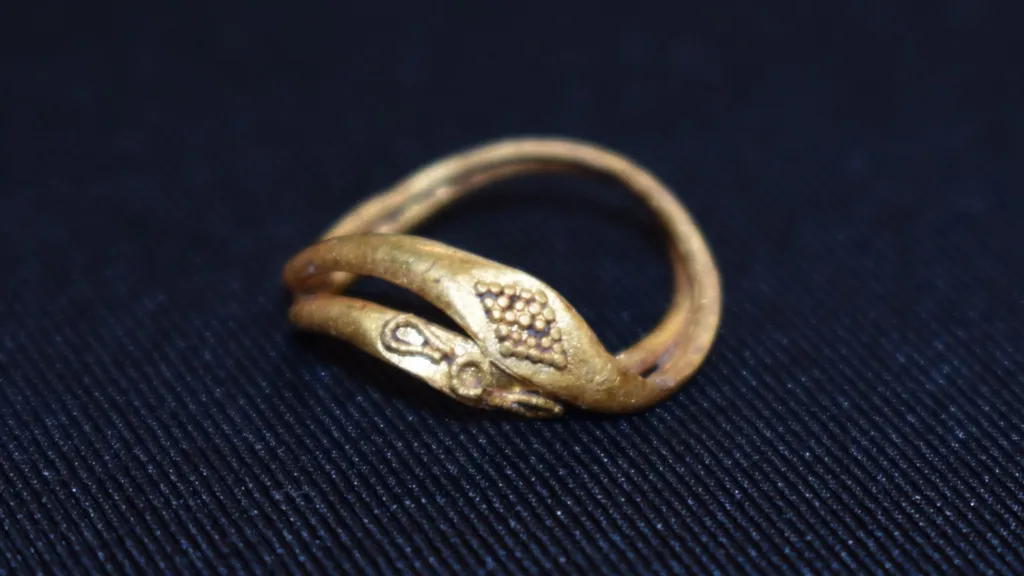
One of the conjoined rings is decorated with 25 tiny gold pellets, arranged in a diamond formation
The trust said the discovery of the linked gold rings—belonging to individuals of “considerable status”—was highly unusual and further supports the view that this area of Colchester was “a wealthy and important part of the city.”
The rings, likely made for a child based on their small size, are dated to between the 1st and 3rd centuries AD.
According to the trust, one ring is decorated with 25 tiny gold beads arranged in a diamond pattern, while the other features a flat, elongated bezel adorned with fine gold wire. The design forms a central circle flanked by drop-shaped motifs, possibly symbolising a flower.
Describing them as an “intimate find,” the trust said the rings serve as a reminder that Roman Colchester “was not only a place of buildings, but of people and families who lived within them.”
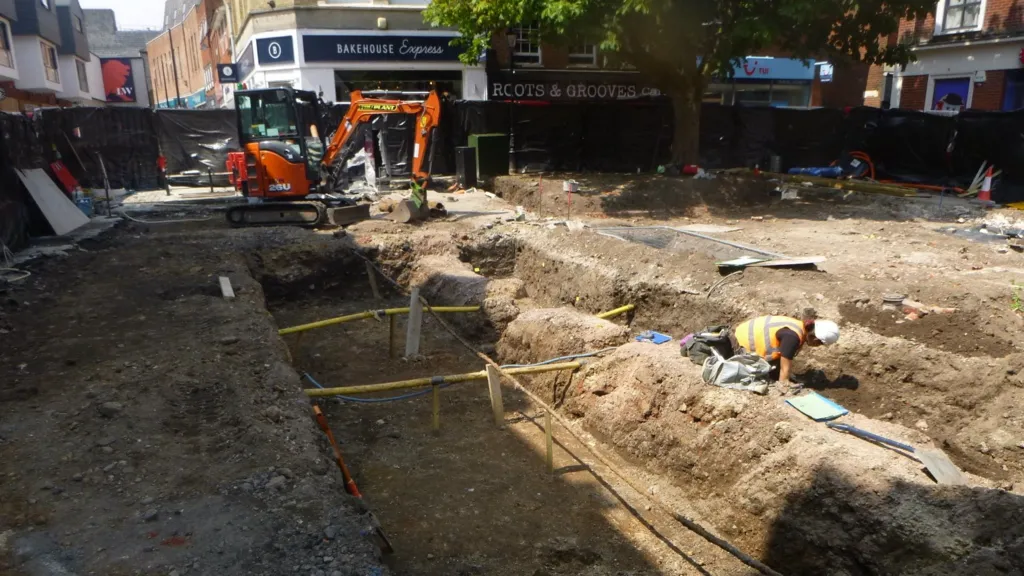
The discoveries were made during excavation work in Colchester's St Nicholas Square
Councillor Julie Young, deputy leader and cabinet member for housing at Colchester City Council, said she was “thrilled” by the discoveries, noting that they underscore “the city’s significance through the centuries and add greater richness to our story as Britain’s First City.”
She also thanked the Colchester Archaeological Trust for their careful and thorough work throughout the project.
“Their expertise ensures our heritage is properly respected and documented, while helping to create a vibrant public space for everyone to enjoy,” she said.
The council added that the redeveloped St Nicholas Square is “already proving to be extremely popular,” having hosted a Ferris wheel during the Christmas period, with monthly Sunday markets planned for the future.