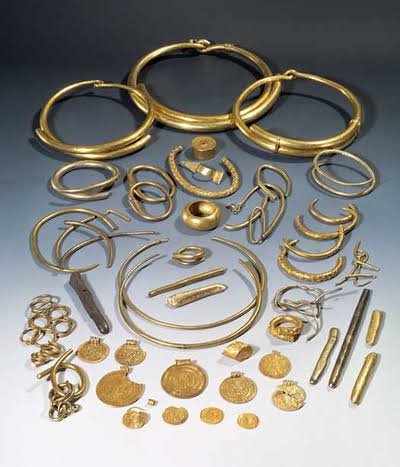
A hoard of coins, believed to have been concealed shortly before the Battle of Hastings, is among the notable discoveries featured in the 2024 Portable Antiquities Scheme (PAS) and Treasures report.
The scheme, administered by the British Museum, has highlighted this find along with several other standout objects included in the latest report.
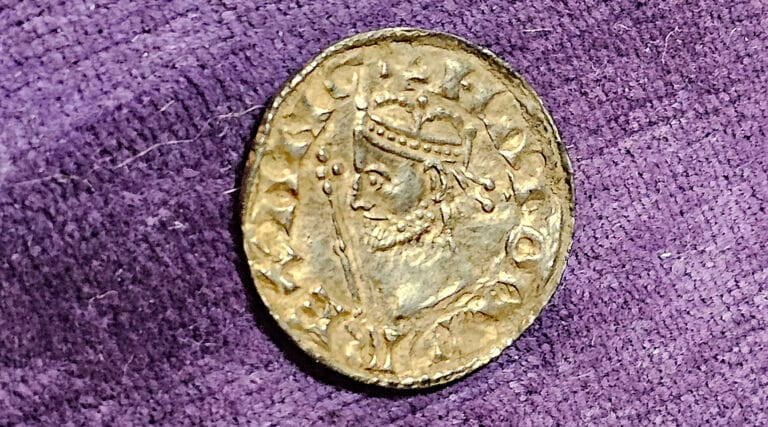
One of the 179 King Harold II silver coins discovered and included in the Treasure report
The report represents the third year in a row to set new records for the number of archaeological finds reported and objects officially declared treasure, helping to ensure their legal protection. Under the Treasure Act, anyone who uncovers a significant find is required to report it. This allows important artefacts to be secured for public collections before they can pass into private ownership, while also guaranteeing fair rewards for finders, most of whom are metal detectorists.
One of the most significant discoveries of 2024 is a hoard of 179 silver pennies dating to 1066. The coins were probably buried for safekeeping during the final weeks of Anglo-Saxon England, at a time when the kingdom’s future was deeply uncertain.
Notably, the hoard consists entirely of coins from the brief reign of King Harold II, indicating it was concealed very late in his rule. It may have been hidden as England prepared for invasion—either during the Norwegian assault led by King Harald Hardrada in September 1066, or in the tense weeks that followed, shortly before Harold confronted William of Normandy at the Battle of Hastings.
Harald Hardrada temporarily seized York after defeating English forces at the Battle of Fulford, near where the hoard was discovered, before being killed at Stamford Bridge. Harold II’s army then undertook a gruelling forced march south, only to face the Norman invasion almost immediately afterwards.
The hoard captures one of history’s great “what if” moments. Had Harold’s forces not been weakened by the northern campaign, the outcome at Hastings—and the future of English history—might have been very different.
The highest numbers of Portable Antiquities Scheme finds were recorded in Norfolk (7,120), Suffolk (5,410), Lincolnshire (5,133), and Gloucestershire (5,034), all predominantly agricultural counties with rich archaeological landscapes. Over the same period, Norfolk (138), Hampshire (110), and North Yorkshire (109) recorded the most Treasure finds. More than 92% of all objects were recovered from cultivated land, where archaeological remains are particularly vulnerable to damage from farming.
Also displayed was a rare, complete Roman copper-alloy vehicle fitting discovered by a detectorist in Essex. Such fittings are uncommon in Britain and were likely attached to a carriage or wagon body, or to the yoke used to harness draught animals.
One interpretation suggests the piece depicts a panther placing its paw on the head of a defeated Englishman who may have incurred Roman punishment. Although most items classed as treasure are made from precious metals, this object was deemed so historically significant that it was designated treasure despite being copper alloy, enabling a museum to acquire it.
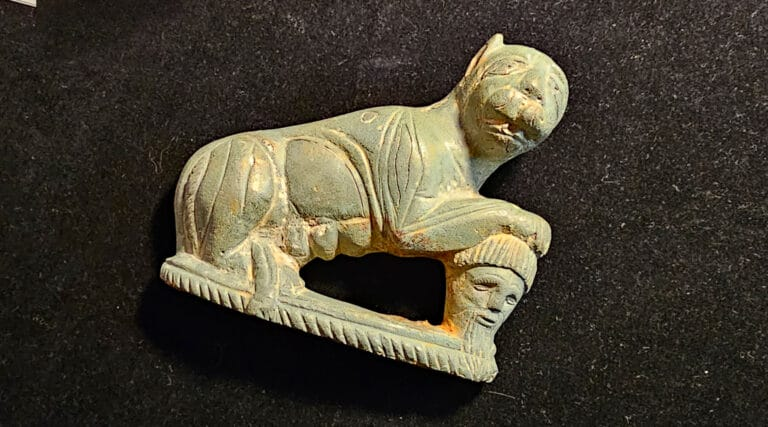
The Essex panther
The final item presented at the event was a group of Early Medieval precious metal objects recovered from ploughed farmland in Wiltshire. The assemblage includes a silver, gold, and garnet bird’s-head terminal with elephant ivory inlays—possibly once attached to a drinking horn—along with several gold rings and other metal artefacts. Discovered by metal detectorists just metres apart, the objects may represent the remains of a high-status Early Medieval burial. Collectively, they offer valuable insight into elite life and long-distance connections during the period.
A follow-up excavation is scheduled to take place in the coming months, led jointly by Cardiff University and the Portable Antiquities Scheme.
Dr Nicholas Cullinan OBE, Director of the British Museum, said: “The British Museum is proud to manage the Portable Antiquities Scheme and the Treasure process. Together, they play a crucial role in safeguarding and documenting Britain’s past, ensuring that extraordinary discoveries made by the public are protected, researched, and shared with all.”
The British Museum has also placed the exceptionally rare Tudor Heart on display in its Treasures Gallery on the ground floor, as efforts continue to raise £3.5 million to secure it for the nation. It was announced this morning that the Art Fund has contributed £400,000 to the campaign. Visitors can now also make smaller contributions using a tap-to-donate screen located beside the display.
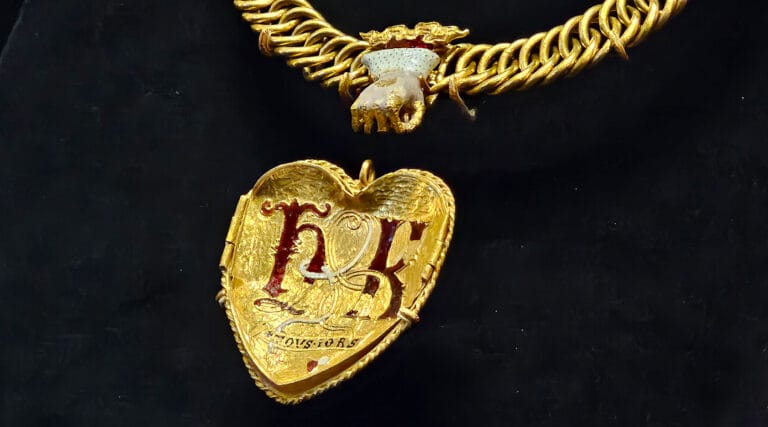
Tudor Heart on display at the British Museum
It was also announced that the Portable Antiquities Scheme (PAS) website will undergo an upgrade later this year. The improvements are expected to make it much simpler for finders to record and report their discoveries, while also making it easier for the public to explore what has been found and see which museums have acquired objects for public display.