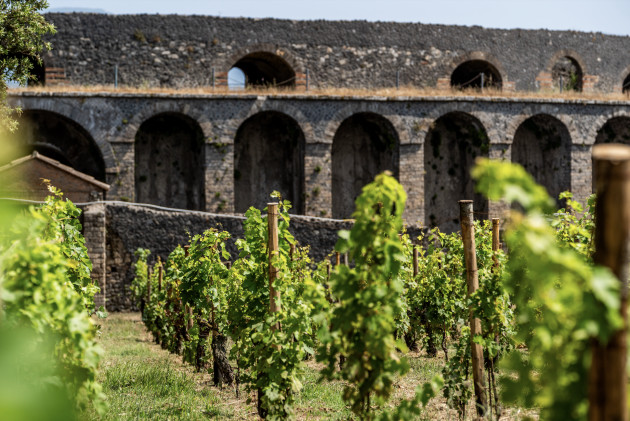
The Pompeii Wine Project is blending history, culture, and viticulture in a uniquely immersive way. Launched in late February at the Italian Cultural Institute in London, the initiative—dubbed “Cultivating History”—aims to plant vineyards within the boundaries of the Pompeii Archaeological Park. The goal is not only to produce wine but also to revive its historical role as a cultural ambassador, connecting modern visitors to the Roman past.
A collaboration between Campania producer Feudi di San Gregorio, local government, and Pompeii’s archaeological authorities, the project combines sustainable wine production with heritage preservation. One plot has already been planted with regionally indigenous grape varieties, and five more are being developed, including Greco, Aglianico, Piedirosso, Falanghina, and Sciascinoso. A winery and tasting area are also under construction within the ancient city.
Gabriel Zuchtriegel, director general of Pompeii Archaeological Park, emphasized the historical and cultural continuity: “The Italian landscape has been created, and is still being created, by the women and men that still work the land. We are looking to cultivate vines in vineyards that were vineyards 2,000 years ago.” He highlighted that in 79 AD, before Vesuvius erupted, the slopes were covered in vineyards—a vivid reminder of the intertwined tangible and intangible heritage at Pompeii.
From a viticultural perspective, the project combines ancient practices such as albarello vine training with modern, fully organic winemaking techniques. Fermentation will employ both tonneau barrels and amphorae, creating a bridge between Roman tradition and contemporary craftsmanship. Antonio Capaldo, president of Feudi di San Gregorio, described the project as “a little bit ambitious, creating a unique wine experience for the world,” emphasizing the cultural resonance of cultivating volcanic soils untouched for two millennia.
The project also underscores biodiversity, prioritizing indigenous grape varieties and highlighting the Romans’ historical approach of planting vines and olives as a statement of permanence: “The Roman’s planted vines and olives wherever they went, the message was ‘we are here to stay’, so this is central to our culture,” Capaldo explained.
While some experimental batches are already underway, the first full commercial bottling is expected around 2028, when the vines reach maturity. Beyond wine, the initiative is envisioned as a celebration of longevity, community, and heritage—an antidote to modern society’s fast-paced, self-focused tendencies, offering a tangible connection to Pompeii’s enduring legacy.
The Pompeii Wine Project thus transforms the ancient site into a living landscape, where visitors can experience history not only through ruins but also through taste, cultivation, and shared culture.