Archaeologists working in southern Russia have uncovered the remains of an ancient board game that may represent a very early ancestor of strategic games such as Chess. The discovery offers new insight into cultural exchanges between ancient Mesopotamia and the Eurasian steppe during the fourth millennium BC.
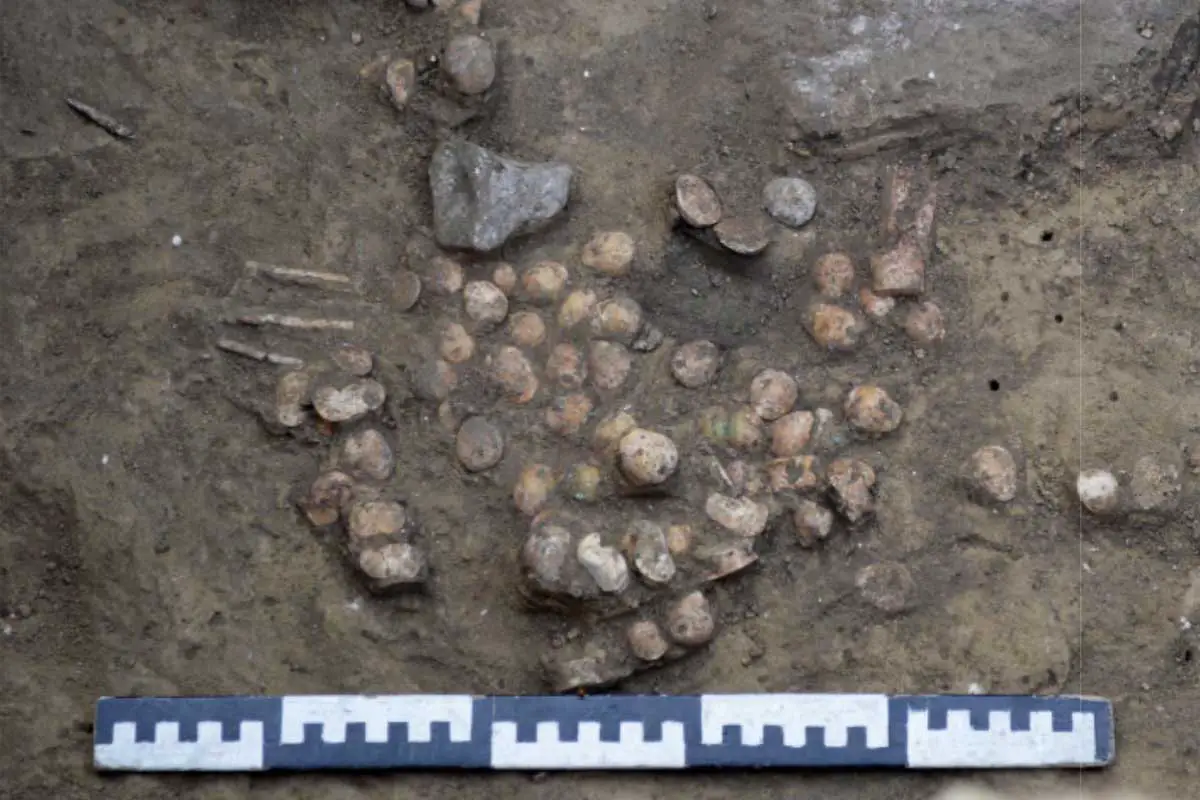
The gaming set was discovered in a burial mound known as Aglitsky I burial mound, located in the Aksaysky District of southern Russia. At the center of the find was a game board divided into two sections by a crossbar. Positioned at the middle stood a stylized human-like figure mounted on a small pedestal, suggesting it may have held symbolic or ritual significance within the game.
Around the board, archaeologists recovered more than fifty small hemispherical gaming pieces carved from bone. These tokens had flat bases and were fashioned from the epiphyses of sheep or ram femurs, indicating that considerable care was taken in shaping them into usable counters.
Based on earlier discoveries linked to the Konstantinovka cultural horizon in the Lower Don region, researchers believe the board game may reflect traditions that originated much farther south. Early board games with patterned squares are known to have appeared in ancient Mesopotamia during the fourth millennium BC, where they were played on boards divided into large and small squares.
Scholars suggest that these gaming traditions may have spread northward through the movement of groups connected to the Uruk culture, one of the earliest urban civilizations in Mesopotamia. These groups may have introduced portable gaming boards—possibly made from leather or textiles painted with squares—along with sets of playing pieces.
The burial context of the find adds another layer of meaning. The gaming set was placed beside the remains of an individual buried on their right side in a curled position. Other objects discovered in the grave included two pointed-bottom ceramic vessels, flint cores, and a stone tool.
Researchers believe the presence of the board game in a funerary setting may indicate that games carried symbolic or ritual importance in ancient societies. Some scholars suggest that such games may have been linked to ideas about fate or the journey of the soul after death.
Although more research is needed, the discovery provides rare archaeological evidence showing how games, migration, and belief systems may have intersected across prehistoric Eurasia, illustrating the deep cultural connections between distant regions thousands of years ago.