More than three million years before the rise of ancient civilizations, a small-brained upright-walking hominin moved across what is now South Africa. Known as “Little Foot,” this remarkable fossil has long fascinated scientists because it represents one of the most complete early human skeletons ever discovered.
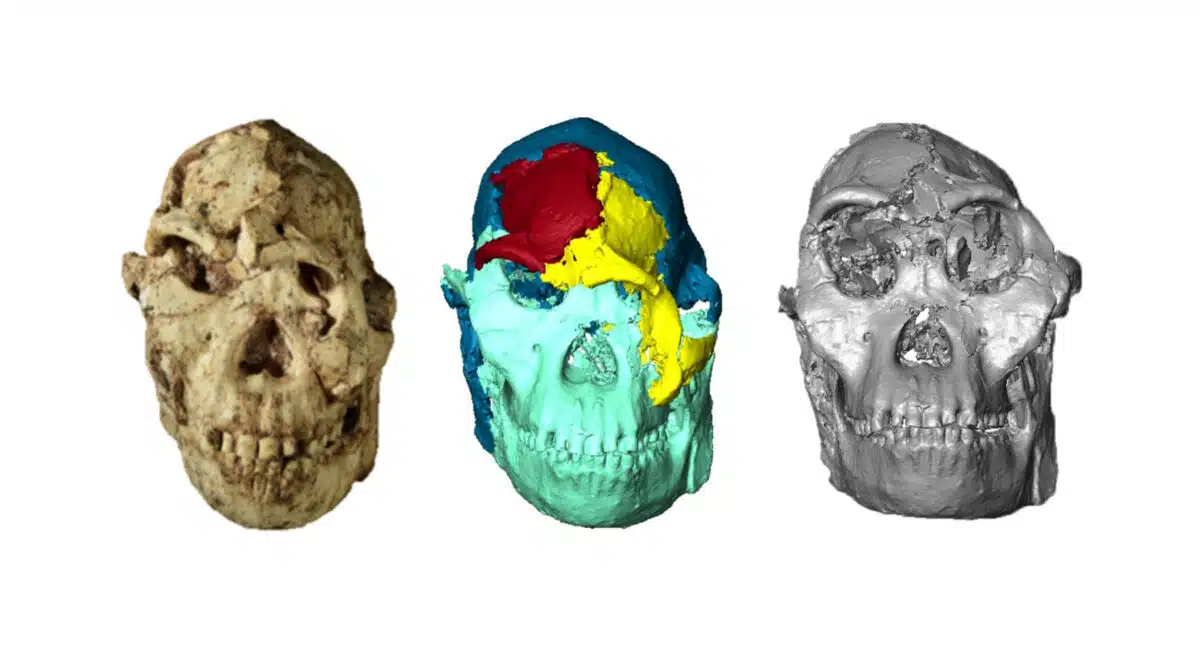
Researchers have now taken an important step toward understanding this ancient relative by digitally reconstructing its face for the first time. Using advanced imaging technology capable of seeing through rock and fossilized bone, scientists created a detailed reconstruction that revealed an unexpected pattern. The facial structure appears to resemble ancient hominin relatives from eastern Africa more closely than fossils found nearby in southern Africa.
This finding contributes to a long-standing debate in paleoanthropology about how early human ancestors evolved across the African continent. Scientists have questioned whether early members of the genus Australopithecus developed independently in different regions or whether populations across Africa shared closer evolutionary connections than previously thought.
Little Foot is believed to belong to the species Australopithecus prometheus and is among the oldest known hominins discovered in southern Africa. Its skeleton was uncovered in the famous Sterkfontein Caves, an important fossil site that has produced many discoveries related to early human evolution. Over millions of years underground, the skull became distorted as geological forces shifted and compressed the surrounding rock. When researchers finally completed the delicate excavation process, the facial bones were fragmented and displaced, making traditional reconstruction extremely difficult.
To overcome this challenge, scientists used a powerful synchrotron imaging facility known as the Diamond Light Source. This advanced particle accelerator produces extremely intense X-rays capable of penetrating rock and fossil material with remarkable precision. The process generated more than 9,000 cross-sectional images of the skull, revealing hidden details that could not be seen from the surface.
Using specialized digital software, researchers separated bone fragments from surrounding rock layer by layer. They then identified several large sections of the skull that had shifted over time and digitally repositioned them to restore their original arrangement. Portions of the face that were too damaged were reconstructed by mirroring intact areas from the opposite side of the skull, allowing scientists to produce a complete facial structure.
Once reconstructed, the face was compared with a range of primate species, including modern humans and great apes, as well as other well-known fossils from the genus Australopithecus. Scientists mapped dozens of anatomical reference points across the skulls and measured multiple facial dimensions. By analyzing these shapes digitally, they were able to see how closely Little Foot resembled different fossil groups.
The results suggest that certain facial features may have been shared across early Australopithecus populations living in both eastern and southern Africa. This possibility hints that ancient hominin groups across the continent may have been more connected than previously assumed, perhaps through migration or shared ancestry.
However, researchers caution that these conclusions remain preliminary. Fossilization can distort bones over millions of years, and further studies may refine or even alter the reconstruction. Future work correcting for geological deformation could provide an even clearer picture of Little Foot’s appearance and evolutionary relationships.
Even so, the reconstruction marks a major milestone. By combining cutting-edge imaging technology with digital reconstruction methods, scientists are bringing ancient relatives back into view and uncovering new clues about the complex story of human evolution.
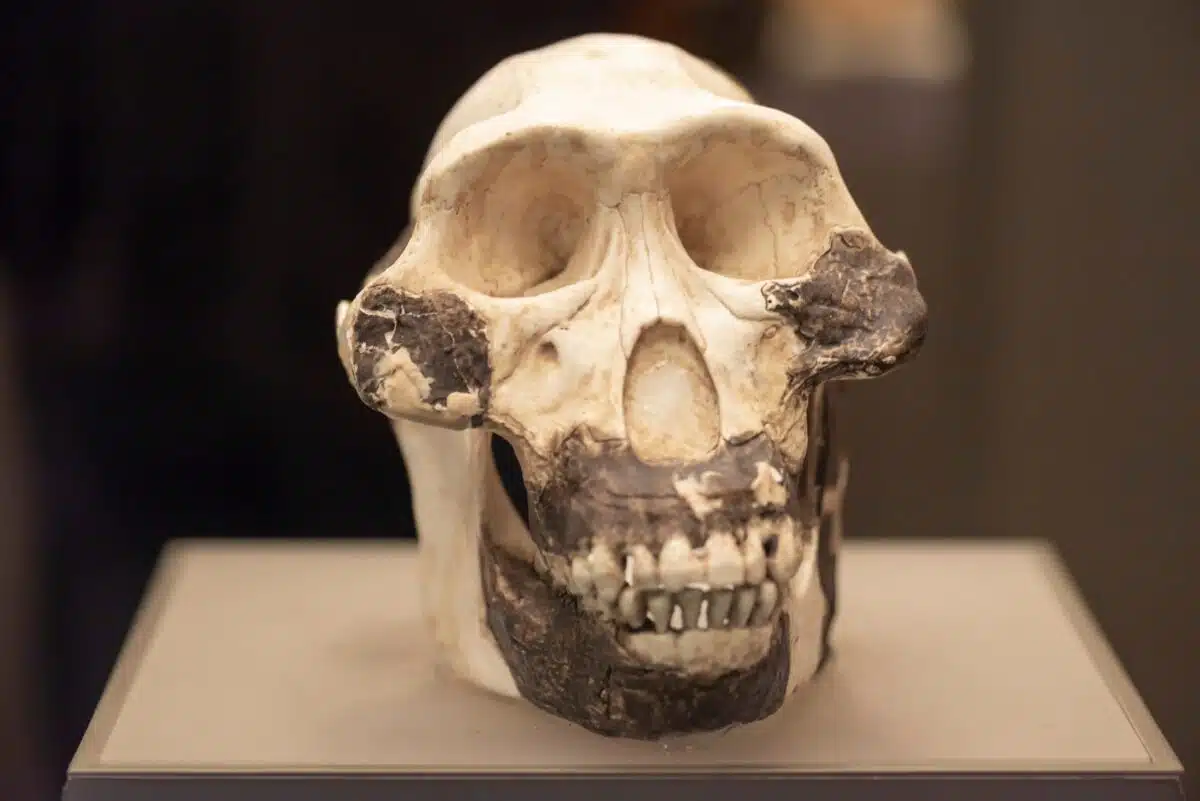
Australopithecus is a genus of early hominins that lived millions of years ago
Further comparisons revealed that Little Foot’s reconstructed face shares stronger similarities with an ancient fossil from Ethiopia than with another skull found in the same South African cave system. In multiple digital shape analyses, Little Foot’s facial structure grouped more closely with the Ethiopian specimen known as A.L. 444-2, while showing clearer differences from the southern African skull called Sts 5.
The comparisons also showed that both Little Foot and the Ethiopian fossil share broader facial characteristics with modern great apes such as chimpanzees and orangutans. These similarities are based on overall facial proportions rather than direct evolutionary relationships, but they help scientists understand how early hominin faces were structured.
When researchers looked at overall size, Little Foot’s face turned out to be among the larger specimens known within the genus Australopithecus. Some of its measurements fall within the same range seen in larger primates like gorillas and orangutans. One striking feature is the shape of the eye sockets. Little Foot’s orbits are large and oval, resembling those seen in orangutans and the Ethiopian fossil A.L. 444-2, rather than the more rectangular eye sockets observed in the South African specimen Sts 5. Variations in orbit shape are significant because this region of the skull differs across Australopithecus species and may reflect evolutionary changes in facial anatomy over time.
The skull known as Sts 5, which is slightly younger and also comes from the Sterkfontein Caves, shows a noticeably different facial structure, particularly around the eye region. Scientists are still uncertain whether these differences represent separate evolutionary lineages, normal variation between individuals, or differences between species.
Taken together, the findings suggest that some facial traits may have been shared among early Australopithecus populations living across both eastern and southern Africa during the Pliocene epoch. Little Foot in the south and the Ethiopian skull appear to display a similar facial pattern despite being separated by large distances and significant spans of time. If Sts 5 truly represents a typical southern African form, this could mean that facial structures within the genus developed along slightly different paths in different regions of Africa.
Researchers emphasize that the reconstruction is still considered preliminary. The digital reassembly of the skull relied mainly on visual alignment of the fossil fragments, and it does not yet correct for the subtle distortions that fossils accumulate after millions of years underground. Future studies using advanced modeling techniques may adjust the reconstruction to account for these geological changes and provide a more precise picture of the original anatomy.
Even with these limitations, the reconstruction of Little Foot’s face offers an important new piece of evidence in the study of human origins. By combining modern imaging technology with fossil analysis, scientists are gradually uncovering more details about how early members of the genus Australopithecus lived and evolved across the African continent.