Introduction
The Viking Age is often remembered for spectacular ships such as the Oseberg and Gokstad vessels, but our understanding of Viking maritime culture depends on a much larger archaeological record. Among the lesser-known examples associated with Norway's Viking ship tradition is the vessel from Hoprekstad, representing the sophisticated shipbuilding culture that allowed Scandinavian sailors to travel across coastal waters and beyond.
Viking ships were not simply transportation devices. They were technological systems that combined woodworking, hydrodynamics, sailing knowledge, navigation, logistics, and social organization.
The development of such ships transformed Scandinavian mobility during the early medieval period.
Why Ships Were So Important
Norway's geography encouraged maritime transportation.
Mountains, fjords, islands, and rugged coastlines made overland travel difficult. Boats could provide a faster and more efficient method of moving people and goods.
A capable vessel could carry cargo, livestock, warriors, and supplies.
This maritime infrastructure contributed directly to the expansion of Viking Age trade and warfare.
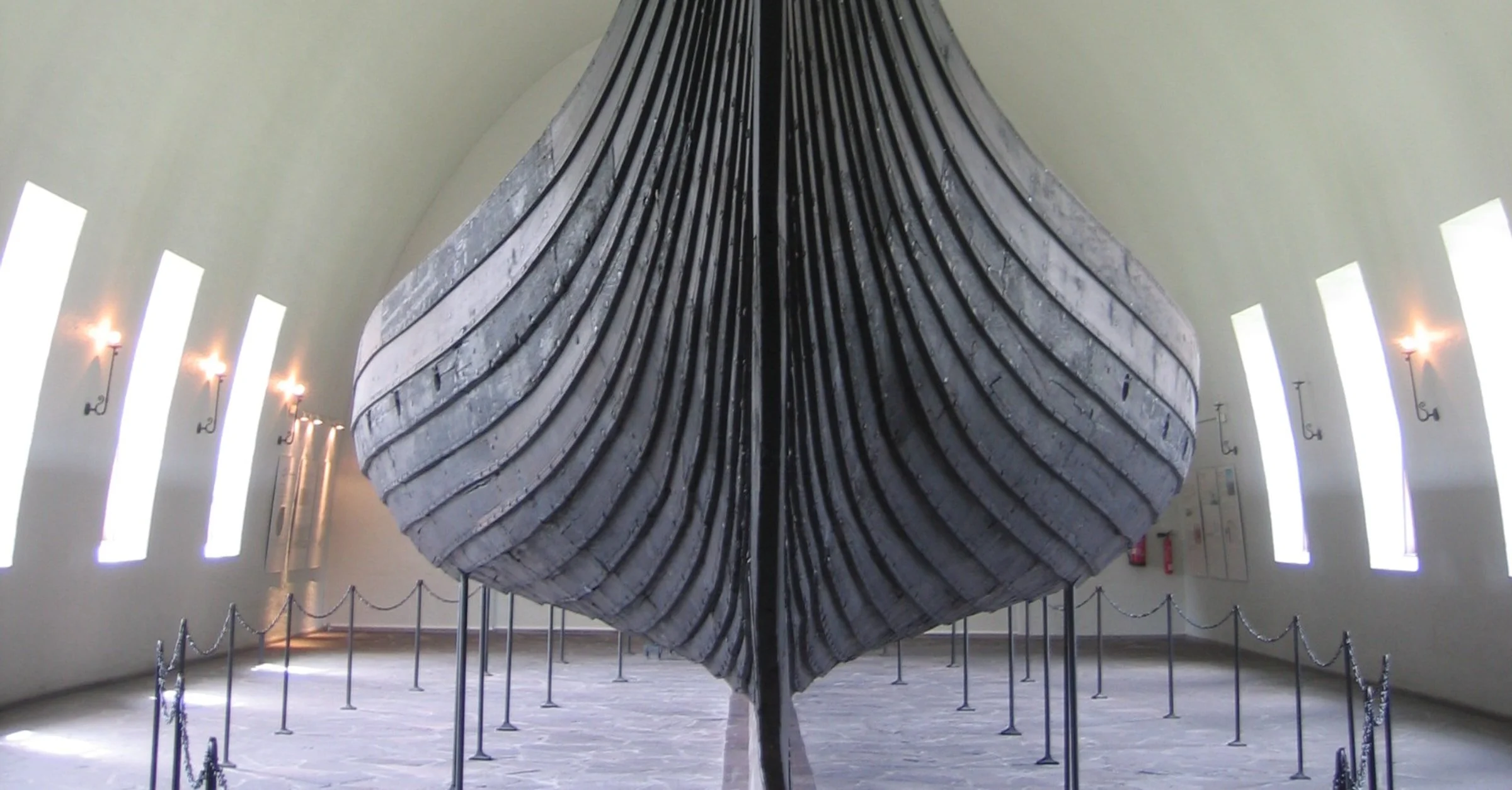
Clinker Construction
The characteristic Scandinavian technique was clinker construction.
Instead of beginning with a thick solid hull, shipbuilders arranged overlapping planks along the sides of the vessel.
These overlapping boards created a flexible but strong hull.
The technique had several advantages.
It reduced weight, allowed controlled flexibility, and produced a hull capable of operating in rough water.
The planks could be fastened with iron rivets or other appropriate connections, while internal frames and crossbeams provided additional structural strength.
Selecting Timber
Ship construction began with the forest.
Builders needed suitable trees for different components.
Straight-grained timber was particularly valuable for planking, while naturally curved pieces could be useful for structural elements.
The shape of a tree could influence the shape of a component.
This meant that shipbuilding depended on careful observation of natural materials.
Medieval shipwrights effectively designed vessels around the properties of the timber available to them.
The Viking Sail
The introduction and widespread use of large sails dramatically increased the capabilities of Scandinavian ships.
A sail allowed the wind to provide much of the vessel's propulsion.
This did not eliminate the need for oars.
Oars remained essential when maneuvering in harbors, rivers, narrow passages, or periods of calm weather.
The combination of sail and oar gave Viking ships exceptional flexibility.
The Human Element
A ship's performance depended on its crew.
Sailors had to coordinate steering, rowing, sail handling, anchoring, loading, and navigation.
Long-distance voyages required knowledge of coastlines, weather patterns, currents, winds, and seasonal conditions.
This knowledge was probably transmitted through practical experience and oral traditions.
Ships and Viking Society
Ships had social significance.
Owning, commissioning, or commanding a substantial vessel required resources.
A ship represented investment in timber, iron, labor, and skilled craftsmanship.
Consequently, ships could symbolize political power and social status.
They also facilitated relationships between distant communities.
Ships and Warfare
The image of the Viking longship as an unstoppable war machine is somewhat simplified.
Viking vessels were effective because of their combination of speed, shallow draft, and flexibility.
A shallow-draft ship could approach beaches and travel into waterways that larger vessels could not easily reach.
This allowed warriors to choose landing locations quickly.
Mobility was therefore a major military advantage.
Ships and Trade
The same characteristics that made Viking vessels useful for warfare also made them valuable for commerce.
Merchants could transport commodities along Norway's coast and across the North Atlantic.
Viking trade networks connected Scandinavia with Britain, Ireland, continental Europe, the Baltic, and beyond.
The archaeological record demonstrates that Viking maritime activity was not exclusively raiding.
It involved trade, migration, diplomacy, exploration, and settlement.
Archaeological Importance
Ship remains are unusually valuable archaeological evidence because they preserve construction details that are rarely visible in written sources.
A vessel can reveal:
plank dimensions;
timber selection;
fastening techniques;
hull shape;
repair history;
construction sequence;
evidence of use.
These details allow archaeologists to reconstruct technological traditions.
Conclusion
The Hoprekstad ship belongs to the broader technological world that made the Viking Age possible.
Its significance lies not simply in being an old vessel but in representing a sophisticated maritime tradition developed through generations of experimentation.
Viking shipbuilders understood how to manipulate timber, design flexible hulls, balance sail and oar propulsion, and construct vessels suited to Norway's challenging waters.
These technologies transformed the possibilities of movement across the medieval North Atlantic.
The Viking Age was therefore, in many respects, an age of maritime engineering—and ships such as the Hoprekstad vessel provide the archaeological foundation for understanding that transformation.