Introduction
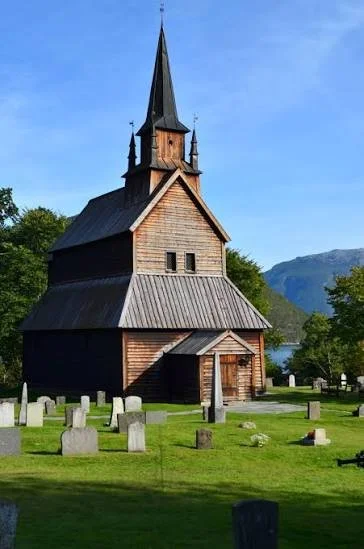
Kaupanger Stave Church is one of the most important surviving medieval timber churches in Norway. Situated in the Sogn region of western Norway, the church occupies a landscape historically shaped by fjords, agriculture, maritime transportation, and long-distance communication.
Its survival provides an extraordinary opportunity to examine the architectural and technological achievements of medieval Norwegian builders.
Kaupanger is particularly valuable because its construction and later history preserve evidence of the evolution of stave architecture. The church demonstrates that medieval timber architecture was not primitive or improvised. It was a highly developed construction system requiring careful planning, specialized craftsmanship, and extensive knowledge of wood.
Kaupanger and the Sogn Landscape
Sogn is characterized by dramatic fjords and mountainous terrain.
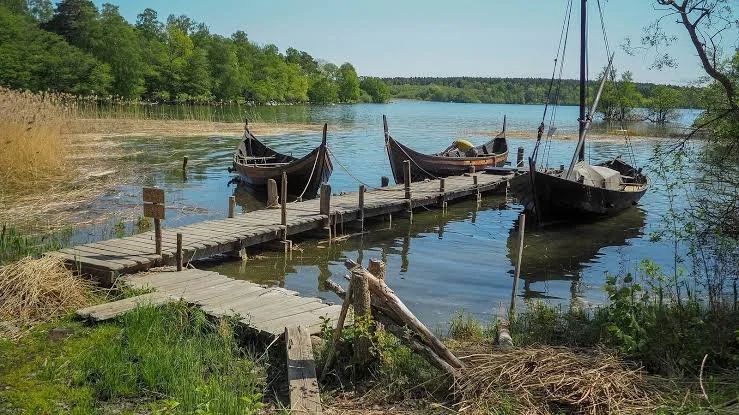
Travel through such a landscape historically depended heavily on water.
The fjords functioned as transportation corridors, allowing people and goods to move between settlements. This gave communities along the waterways strategic and economic importance.
Kaupanger developed in this broader environment as an important settlement and trading location.
A substantial church in such a location therefore had significance beyond its immediate religious function.
The Stave Construction System
Kaupanger belongs to the stave church tradition.
Its principal structure consists of vertical timber staves connected by horizontal beams and supported by additional structural components.
The system is remarkably sophisticated.
Instead of depending primarily on thick masonry walls, builders created a timber framework capable of carrying substantial roof loads.
This was particularly advantageous in Norway, where forests provided abundant construction material.
Medieval Carpentry
Constructing a large stave church required skilled carpenters.
Trees had to be selected carefully, transported to the construction site, shaped, and assembled.
The craftsmen worked with hand tools such as axes, chisels, and woodworking planes.
Without modern measuring equipment, builders relied on geometric principles, practical experience, standardized proportions, templates, and repeated construction knowledge.
The accuracy visible in surviving medieval timber buildings demonstrates the effectiveness of these methods.
A Church Within a Christianizing Society
Kaupanger's church emerged within the broader transformation of Norwegian society following the adoption of Christianity.
Christianization changed religious practices, burial customs, festivals, social institutions, and political relationships.
Churches became permanent physical expressions of the new religious system.
They also provided communities with spaces for rituals marking important stages of life.
Architectural Continuity
One of the most fascinating aspects of stave churches is their combination of innovation and continuity.
Christian architecture introduced new forms and spatial requirements. Yet local builders continued using traditional Scandinavian techniques.
This created buildings that were unmistakably Christian but also distinctly Nordic.
Carved animal motifs and interlaced decoration demonstrate how Scandinavian artistic vocabulary survived within Christian contexts.
The Importance of Timber
Timber was more than a convenient building material.
It shaped Norwegian architecture.
Stone was available in Norway, but transporting and shaping large quantities of masonry could be expensive and difficult, especially in remote regions.
Wood could be harvested locally.
The challenge was ensuring durability.
The survival of Kaupanger demonstrates that medieval builders were able to protect timber from many of the environmental conditions that normally cause wooden buildings to deteriorate.
Archaeological Information From Wooden Buildings
Wooden buildings can provide unusually detailed chronological evidence.
Annual growth rings record environmental conditions during the life of a tree. When these sequences can be matched with regional tree-ring chronologies, researchers can sometimes determine when particular timbers were felled.
This makes dendrochronology an important tool in the study of stave churches.
Researchers can also examine tool marks and construction joints to understand how medieval craftsmen worked.
The church therefore preserves technological evidence as well as architectural evidence.
Changes Through Time
Kaupanger was not preserved because history stopped.
Like other long-lived churches, it experienced repairs, alterations, and changing functions.
Each generation inherited the building and made decisions about how to maintain it.
These changes reveal changing attitudes toward architecture, worship, and practical requirements.
Modern conservation therefore seeks to preserve both the medieval structure and evidence of its later history.
Why Kaupanger Matters
Kaupanger Stave Church is particularly important for understanding western Norway because it connects architecture with a landscape dominated by maritime communication.
Its existence demonstrates how Christianity became embedded within communities connected by fjord networks.
The church also illustrates the high level of engineering achieved by medieval Norwegian carpenters.
Conclusion
Kaupanger Stave Church is a remarkable survival from medieval Norway.
Its timber framework, architectural proportions, and long history demonstrate the sophistication of stave construction. Its location in the Sogn region places it within a landscape where fjords served as major transportation routes and settlements depended upon maritime communication.
The church also tells a larger story about cultural transformation.
Christianity brought new religious institutions to Norway, but local craftsmen expressed those institutions through traditional woodworking technologies and Scandinavian artistic traditions.
Kaupanger therefore stands as a monument to both religious change and technological continuity—a building in which the Christian Middle Ages of Norway remain visible in timber.