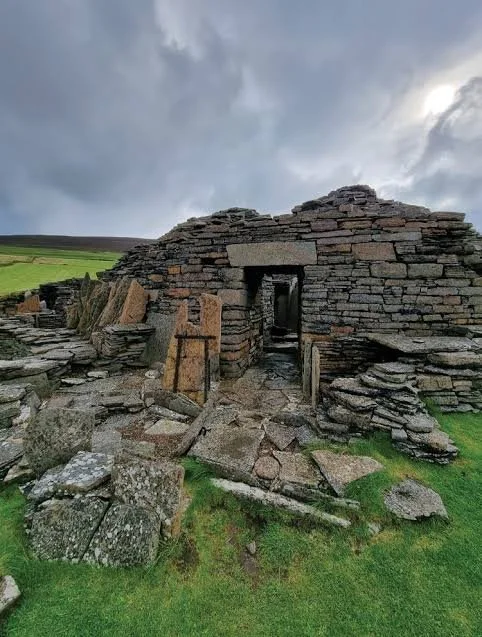
The Knowe of Swandro on Rousay is associated with the long history of Norse settlement and occupation in Orkney. The Viking Age and subsequent Norse period transformed the islands culturally, politically, economically, and linguistically. Archaeological sites associated with Viking and medieval settlement provide evidence for this transformation and demonstrate how Norse communities adapted to an environment already occupied by prehistoric societies.
A longhouse is particularly important because it represents a form of domestic architecture closely associated with northern European farming communities. Such structures could function as residences, agricultural centers, workshops, and social spaces.
The Arrival of the Norse
Norse influence in Orkney began during the Viking Age.
Scandinavian settlers and raiders entered the North Atlantic world, establishing connections across the Northern Isles, Scotland, Ireland, Iceland, and eventually Greenland and beyond.
Orkney became one of the most important Norse territories in the North Atlantic.
The islands were strategically positioned along maritime routes connecting Scandinavia with the British Isles and the North Atlantic.
The Longhouse
A longhouse was typically an elongated building organized around a central interior space.
Its design was well suited to farming communities.
People and animals could occupy different parts of the building, depending on local architectural traditions.
The central hearth was fundamental.
It provided heat and light while serving as a cooking area and a focus of domestic life.
Farming and Household Economy
Norse communities in Rousay relied heavily on agriculture.
Cattle, sheep, pigs, and horses were important livestock.
Cereals were cultivated where conditions allowed.
Dairy production could be particularly important in northern environments because milk could be transformed into products that lasted longer, including butter and cheese.
The sea supplemented farming through fishing and other marine resources.
Norse Material Culture
Archaeological remains from Norse settlements can include pottery, spindle whorls, metal objects, bone tools, gaming pieces, and personal ornaments.
Textile production was especially important.
Wool provided material for clothing, blankets, sails, and other products.
Spinning and weaving could occur within the household, making textile production an essential part of the domestic economy.
Social Life in the Longhouse
The longhouse was more than a shelter.
It was a social environment.
Families ate together, worked together, entertained visitors, and passed stories between generations.
The household could include extended family members, dependents, workers, and possibly enslaved people.
Hospitality was an important feature of Norse social culture, particularly in societies where political relationships depended on personal networks.
Maritime Society
Rousay's Norse inhabitants were experienced seafarers.
Boats connected settlements with neighboring islands and distant regions.
Travel allowed communities to exchange goods and maintain political relationships.
Norse maritime activity also facilitated the movement of ideas, technologies, languages, and religious practices.
Christianity and Cultural Change
During the medieval period, Christianity became increasingly important in Orkney.
The transition from Norse pagan traditions to Christianity did not occur instantly.
Instead, religious practices changed gradually.
Burial evidence, churches, crosses, and imported objects provide archaeological clues to this transformation.
Archaeological Importance
The Knowe of Swandro is valuable because it contributes to the study of continuity and change.
The landscape had already been occupied for thousands of years before the arrival of Norse settlers.
Norse communities therefore encountered an existing archaeological environment filled with ancient monuments.
They may have reused, avoided, or incorporated earlier places into their own landscape.
Coastal Change
Coastal archaeology is particularly vulnerable to erosion.
Rousay's coastline has experienced natural changes over centuries, threatening archaeological deposits.
Sites such as Swandro demonstrate the importance of recording archaeological remains before they are lost.
Modern archaeology increasingly combines excavation with digital survey, photogrammetry, drone mapping, and environmental monitoring.
Conclusion
The Knowe of Swandro represents the Norse transformation of Rousay and the wider Orkney Islands.
Its longhouse tradition provides evidence for farming, household production, maritime activity, social organization, and cultural change.
The site also demonstrates the value of studying ordinary domestic settlements rather than focusing exclusively on castles, churches, and elite monuments.
Within the walls of a longhouse lived the people who transformed Orkney into one of the most distinctive Norse societies of the medieval North Atlantic.