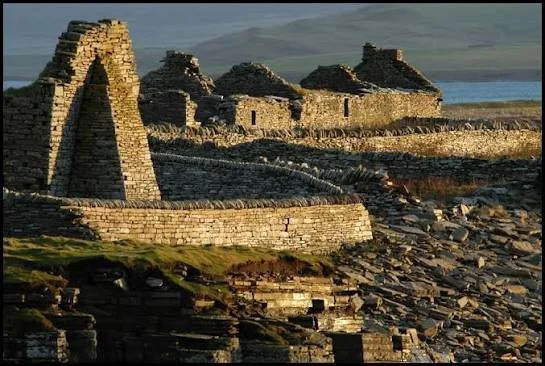
Wasbister on Rousay forms part of the remarkable Neolithic archaeological landscape of Orkney. Rousay is sometimes described as an “archaeological treasure island” because its relatively small area contains an extraordinary concentration of prehistoric monuments, settlements, tombs, and later remains.
The Neolithic evidence associated with Wasbister contributes to understanding how farming communities inhabited, organized, and transformed the island thousands of years ago.
Neolithic Rousay
The Neolithic period brought profound changes to northern Scotland.
Communities increasingly practiced agriculture and animal husbandry, constructed permanent or semi-permanent settlements, developed distinctive pottery traditions, and created monumental burial architecture.
Rousay became part of this wider cultural transformation.
Its fertile land and access to marine resources made it capable of supporting agricultural communities while its location within the Orkney archipelago facilitated communication.
Farming Communities
Neolithic farmers depended on a mixture of crops and livestock.
Barley was especially important because of its suitability to northern conditions. Other cereals may also have been cultivated.
Cattle, sheep, and pigs provided meat and secondary products.
However, the people of Rousay were not exclusively agricultural.
The sea remained an important source of food and transportation.
Houses and Household Life
Neolithic homes were centers of production and social life.
Cooking took place around hearths. Grain was processed with stone tools, pottery was used for food preparation and storage, and textiles may have been produced within households.
Children would have grown up participating in many aspects of domestic production.
The household was therefore simultaneously a family unit, workplace, and social institution.
Monumental Architecture
Rousay is especially famous for chambered tombs.
These monuments were designed to accommodate the remains of multiple individuals and were likely associated with complex funerary practices.
Their construction demonstrates that Neolithic communities could mobilize considerable labor.
The relationship between settlements and tombs suggests that the dead were not separated completely from everyday life. Ancestral monuments remained visible components of the landscape.
Social Organization
Monument building provides evidence for cooperation.
Large construction projects required people to coordinate labor and resources.
This does not necessarily mean that Neolithic Orkney possessed centralized states.
Communities may instead have organized work through kinship, ritual authority, communal decision-making, or temporary leadership.
Pottery and Material Culture
Neolithic pottery provides archaeologists with valuable evidence.
Different vessel styles can help identify cultural relationships between communities.
Residues can sometimes reveal what vessels contained.
Stone tools provide additional evidence for woodworking, agriculture, animal processing, and other activities.
Environmental Adaptation
The inhabitants of Rousay had to manage a northern island environment.
Wind, rainfall, temperature, and soil conditions affected agricultural production.
Diversification was therefore essential.
A household that combined crops, livestock, fishing, shellfish gathering, and other activities would have been better positioned to withstand fluctuations in any single resource.
Maritime Connections
Rousay's position meant that travel by boat was essential.
People could visit neighboring islands, exchange materials, attend gatherings, and maintain social relationships.
The sea was therefore a connective network rather than a boundary.
This helps explain the cultural similarities seen across the Orkney Islands.
Conclusion
Wasbister's Neolithic context contributes to the broader understanding of one of Europe's most remarkable prehistoric landscapes.
The site represents communities that combined agriculture, livestock management, maritime resources, domestic production, and monumental construction.
Its significance is especially clear when considered alongside the many prehistoric monuments of Rousay.
Together, these sites reveal that Neolithic Orkney was not a peripheral society but a complex and highly organized island world with distinctive cultural traditions and extensive social connections.