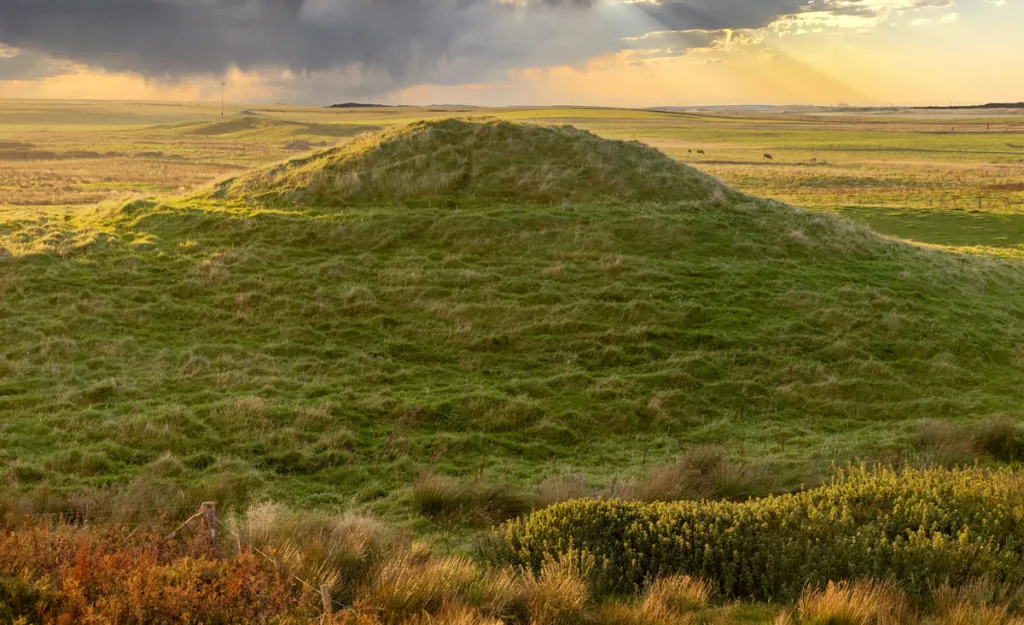
Knowe of Trotty: Eday's Cairn
The prehistoric landscape of Eday contains numerous mounds and cairns, reflecting a long tradition of constructing monuments for burial, remembrance, ceremony, and possibly territorial display. The Knowe of Trotty belongs to this wider tradition of Orcadian prehistoric monument construction.
The word "knowe" is itself revealing. Across Scotland and particularly Orkney, names containing knowe often refer to prominent artificial or natural mounds. Such places frequently preserve archaeological remains beneath what appears today to be an ordinary hill.
Cairns in Orkney
Stone cairns were among the most enduring monuments created by prehistoric communities.
They could contain:
Human burials
Cremated remains
Stone chambers
Cists
Grave goods
Later prehistoric deposits
But not every cairn necessarily served exactly the same function.
Some were primarily funerary monuments, while others may have had ceremonial or commemorative roles.
The Importance of Mounds
A mound changes how people experience a landscape.
Even a relatively small cairn can become a visible landmark. Its height distinguishes it from the surrounding ground, while its construction demonstrates that people intentionally transformed the landscape.
Over generations, later inhabitants could encounter the monument and assign new meanings to it.
This long-term visibility is particularly important in Orkney because prehistoric monuments often remained prominent long after the societies that constructed them had disappeared.
Eday's Archaeological Landscape
The Knowe of Trotty should therefore not be studied in isolation.
Eday contains a network of prehistoric monuments distributed across hills, agricultural areas, and coastal landscapes. Their locations may reflect choices concerning visibility, access, terrain, and relationships with other monuments.
Archaeologists increasingly approach such sites through landscape archaeology.
Instead of asking simply, "What is inside the cairn?" researchers also ask:
Why was it built here?
What could people see from it?
Which other monuments could be seen?
Was it positioned near settlement?
Did later communities continue to use the surrounding landscape?
These questions can transform a small cairn into evidence for broader social behavior.
Burial and Memory
Prehistoric burial monuments were not simply containers for dead bodies.
They could have acted as places where communities negotiated relationships with ancestors.
Constructing a cairn required labor.
Stone had to be gathered, transported, arranged, and maintained. The process could have brought people together and created a shared experience.
The finished monument then remained as a physical reminder of those activities.
In this sense, monuments could preserve social memory.
Later Use
One of the recurring characteristics of Orkney's archaeological landscape is reuse.
Later prehistoric and historic populations frequently encountered earlier monuments. Some were disturbed, incorporated into fields, used as landmarks, or occasionally reused for burial.
Consequently, the archaeological layers associated with a cairn may represent several different periods.
Archaeological Significance
The Knowe of Trotty contributes to a much larger story about how Eday's inhabitants constructed relationships between community, ancestry, and landscape.
It is a reminder that prehistoric Orkney was not simply a collection of isolated monuments. It was a carefully inhabited landscape in which houses, graves, fields, stones, hills, and coastlines formed interconnected places.